Flooring Liquidation in Honolulu: What Buyers Should Know
Key takeaway
"Flooring liquidation" in Honolulu usually means one of two things: a retailer clearing discontinued or overstocked material at a reduced price, or a warehouse that simply keeps enough in-stock inventory to sell at a flat, low price year-round without needing a "sale" at all. Both can save money, but they're not the same thing, and knowing which one you're looking at changes how you should shop. The safest approach is to compare the per-square-foot price, the quantity actually in stock, and whether installation is included before assuming a liquidation tag means the best deal.
Key takeaways
- A true liquidation sale is temporary and tied to discontinued stock; a published, everyday low price is permanent and tied to a warehouse's standing inventory.
- Check quantity on hand before you fall in love with a liquidation price — closeout lots often run out mid-project, leaving no matching dye lot.
- Compare price per square foot plus installation and demo costs together, not the flooring price alone, since labor is usually the larger line item.
Why "liquidation" pricing exists in flooring
Flooring liquidation typically happens for one of a few reasons: a manufacturer discontinues a color run, a distributor overbought a container, or a retailer is closing a location and needs to move product fast. In all of these cases, the discount is a function of the seller needing to free up warehouse space or cash, not necessarily a reflection of the material's quality. That's useful to know because a discontinued vinyl plank can be just as durable as a current one — the only real downside is that once it sells out, it's gone, and there's no reordering a matching batch later.
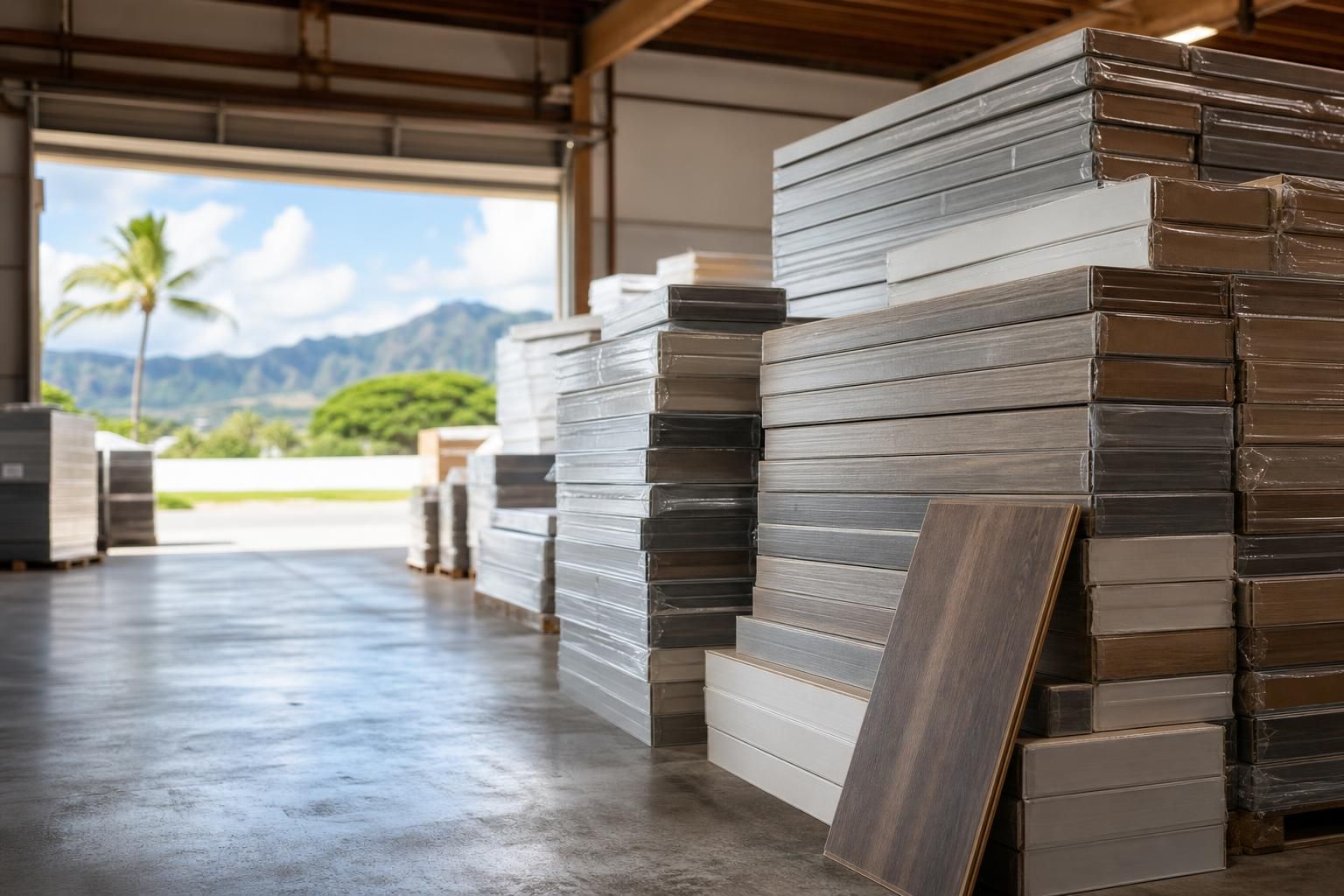
This is different from a warehouse model built around stocking Oahu inventory specifically to avoid the freight delays that come with mainland shipping. A supplier that keeps product on the shelf at a fixed price doesn't need a clearance event to be affordable; the low price is the standing offer, not a temporary markdown. H&W Flooring's Māpunapuna warehouse is an example of that second model — the inventory is kept on hand specifically so homeowners and contractors can buy and pick up the same day rather than waiting on a sale cycle.
What a fair liquidation price looks like for vinyl plank
For waterproof luxury vinyl plank in Honolulu, retail pricing in the $2–$3 per square foot range for the material alone is a reasonable benchmark to compare against. H&W Flooring, for instance, publishes retail luxury vinyl plank at $2.79 per square foot — a flat, standing price rather than a temporary liquidation markdown. If a "liquidation" listing is priced noticeably below that, ask directly whether it's SPC rigid core or a thinner flexible vinyl, since the wear layer and core construction affect both price and how the floor holds up in kitchens, bathrooms, and other wet areas.
Contractors buying in volume should also ask whether a liquidation seller offers tiered pricing the way a standing wholesale program does. Wholesale luxury vinyl plank pricing at H&W steps down as volume increases — $2.79, $2.59, and $2.39 per square foot at purchase thresholds of $5,000, $15,000, and $100,000, with a further tier at $200,000. A one-time liquidation lot rarely offers that kind of structured discount, because it's priced to clear a specific quantity, not to build a repeat trade account.
Installation and demo: the costs liquidation ads often leave out
A liquidation price on the material itself can be misleading if it's advertised without installation. H&W Flooring's installation for vinyl plank is from $8 per square foot, including demo of old flooring, leveling (incl. self-leveling material), and baseboard. When you're comparing a liquidation deal to a standard retail quote, add those labor costs to both sides of the comparison — a steeply discounted box of flooring installed by unpredictable day labor can end up costing more in callbacks and redo work than a slightly higher material price installed correctly the first time.
This is especially relevant for wet areas like bathrooms, where improper substrate prep or waterproofing can cause problems that don't show up until months later. If your project includes a bathroom or laundry area, it's worth asking any liquidation seller whether they handle waterproofing at all, or whether that's a separate trade you'll need to coordinate yourself. For a broader sense of what a full project should cost once labor and prep are factored in, a flooring installation quote for Honolulu that itemizes material, demo, and labor separately is a better comparison tool than a single liquidation sticker price.
Questions to ask before buying liquidation flooring
- How much square footage is actually in stock? Discontinued lots can run short; measure your space and confirm the seller has enough of the same dye lot, with a small overage for cuts and waste.
- Is the price per square foot for material only, or does it include installation? Many liquidation ads quote material-only pricing.
- Is the product SPC rigid core or a thinner flexible vinyl? This affects durability underfoot and in high-traffic or commercial spaces.
- Does the seller offer a written quote, and how fast? A seller who can turn around a written quote within 48 hours is generally easier to hold accountable than one working off a verbal estimate.
- Who is doing the installation? Ask whether it's an in-house crew or subcontracted day labor, since accountability for a bad install differs significantly between the two.
Commercial buyers — landlords, property managers, and contractors managing multiple units — have an added reason to look past one-time liquidation deals: consistency across units matters more than a one-time discount. A multi-unit flooring contractor on Oahu working from standing wholesale inventory can match flooring across several units over time, which a single liquidation lot generally can't guarantee once it sells out.
Verifying who you're buying from
Before paying a deposit on any liquidation deal, confirm the seller's license status if they're also doing installation work. Hawaii requires contractors performing construction work above a certain dollar threshold to hold a license verifiable through the state's Department of Commerce and Consumer Affairs license search. The Federal Trade Commission also maintains guidance on liquidation and "going out of business" sale claims, noting that such advertising is subject to truth-in-advertising rules just like any other pricing claim — worth knowing if a deal feels pressured or urgency-driven. For general background on flooring materials and indoor air quality considerations, the U.S. Environmental Protection Agency publishes consumer information on flooring and indoor air quality that's useful when comparing vinyl products from different sources.
Frequently Asked Questions
Q: Is flooring liquidation the same as a clearance sale?
Generally yes — both refer to a retailer or distributor selling discontinued, overstocked, or closeout material at a reduced price for a limited time, as opposed to a standing low price that doesn't depend on a sale event.
Q: Is liquidation vinyl plank lower quality than regular stock?
Not necessarily. Liquidation pricing is usually driven by the seller needing to move inventory, such as a discontinued color, not by a defect in the product itself; the main risk is limited quantity rather than lower quality.
Q: What's a reasonable price per square foot for waterproof vinyl plank in Honolulu?
Retail luxury vinyl plank pricing in the $2–$3 per square foot range for material is a common benchmark locally; always confirm what installation includes, and whether demo is quoted separately.
Q: Should I buy liquidation flooring without seeing a sample first?
No. Request a physical sample before committing, especially for color-matched installs, since screen colors and lighting can shift the look of vinyl plank considerably — see where to find flooring samples on Oahu for options.
Q: Does liquidation pricing apply to commercial flooring projects?
Sometimes, but commercial buyers should weigh consistency and volume pricing over a one-time discount; a commercial vinyl plank buyer's guide covers what to look for when specifying flooring across larger or multi-phase spaces.