Flooring Supplier Oahu: Contractor Wholesale Pricing Guide
Key takeaway
A flooring supplier on Oahu that works for contractors needs three things: in-stock material for same-day or next-day pickup, published tiered pricing so a bid can be built without a phone call, and a trade account process that verifies your Hawaii contractor license. Anything shipped from the mainland adds freight time and cost that eats into a job's margin, which is why volume buyers on Oahu increasingly look for local warehouses over mainland distributors. Retail-only stores that quote "call for pricing" also slow down estimating, which is the opposite of what a subcontractor on a deadline needs.
Key takeaways
- Ask any Oahu supplier for a written wholesale price sheet before opening a trade account — if they won't publish it, you can't bid off it.
- In-stock SPC and vinyl plank on Oahu typically starts in the $3–$4 per square foot range at retail, with lower tiers for verified contractor volume.
- Confirm the supplier can produce same-day or next-day material, since a mainland backorder can stall a crew for weeks.
What Contractors Should Vet Before Opening an Account
A supplier relationship is worth more than a single order, so the vetting should go past price. Ask how the tiered discount is structured — flat percentage off retail, or breakpoints tied to square footage per order or per year. Ask whether pricing is honored across all in-stock SKUs or only a subset. And ask what happens when a job needs 200 more square feet mid-install to match a dye lot; a local warehouse can often pull from the same pallet, while a broker reordering from the mainland cannot.
Licensing verification matters too. Legitimate wholesale accounts in Hawaii generally require a valid contractor license number, which suppliers can check against the state's public license database before extending trade pricing. That protects the pricing tier for contractors who are actually buying at volume rather than reselling retail-tier product under a business name.
Wholesale vs. Retail Pricing Tiers, Explained
Retail pricing is the shelf price a homeowner pays for a single room. Wholesale pricing is a lower, volume-based rate extended to licensed contractors buying repeatedly or in bulk — often a whole condo tower or a multi-unit renovation. At H&W Flooring, waterproof vinyl plank starts at $3.99 per square foot at retail, with installation priced separately at $3 per square foot; contractors buying at volume access tiered pricing below that retail floor. The gap between retail and wholesale is usually where a contractor's margin lives, so a supplier that keeps that number vague makes it harder to bid competitively. For a deeper breakdown of how wholesale tiers are structured and who qualifies, see this guide on what wholesale flooring pricing actually means for Hawaii contractors.
Published pricing also cuts down on estimating time. If a contractor is bidding three condo units this week, working off a static price sheet is faster than waiting on a callback quote for each one — especially when the material and installation numbers are already broken out per square foot.
Why Local Stock Beats Mainland Shipping
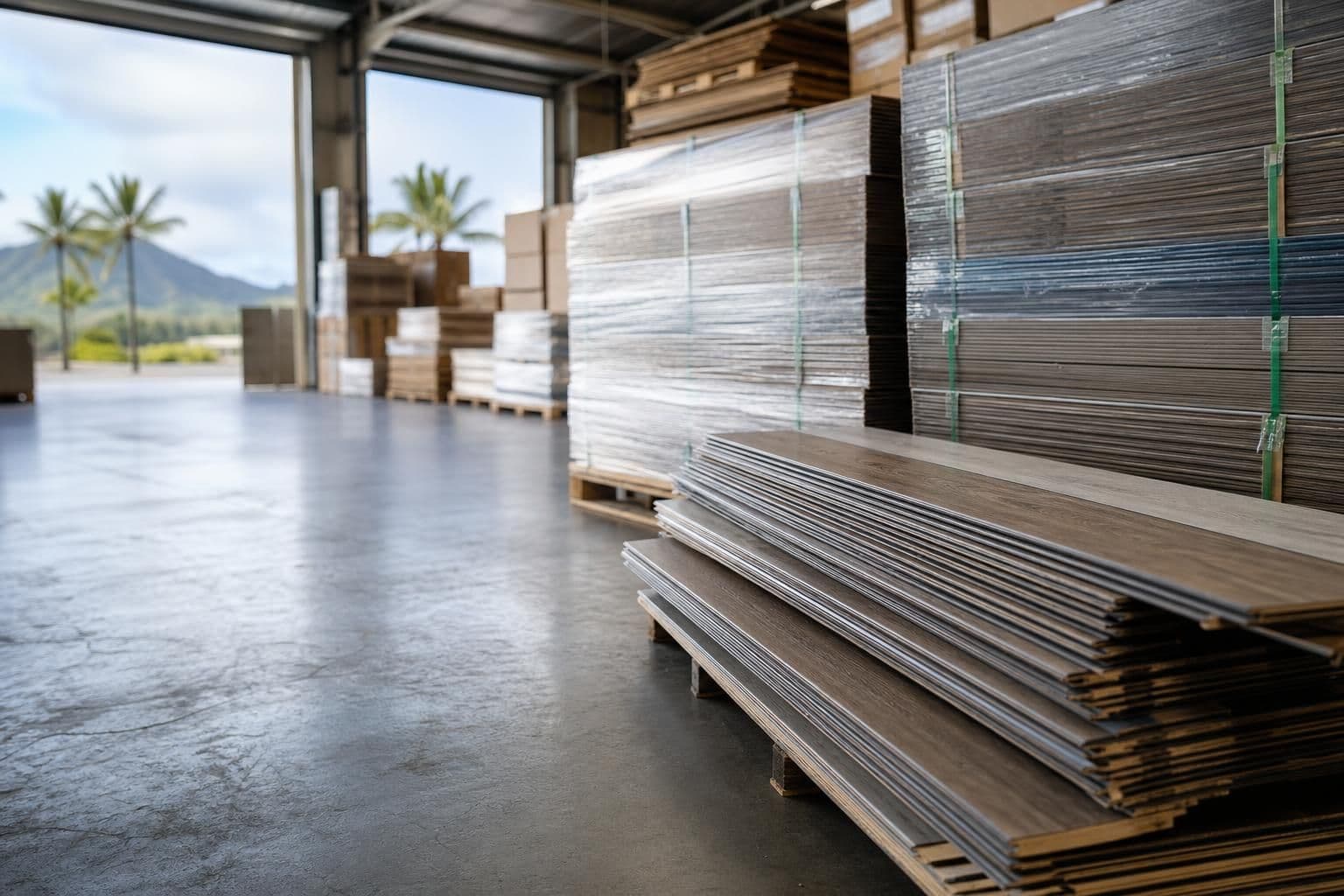
Almost all flooring sold in Hawaii originates from mainland or overseas manufacturers, which means the difference between suppliers isn't where the product is made — it's where it's sitting when you need it. A supplier holding inventory in a Honolulu warehouse can hand off material same-day; a supplier drop-shipping from a distributor in California or Georgia is quoting freight transit on top of production time, and ocean freight to Hawaii routinely adds days to weeks depending on carrier schedules and container availability, a dynamic the U.S. Maritime Administration tracks as part of Jones Act shipping between the mainland and Hawaii.
For a contractor on a change-order deadline, that lead-time gap is the whole ballgame. A crew that discovers a shortfall on day three of a tear-out needs a supplier who can restock from a shelf in Māpunapuna, not one waiting on the next barge.
Vinyl Plank and SPC: What Wholesale Buyers Are Actually Ordering
Most of the wholesale volume moving through Oahu flooring suppliers right now is SPC (stone plastic composite) and waterproof vinyl plank rather than solid hardwood, largely because it tolerates humidity and slab moisture better in island conditions. SPC core products are built to standards like ASTM F1700 and related resilient-flooring test methods maintained by ASTM International, which cover things like indentation resistance and dimensional stability — specs worth asking about when comparing two vinyl products that look similar on a sample board.
For wet-area work — bathrooms, laundry rooms, lanai transitions — the flooring itself is only half the system. Proper waterproofing at seams, thresholds, and wall-floor junctions matters as much as the plank's water rating, which is why remodel scopes that include tile or vinyl in wet areas should specify the waterproofing membrane and method up front rather than leaving it to the installer's discretion on-site.
Owner-Supervised Installs vs. Subcontracted Day Labor
A supplier that also installs changes the wholesale conversation slightly. Contractors sometimes buy material only and self-perform installation; others want material plus labor bundled into one number. When a flooring company runs its own installation crew rather than dispatching day labor through a subcontractor network, the material specs and the install technique are more likely to match — SPC click-lock systems, for instance, have specific acclimation and expansion-gap requirements that a crew trained on that exact product line will already know cold.
Frequently Asked Questions
Q: What's the difference between wholesale and retail flooring pricing on Oahu?
Retail pricing is the per-square-foot rate a homeowner pays for a single-room purchase. Wholesale pricing is a discounted, volume-based rate reserved for licensed contractors buying repeatedly or in bulk, and it's usually tiered based on order size or annual volume.
Q: Do I need a contractor license to open a wholesale flooring account?
Most suppliers require a valid Hawaii contractor license to extend trade pricing, and they typically verify it against the state's public contractor license database before approving the account.
Q: How fast can a local Oahu supplier deliver flooring compared to a mainland distributor?
A supplier holding in-stock inventory in a Honolulu warehouse can often provide same-day or next-day pickup, while material shipped from a mainland distributor is subject to ocean freight schedules that can add days to weeks depending on carrier availability.
Q: Is vinyl plank or SPC actually waterproof, or just water-resistant?
Rigid SPC core planks with a sealed click-lock system are generally rated fully waterproof for surface moisture, but the wet-area system around them — seams, thresholds, and wall junctions — still needs proper waterproofing detailing to prevent moisture from reaching the subfloor.
Q: Can a homeowner get wholesale flooring pricing without a contractor license?
Generally no — wholesale tiers are reserved for verified, licensed contractors buying at volume, while homeowners doing a single room typically pay the published retail rate.