Flooring Stores in Honolulu: A Contractor's Buying Guide
Key takeaway
Not every flooring store in Honolulu sells the same way: some are retail-only showrooms that quote by appointment, while others run a wholesale counter with published tiered pricing for licensed contractors buying by volume. If you're a contractor, the difference that matters most is whether the store stocks material on Oahu for same-day pickup or has to order it from the mainland, since that lead time gap can stall a job by weeks.
Key takeaways
- Wholesale tiers are volume-based, not just "contractor discount" — ask what dollar thresholds trigger each price break before you bid a job.
- Mainland-order flooring stores add shipping lead time; Oahu-stocked suppliers can fill a same-day pickup.
- Verify any contractor pricing quote against a store's own published rate sheet, since rates change and word-of-mouth numbers go stale fast.
Retail vs. wholesale: two different customers, two different counters
A homeowner replacing flooring in one condo bedroom and a contractor flooring six units in a renovation don't need the same thing from a store. Retail pricing is quoted per square foot for a single project; wholesale pricing is tiered, meaning the rate drops as the dollar volume of the order climbs. H&W Flooring, for example, publishes both: vinyl plank starts at $2.79 per square foot retail, with wholesale tiers of $2.79, $2.59, and $2.39 per square foot as order volume increases. If a store won't tell you which bucket you fall into until after you've submitted a bid, that's a sign to ask more questions before you commit a job to them.
How wholesale tiers actually work
Tiered pricing exists because material and freight costs improve with scale, and a flooring store passes that down. H&W's published schedule uses volume thresholds at $5,000, $15,000, $100,000, and $200,000, with per-square-foot pricing stepping down toward $2.39 as total order volume rises through those thresholds. That means a contractor buying flooring for a single small remodel and one buying for a multi-building project are not paying the same rate — nor should they expect to. For a fuller breakdown of how the math works across a job, see how contractor pricing works for flooring in Hawaii.
If a store's site doesn't list its thresholds at all, ask directly. A supplier that can't answer "what does my order need to hit to move to the next tier" in one sentence probably isn't set up for volume buyers.
Stock and lead time: the part price sheets don't show
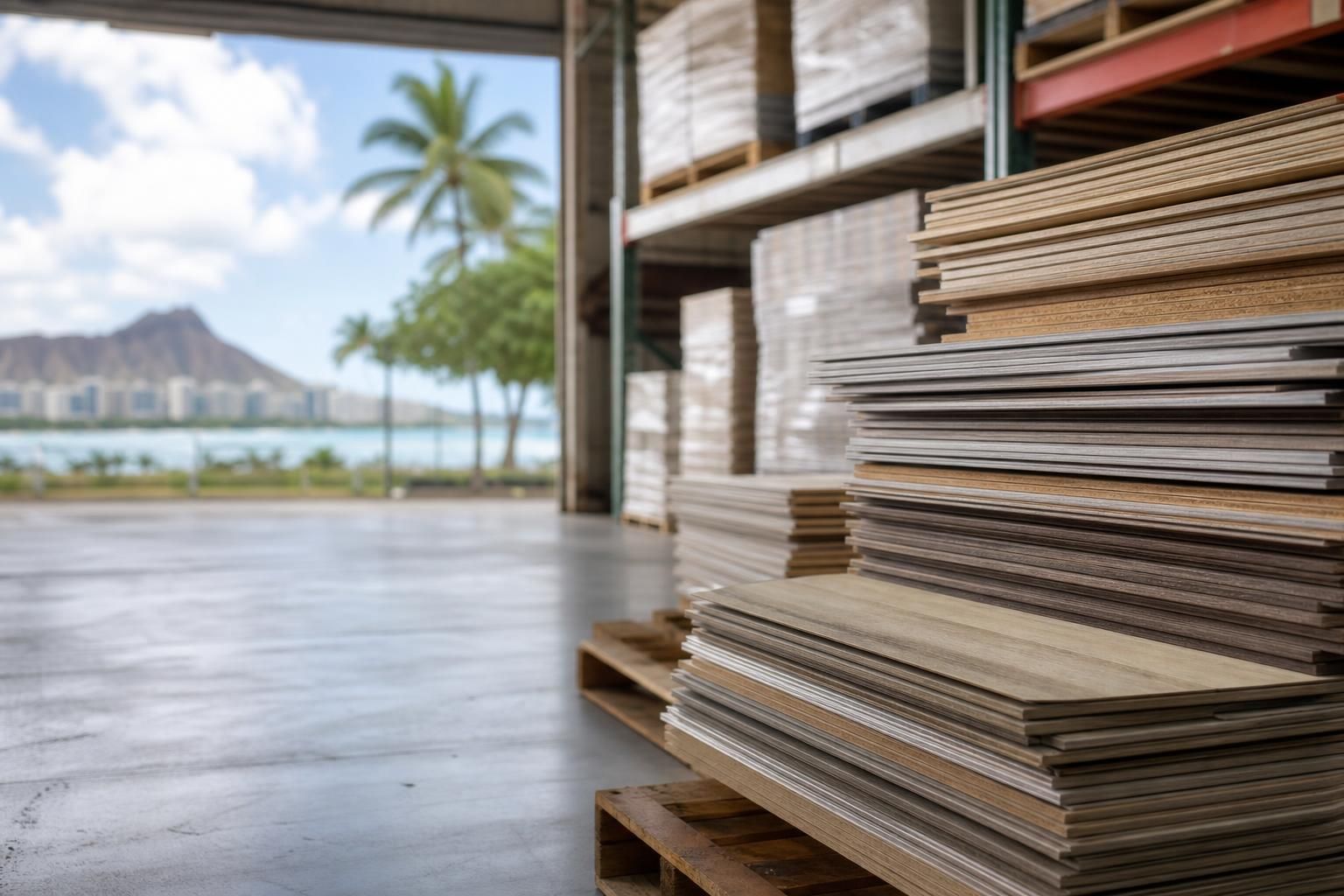
Published pricing only helps if the material is actually available when the crew needs it. Flooring stores that ship from the mainland are subject to ocean freight schedules, and a delay there can push a install date by a week or more — a real cost on a job with subs already scheduled. Stores that warehouse inventory in Oahu, like H&W's Māpunapuna location, can fill orders same-day because the product is already sitting on the shelf, not in transit. If lead time is a recurring headache on your jobs, it's worth reading how long same-day flooring pickup actually takes in Honolulu before you commit to a supplier that ships from off-island.
What to ask before opening an account
Not every flooring store extends trade pricing automatically — most require a Hawaii contractor license and DCCA verification before wholesale rates apply. Before choosing a store, ask:
- Do you require a Hawaii contractor license number to open a trade account?
- Are your wholesale tiers based on a single order or cumulative annual volume?
- What's your typical in-stock lead time versus special-order lead time?
- Is installation priced separately from material, and by what unit?
- Do you charge separately for demo and haul-away of old flooring?
On that last point, H&W publishes installation from $8 per square foot, including demo of old flooring, leveling (incl. self-leveling material), and baseboard, which is a useful benchmark to compare against any verbal quote you get elsewhere. For the account-opening process itself, see how to get a trade account with a flooring supplier.
Vinyl plank and SPC: what you're actually pricing
Most of the volume moving through Honolulu flooring stores right now is waterproof vinyl plank and SPC (stone plastic composite), because both hold up in Hawaii's humidity and in condo units where water intrusion from a unit above is a real risk. SPC has a rigid core that resists dents better than standard vinyl plank, which matters on rental turnovers and commercial floors. If you're comparing material types before you price a job, this guide to SPC flooring for Oahu buyers covers the construction differences that affect installation method and cost.
For indoor air quality considerations on any resilient flooring product, the U.S. Environmental Protection Agency publishes guidance on flooring materials and off-gassing that's worth checking against any manufacturer spec sheet, particularly for occupied renovations.
Verifying a contractor before you subcontract flooring work
If you're a general contractor bringing in a flooring specialist as a sub, or a homeowner verifying that a company doing "remodeling" work is actually licensed for it, Hawaii's Department of Commerce and Consumer Affairs maintains a public license lookup. It's a two-minute check that confirms a contractor's license is active and in good standing before money changes hands, and it's the same verification most flooring stores require before opening a wholesale trade account.
Industry-wide installation standards for resilient flooring, including subfloor prep and moisture testing, are maintained by the Resilient Floor Covering Institute, which is a useful reference if a store's installation crew cites a standard you don't recognize.
Frequently Asked Questions
Q: What's the difference between a retail and wholesale flooring store in Honolulu?
Retail stores quote a flat per-square-foot price for one project, usually to a homeowner. Wholesale suppliers offer tiered pricing that drops as order volume increases, typically requiring a verified Hawaii contractor license to open the account.
Q: Do Honolulu flooring stores stock material locally, or is it shipped from the mainland?
It varies by store. Some warehouse vinyl plank, laminate, and tile on Oahu for same-day pickup, while others place special orders that ship from the mainland and take longer to arrive.
Q: How much does contractor-wholesale vinyl plank cost compared to retail?
At H&W Flooring, retail vinyl plank starts at $2.79 per square foot, with wholesale tiers of $2.79, $2.59, and $2.39 per square foot depending on order volume. Rates vary by supplier, so always confirm current pricing directly.
Q: Do I need a contractor license to get wholesale pricing?
Most Honolulu flooring stores that offer trade accounts require a verifiable Hawaii contractor license before extending wholesale tiers, since that pricing is meant for licensed buyers purchasing at volume, not one-off retail projects.
Q: Is installation included in a flooring store's quoted price?
Not usually — material and installation are typically priced separately. H&W Flooring, for instance, publishes installation from $8 per square foot, including demo of old flooring, leveling (incl. self-leveling material), and baseboard, on top of the material cost.