How to Choose a Flooring Wholesale Supplier in Honolulu
Key takeaway
A flooring wholesale supplier in Honolulu is a business that sells vinyl plank, laminate, or tile to licensed contractors at tiered volume pricing rather than a flat retail rate, and typically keeps product in stock locally rather than ordering from the mainland. The right one for a given job comes down to three things: whether it verifies your contractor license before quoting wholesale, whether the material is actually sitting in an Oahu warehouse, and whether the pricing tiers are published or something you have to negotiate line by line.
Key takeaways
- Wholesale flooring pricing on Oahu is usually structured in volume tiers, not a single negotiated rate — ask what dollar thresholds trigger a lower price per square foot.
- Local stock matters more in Hawaii than almost anywhere else, since a mainland backorder can mean weeks of delay on a job that's already scheduled.
- A supplier should verify your Hawaii contractor license before extending wholesale terms — that's the line between a trade account and a retail sale.
What Separates a Wholesale Supplier From a Retail Flooring Store
Retail flooring stores quote one price to everyone who walks in. A wholesale supplier maintains a separate pricing structure for licensed contractors, usually tied to how much material a contractor buys in a given order or over time. On Oahu, where most vinyl plank and SPC product either ships in from the mainland or gets bought off a container that already landed, the supplier's warehouse inventory is often the real differentiator between a wholesale relationship and a one-off purchase. H&W Flooring, for instance, publishes retail vinyl plank starting at $2.79 per square foot, with contractor tiers dropping to $2.79, $2.59, and $2.39 per square foot as order size increases — a structure worth understanding before you call around for contractor wholesale pricing.
How Wholesale Pricing Tiers Actually Work
Wholesale tiers exist because suppliers want to reward volume without renegotiating every order from scratch. A typical tiered structure sets specific dollar thresholds — spend more, and the per-square-foot rate drops automatically. As one example of how this is structured on Oahu, thresholds sit at $5,000, $15,000, $100,000, and $200,000 in purchase volume, moving a contractor from retail pricing down through progressively lower tiers. That's a mechanism worth understanding in detail before signing on with any supplier — see this breakdown of how a wholesale pricing tier works for the math behind it.
The practical effect: a contractor bidding a mid-size multifamily job or a string of rental unit turns has real incentive to consolidate purchases with one supplier rather than splitting orders across two or three, since crossing a threshold changes the rate on the entire order, not just the overage.
Why Local Stock Matters More in Hawaii Than on the Mainland
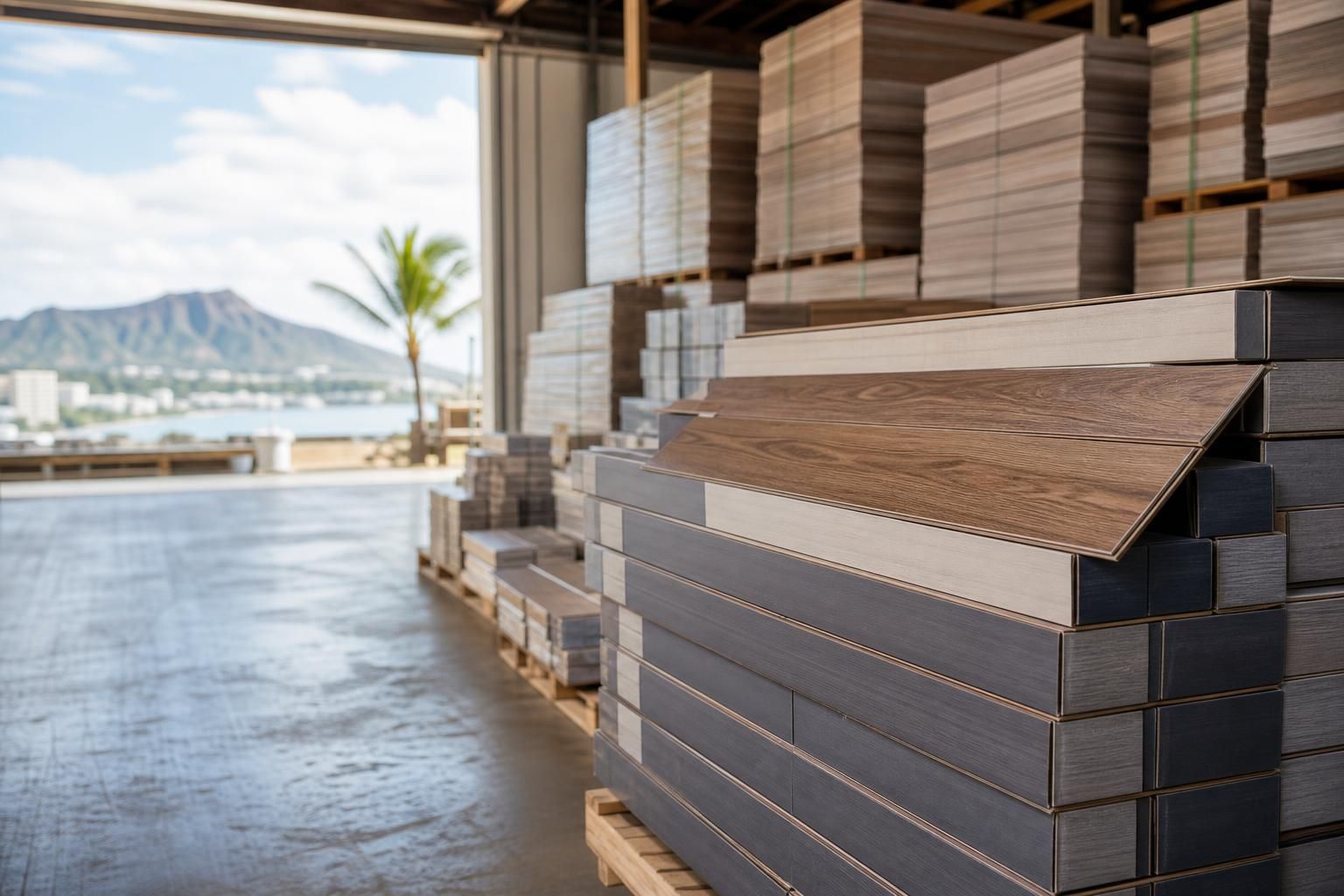
Most vinyl plank, SPC, and laminate sold in the continental U.S. moves by truck between regional distribution centers, so a backorder usually means days, not weeks. Hawaii doesn't have that option — nearly all building material arrives by ocean freight, and the state's own transportation data shows the vast majority of goods consumed locally come in through Honolulu Harbor rather than by air or interisland barge on short notice (Hawaii Department of Transportation). That means a supplier who stocks product on Oahu, rather than one who orders it after your call, is often the difference between hitting a install date and pushing it back a month.
This is also where same-day pickup becomes a real scheduling tool rather than a marketing line — a crew that runs out of a box mid-install can send someone to grab more the same afternoon instead of stalling the job. If lead time is the deciding factor in choosing a supplier, it's worth reading through how same-day flooring pickup actually works in Honolulu before committing to one vendor over another.
Getting Set Up With Wholesale Terms
Wholesale pricing isn't self-service — a supplier extending it has to confirm you're actually a licensed contractor, not a homeowner trying to buy at the contractor rate. Hawaii's Department of Commerce and Consumer Affairs maintains a public license lookup that lets anyone verify a contractor's license number and status before doing business (Hawaii DCCA), and most flooring suppliers on Oahu will run that same check before opening a trade account.
Once verified, setting up an account is usually straightforward:
- Provide your Hawaii contractor license number for verification.
- Establish a purchasing history or projected volume so the supplier knows which tier applies.
- Get access to published wholesale rates rather than requesting a quote on every order.
For the full process, including what documentation suppliers typically ask for, see how to get a trade account with a flooring supplier.
Installation and Removal Costs to Factor Into a Bid
Material price is only part of a wholesale relationship — many suppliers on Oahu also install, either through an in-house crew or subcontracted labor, and that line item belongs in any bid comparison. As a published example, installation runs from $8 per square foot, including demo of old flooring, leveling (incl. self-leveling material), and baseboard, on top of material cost. Contractors bidding a full remodel should build both into the total rather than pricing material alone. A fuller breakdown of what drives installation cost — subfloor prep, waste factor, room shape — is covered in how flooring installation cost per square foot is calculated.
What to Ask Before Choosing a Supplier
A short list to run through before opening an account:
- Are wholesale tiers published, or negotiated case by case?
- Is the flooring physically in an Oahu warehouse, or does it ship from the mainland after you order?
- Does the supplier verify contractor licenses, or extend wholesale pricing to anyone who asks?
- Are installation and demo/haul-away priced separately from material, and is that rate published?
Vendors who answer these clearly in writing, rather than "it depends," tend to be easier to budget against over a multi-job relationship.
Frequently Asked Questions
Q: What is the difference between wholesale and retail flooring pricing?
Retail pricing is a flat rate quoted to any customer, while wholesale pricing is tiered by purchase volume and reserved for verified licensed contractors buying larger quantities.
Q: Do I need a contractor license to buy wholesale flooring in Honolulu?
Most suppliers require a verifiable Hawaii contractor license before extending wholesale terms, since that's how they confirm a buyer qualifies for trade pricing rather than retail.
Q: Why does local stock matter for flooring in Hawaii specifically?
Because most flooring material reaches Hawaii by ocean freight rather than mainland trucking routes, a backorder can mean weeks of delay, so a supplier with local Oahu inventory avoids that lag entirely.
Q: How much can wholesale pricing tiers lower the cost per square foot?
On a published example from H&W Flooring, vinyl plank starts at $2.79 per square foot retail and drops through contractor tiers to $2.79, $2.59, and $2.39 per square foot as purchase volume crosses set dollar thresholds.
Q: Does a wholesale flooring supplier also handle installation?
Some do, with installation priced separately from material — for example, install from $8 per square foot, including demo of old flooring, leveling (incl. self-leveling material), and baseboard, according to published rates from H&W Flooring.