SPC Flooring vs. Vinyl Plank Flooring: A Contractor's Guide
Key takeaway
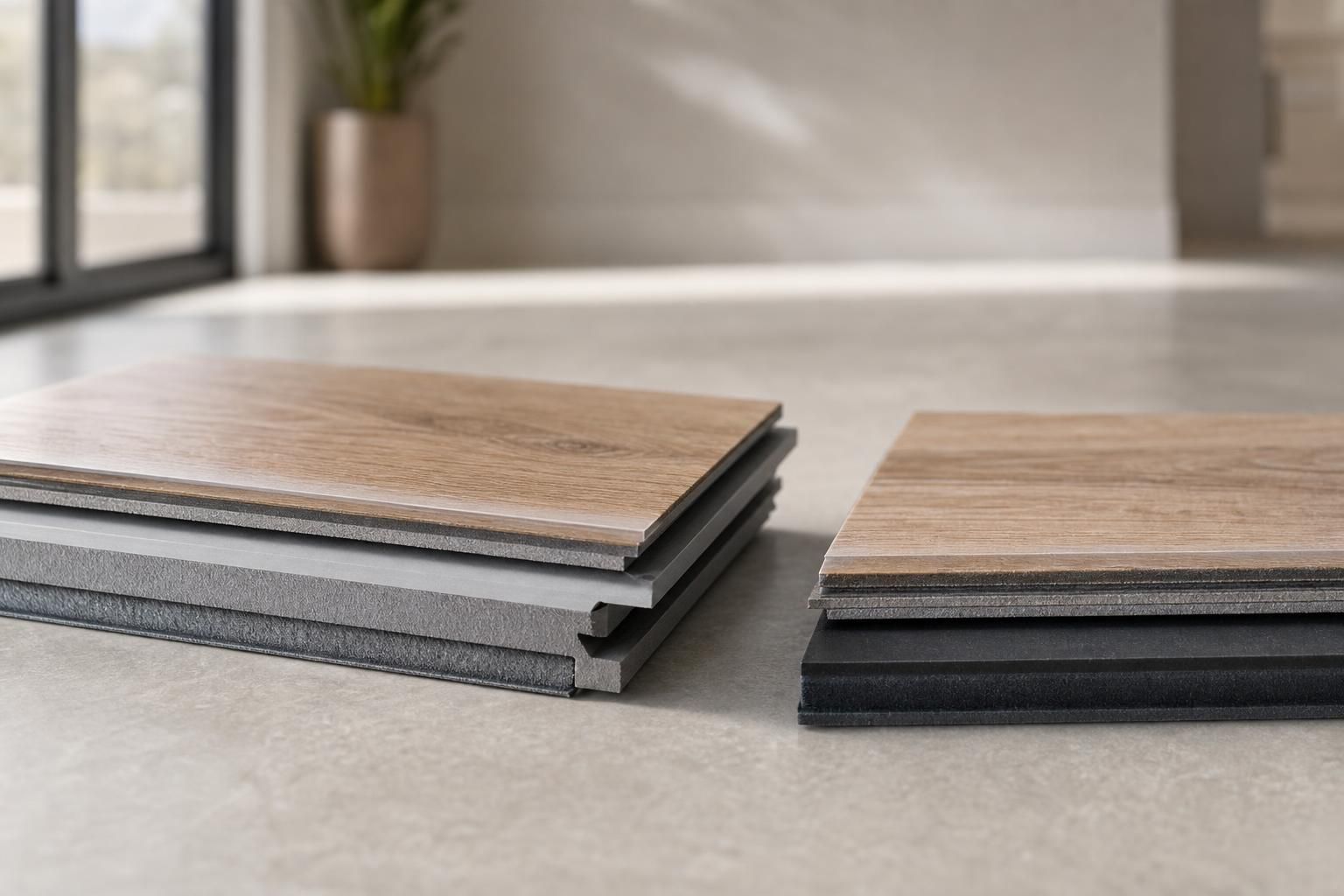
SPC (stone plastic composite) is a category of rigid-core vinyl plank, not a separate material — every SPC floor is a vinyl plank floor, but not every vinyl plank floor is SPC. The practical difference is the core: standard flexible WPC or "luxury vinyl plank" bends underfoot and hides subfloor texture less well, while SPC's dense limestone-composite core resists denting and telegraphing better, which matters most under heavy furniture, rolling equipment, or commercial foot traffic. For most Oʻahu remodels and rental units, either performs fine as waterproof flooring; the choice usually comes down to subfloor condition, budget per square foot, and what's actually in stock.
Key takeaways
- SPC's rigid limestone-composite core resists dents and subfloor telegraphing better than flexible vinyl plank, making it the safer pick over uneven concrete or old tile.
- H&W Flooring prices vinyl plank starting at $2.79/sq ft retail, with contractor wholesale tiers dropping to $2.79, $2.59, and $2.39/sq ft as order size increases.
- Same-day pickup on in-stock product matters more on Oʻahu than the SPC-vs-standard debate, since mainland-shipped orders can stall a job for weeks.
What "SPC" Actually Means
SPC stands for stone plastic composite (sometimes "stone polymer composite"). The core layer is a mix of limestone powder and PVC, calendared into a rigid board that's typically denser and stiffer than the WPC (wood plastic composite) cores used in some flexible vinyl planks. Above that core sits the same basic layer stack as any waterproof vinyl plank: a printed design layer, a clear wear layer, and often a factory-attached underlayment pad. The wear layer thickness — not the core type — is what determines scratch and traffic resistance, and it's rated independently of whether the product is labeled SPC.
Where the Two Actually Differ on the Job Site
- Subfloor tolerance: SPC's rigidity bridges minor subfloor imperfections better, which is useful over patched concrete slabs common in older Oʻahu homes and condos.
- Feel underfoot: Flexible vinyl plank without a rigid core can feel slightly softer and quieter; SPC tends to sound and feel closer to laminate.
- Dimensional stability: Rigid-core products generally handle Hawaiʻi's heat and humidity swings with less expansion gap needed at walls, though installers should still follow the manufacturer's acclimation instructions.
- Waterproofing: Both are fully waterproof at the plank level when the core is vinyl-based; water resistance issues in real installs almost always come from seams, transitions, or wall penetrations, not the plank itself.
Moisture management in wet climates is a documented concern for any flooring choice, which is part of why agencies like the U.S. Environmental Protection Agency publish guidance on controlling indoor humidity and moisture at the building envelope rather than relying on the floor covering alone.
Cost and Stock Comparison
| Factor | SPC (rigid core) | Standard vinyl plank |
|---|---|---|
| Feel underfoot | Firmer, more rigid | Slightly softer, quieter |
| Subfloor tolerance | Better over uneven concrete | Best over already-flat subfloors |
| H&W retail starting price | From $2.79/sq ft | From $2.79/sq ft |
| Contractor wholesale entry tier | $2.79/sq ft at $5,000+ orders | $2.79/sq ft at $5,000+ orders |
| Typical stock availability | Common in-warehouse SKU | Common in-warehouse SKU |
Both categories fall under the same published pricing at H&W Flooring, so the decision between them shouldn't come down to price alone — it comes down to which core suits the subfloor and traffic level on that specific job.
Wholesale Pricing Tiers for Contractors
For licensed Hawaiʻi contractors buying either SPC or standard vinyl plank in volume, H&W Flooring runs tiered wholesale pricing off the same in-stock inventory homeowners buy from at retail. Per H&W's published rates: vinyl plank starts at $2.79/sq ft once an order crosses $5,000, drops to $2.59/sq ft at $15,000, and reaches $2.39/sq ft at $100,000; a further tier applies above $200,000 and is quoted directly given the volume involved. Installation is a separate line item, from $8/sq ft, including demo of old flooring, leveling (incl. self-leveling material), and baseboard. If you're new to how these thresholds get applied to a real bid, the breakdown in what a wholesale pricing tier actually is walks through how order size, not just DCCA license status, determines the rate a contractor lands on.
Lead Time Is the Bigger Variable on Oʻahu
On the mainland, SPC vs. standard vinyl plank is often a debate about product spec sheets. On Oʻahu, it's more often a debate about the shipping container. Vinyl and SPC flooring sold by mainland-affiliated suppliers frequently ships in on a schedule measured in weeks, while H&W Flooring stocks its vinyl plank lines on-site in Māpunapuna for same-day pickup. For a contractor mid-punch-list, that difference can matter more than which core construction is technically stiffer. The wholesale pricing guide for Oʻahu contractors covers how in-stock volume and lead time interact with the tier pricing above.
When SPC Is the Better Call
Choose SPC when the subfloor has minor irregularities that would otherwise telegraph through a softer product, or when the space sees rolling loads — office chairs, hand trucks, gym equipment. Standard flexible vinyl plank is a reasonable, equally waterproof choice for straightforward rooms over a flat, prepped subfloor, especially bedrooms and living areas without heavy point loads. Neither category should be installed directly over standing moisture or an unaddressed leak; that's a waterproofing and remodeling scope, not a flooring-product decision. For bathroom and wet-area work specifically, the underlying membrane and slope work matters as much as which plank sits on top, which is covered in more detail in guidance on what to expect from a Māpunapuna remodeling contractor.
How Wear-Layer Ratings Fit In
Independent of SPC vs. standard core, wear layers are typically measured in mils and tested against industry standards for abrasion resistance — the kind of testing method documented by standards bodies such as ASTM International, which maintains the resilient flooring test methods manufacturers cite on spec sheets. A thicker wear layer generally costs more per square foot regardless of core type, so contractors comparing bids should confirm wear-layer thickness alongside core construction, not instead of it.
Frequently Asked Questions
Q: Is SPC flooring more waterproof than standard vinyl plank?
No — both are fully waterproof at the plank level because both use a vinyl-based core and wear layer. The difference is rigidity and subfloor tolerance, not water resistance.
Q: Does SPC cost more per square foot than regular vinyl plank?
Not necessarily. At H&W Flooring, both fall under the same published retail starting price of $2.79/sq ft and the same wholesale tier structure for contractors, so cost differences come down to the specific product line and wear-layer thickness, not the core category alone.
Q: Can SPC go over uneven concrete without self-leveling first?
SPC tolerates minor imperfections better than flexible vinyl plank because of its rigid core, but manufacturers still specify a maximum subfloor variance; significant humps or dips still need to be corrected before installation regardless of core type.
Q: Do contractors get a different price than homeowners for the same SPC product?
Yes. Licensed contractors buying in volume access H&W Flooring's tiered wholesale pricing — starting at $2.79/sq ft on orders over $5,000 and stepping down from there — while homeowners buy the same in-stock product at the published retail rate.
Q: How does installation pricing work once the product is chosen?
At H&W Flooring, installation is billed separately from the flooring material, from $8/sq ft, including demo of old flooring, leveling (incl. self-leveling material), and baseboard. The contractor pricing explainer breaks down how material and labor lines are typically separated on a bid.