Flooring for New Construction Homes on Oahu
Key takeaway
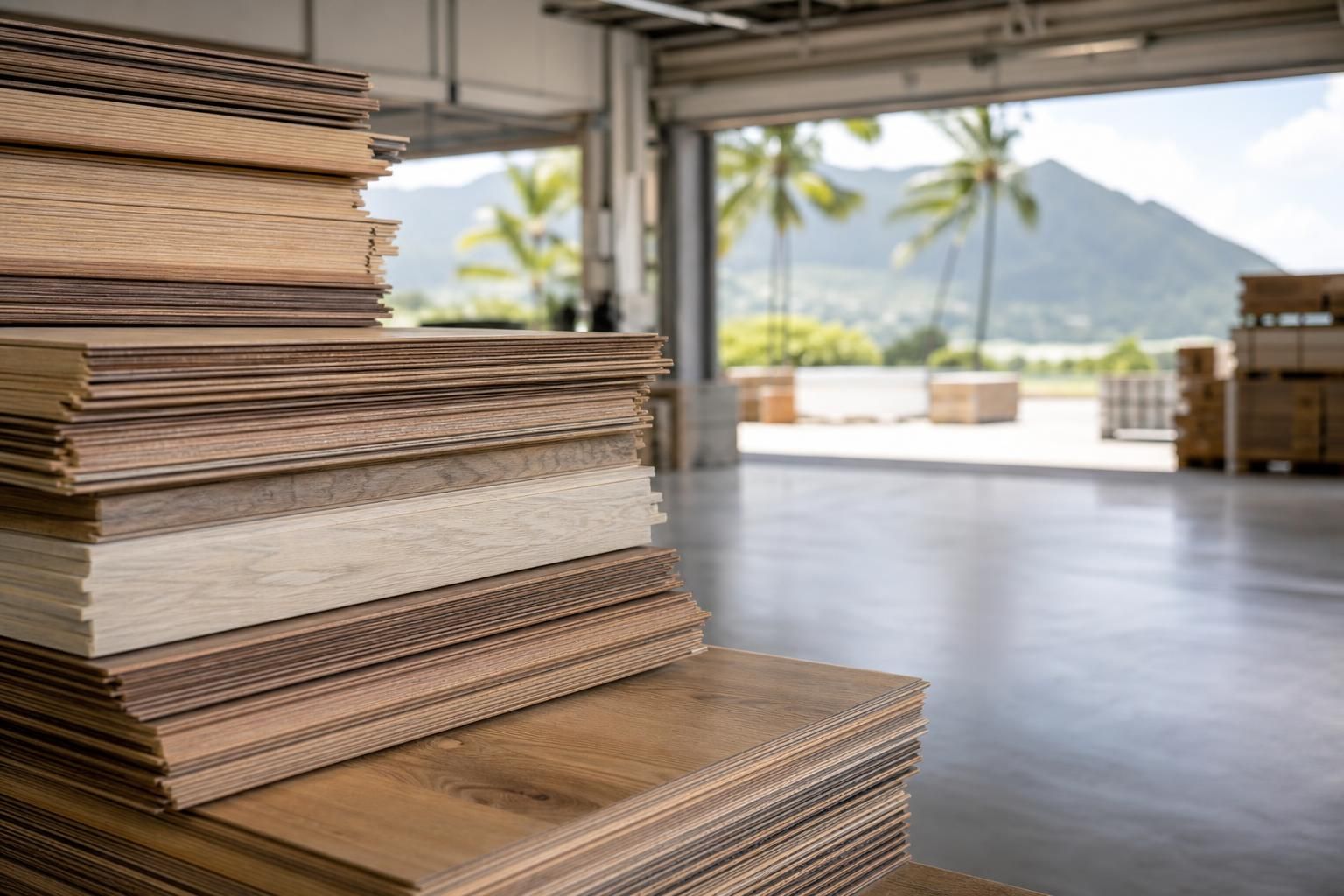
For new construction on Oahu, waterproof vinyl plank and SPC are the flooring categories builders specify most often because they hold up to jobsite traffic before move-in, don't require acclimation delays like solid hardwood, and are sold on contractor wholesale tiers that scale with the number of units in a project. The deciding factors on a build schedule are usually stock availability and lead time, not just material cost, since a shipping delay on a mainland order can hold up a closing date. Buying from an Oahu warehouse that stocks product locally removes that risk.
Key takeaways
- Vinyl plank and SPC are the default choice for new builds because they install fast, resist jobsite moisture, and don't need an acclimation period.
- H&W Flooring publishes wholesale tiers at $2.79, $2.59, and $2.39 per square foot, triggered at $5,000, $15,000, $100,000, and $200,000 in purchase volume.
- Same-day pickup from Oahu stock avoids the shipping delays that come with mainland-sourced material on a construction timeline.
Why vinyl plank and SPC fit new construction better than site-finished materials
New construction crews move fast between trades, and flooring is usually one of the last items installed before final walkthrough. Waterproof vinyl plank and SPC (stone plastic composite) click together or glue down without the multi-day finishing and drying time that solid hardwood or site-poured epoxy require. Because the wear layer is factory-cured, the floor is walkable and load-bearing almost immediately, which matters when punch-list crews, cabinet installers, and inspectors are still moving through the unit.
SPC in particular uses a rigid limestone-composite core, which resists the subfloor telegraphing and denting that can happen with softer vinyl when pallets or tools sit on it during the final stretch of a build. For a side-by-side on core construction and where each performs better, see what SPC flooring actually is and how it differs from standard vinyl plank.
Buying on a builder's timeline: why lead time matters as much as price
A flooring order that ships from the mainland can take weeks to land on Oahu, and a single delayed container can push back a closing date on an entire spec home or a multi-unit phase. According to the National Association of Home Builders, material and supply-chain delays remain one of the most cited causes of schedule slippage on residential construction, and flooring is a trade that typically can't start until drywall, paint, and cabinetry are substantially done — leaving little slack if the material itself is late.
Stocking flooring on Oahu for same-day pickup removes that variable from the schedule. A builder ordering vinyl plank for a four-unit spec project can walk out with product the same day an order is confirmed, rather than waiting on a freight window tied to vessel schedules.
How contractor wholesale pricing scales with project size
H&W Flooring publishes contractor wholesale pricing in tiers rather than negotiating case by case, which lets a builder pencil out material cost before bidding a job. Vinyl plank retails at $2.79 per square foot, with wholesale tiers stepping down to $2.79, $2.59, and $2.39 per square foot as cumulative purchase volume crosses $5,000, $15,000, $100,000, and $200,000. A builder running several units through one trade account can reach the lower tiers faster than a single-home buyer, which is part of why volume production builders and spec-home contractors tend to land in the lower brackets within a single phase of construction.
For the full breakdown of how the thresholds work and what a DCCA-licensed contractor needs to open an account, see how contractor pricing works for flooring in Hawaii.
Installation and site prep costs to budget for new builds
Material is only one line item. H&W Flooring prices installation from $8 per square foot, including demo of old flooring, leveling (incl. self-leveling material), and baseboard — the demo portion is usually moot on true new construction since there's no existing floor to remove, but it's covered on any unit where a builder is replacing a developer-grade floor covering before resale. On a concrete slab, which is standard for most Oahu multi-family and many single-family foundations, vinyl plank and SPC can usually go down directly over cured concrete without a plywood subfloor, which keeps both material and labor costs lower than on a wood-framed floor system. The specifics of slab moisture testing and underlayment requirements are covered in installing vinyl plank flooring over concrete.
Specifying flooring that holds up to final inspection
Building codes and lender inspections on new construction often reference flooring performance standards for slip resistance and moisture tolerance, particularly in bathrooms and entryways. ASTM International maintains the testing standards most vinyl and SPC manufacturers reference for wear-layer thickness and static coefficient of friction, and specifying a product with published test data makes it easier to satisfy a lender's or inspector's documentation request without a change order late in the build.
For wet areas specifically — primary bathrooms, powder rooms, and laundry closets — waterproofing the substrate before the floor goes down is a separate scope from the flooring material itself. A rundown of what that involves on Oahu builds is in what flooring and waterproofing combination works best for a bathroom.
What to decide before placing a bulk order
Before committing a purchase order, a builder or GC should have:
- A firm plank or tile count per unit, including a waste factor, so the order crosses a pricing tier intentionally rather than by accident.
- Confirmation of subfloor type (slab vs. plywood) per unit, since underlayment needs can differ between units on the same project.
- A delivery or pickup schedule that matches the trade sequence, since flooring sitting on a jobsite for weeks before install invites damage.
- A single point of contact for the wholesale account so unit-by-unit reorders don't each start pricing negotiations from scratch.
Frequently Asked Questions
Q: What type of flooring is most common in new construction homes on Oahu?
Waterproof vinyl plank and SPC are the most common choices because they install quickly, tolerate jobsite moisture and traffic, and don't require the acclimation time solid hardwood needs before a closing date.
Q: Does vinyl plank flooring need a plywood subfloor in new construction?
Not usually on a concrete slab. Vinyl plank and SPC can typically be installed directly over cured, properly tested concrete, which is common in Oahu construction, though moisture testing is still required before installation.
Q: How does contractor wholesale pricing work for a multi-unit build?
Pricing is set in tiers tied to cumulative purchase volume rather than negotiated per job; H&W Flooring's tiers step from retail down to $2.79, $2.59, and $2.39 per square foot as an order crosses $5,000, $15,000, $100,000, and $200,000 in volume.
Q: Is SPC flooring better than standard vinyl plank for new builds?
SPC has a rigid limestone-composite core that resists denting and subfloor telegraphing better than standard flexible vinyl plank, which can matter when a floor is installed before the final stretch of trade work is finished.
Q: Why does lead time matter more on new construction than on a remodel?
A remodel can often absorb a short material delay, but new construction has a closing date or unit-turn deadline tied to it, so a flooring order sourced from local Oahu stock avoids the shipping delays common with mainland suppliers.