Can Vinyl Plank Flooring Be Installed Over Concrete?
Key takeaway
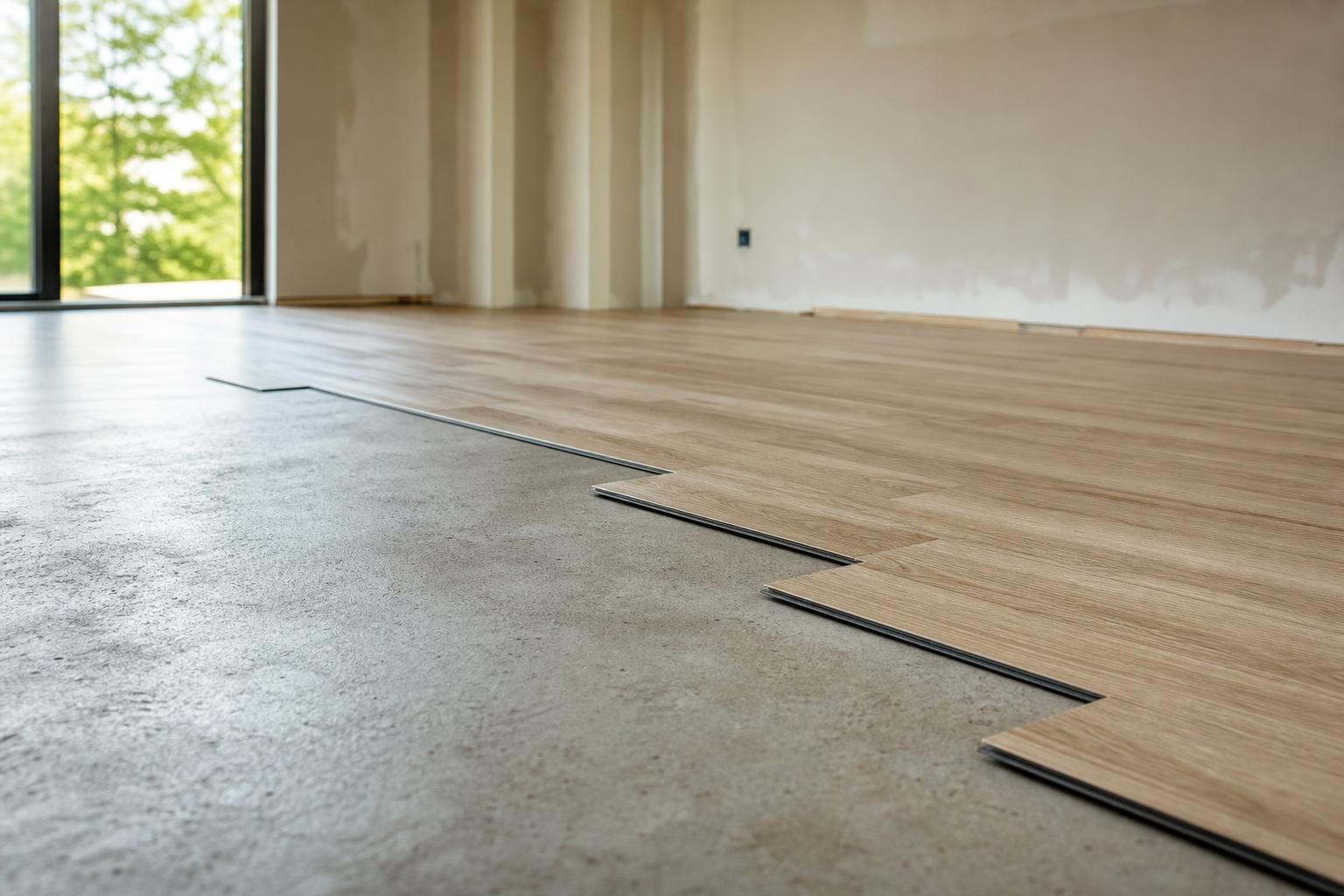
Yes — waterproof vinyl plank and SPC flooring are designed to go directly over a concrete slab, and on Oʻahu, where most homes and condos are built on slab-on-grade foundations, this is the standard installation, not the exception. The concrete just needs to be flat, clean, dry, and tested for moisture before planks go down. Skipping that step is the single most common reason a vinyl floor fails within its first year.
Key takeaways
- Vinyl plank and SPC can float or glue directly over concrete once it's tested dry, flat within roughly 3/16 inch over 10 feet, and free of oil, dust, and old adhesive.
- Concrete moisture testing (calcium chloride or RH probe) should happen before ordering underlayment, since a wet slab changes the assembly, not just the install date.
- Contractors bidding slab jobs at volume should price moisture testing and demo separately from the flooring itself — wholesale pricing tiers work differently than a one-room retail quote.
Why Concrete Slabs Are the Norm in Hawaii
Most single-family homes and nearly all condo units in Honolulu sit on a poured concrete slab rather than a raised wood subfloor. That's partly climate — slab construction resists termite and moisture damage better than framed subfloors in a humid environment — and partly building convention that's been standard here for decades. This matters for flooring choice because it rules out anything that needs a nailed-down wood subfloor and puts vinyl plank, SPC, and glue-down or floating laminate at the top of the list of options that actually work on the substrate homeowners here already have.
What the Concrete Needs Before Installation
Concrete doesn't need to be perfect, but it does need to meet a few specific conditions before vinyl plank goes over it:
- Moisture level — Concrete slabs, especially newer pours or ones near grade, can still be releasing moisture vapor. The ASTM International F710 standard covers how installers should test a concrete subfloor before resilient flooring goes down, typically with a calcium chloride test or an in-situ relative humidity probe. A slab that reads too wet needs a moisture-mitigating underlayment or primer before planks are installed, not just a longer wait.
- Flatness — Vinyl plank telegraphs small dips and humps more than carpet does. Low spots typically get filled with a cementitious patch compound; high spots get ground down.
- Cleanliness — Old mastic, paint overspray, and construction dust all interfere with adhesion on glue-down jobs and can trap grit under a floating floor's click-lock seams.
- Cracks — Hairline cracks generally aren't structural, but active or moving cracks need to be addressed (often with a crack isolation membrane) so they don't telegraph through the new floor.
None of this is unique to Hawaii, but it's worth flagging because a slab that's been through decades of Oʻahu humidity and prior flooring removals often needs more prep than a textbook new-construction pour.
Vinyl Plank vs. Other Flooring Options Over Concrete
Solid hardwood generally isn't recommended directly over a slab because wood plank reacts to the moisture concrete can hold, even when it tests within range for vinyl. Engineered hardwood can work with the right underlayment, but it's a narrower margin for error. Vinyl plank and SPC, by contrast, are built with a waterproof core specifically so a small amount of residual slab moisture isn't a failure point the way it would be for a wood product. That's a meaningful difference for wet-adjacent rooms — laundry closets, lanai-facing slabs, bathrooms — where waterproofing the wet area matters as much as the flooring choice itself.
Installation Cost Breakdown When Concrete Is Involved
A concrete-slab install typically has two cost components beyond the flooring itself: demo of whatever's currently on the floor, and the installation labor for the new material. H&W Flooring publishes installation from $8 per square foot, including demo of old flooring, leveling (incl. self-leveling material), and baseboard, on top of the material cost — a figure worth having in hand before a job gets quoted, since removing the old tile or carpet and putting down the new vinyl are covered by one all-inclusive rate rather than a lump estimate. Moisture mitigation product or self-leveling compound, when the slab needs it, is priced by the job rather than folded into a flat rate, since the amount of prep varies with how far out of flat the existing slab is.
Wholesale Considerations for Contractors Installing Over Slab
For a licensed contractor bidding several slab units — a condo renovation package, a multi-unit rental turnover — the volume of underlayment, moisture-barrier product, and flooring itself is where wholesale pricing tiers start to matter more than the per-square-foot retail number. H&W Flooring's wholesale tiers move to $2.79, $2.59, and $2.39 per square foot at $5,000, $15,000, and $100,000 order thresholds respectively, which changes the math meaningfully on a job where every unit is on the same slab type and needs the same prep. Setting up a trade account before bidding means those tiers are already locked in rather than negotiated unit by unit.
Common Mistakes to Avoid
- Skipping the moisture test because the slab "looks dry." Visual dryness and vapor emission rate are two different things, and only one of them is measured with a test kit.
- Assuming all vinyl plank handles moisture the same way. SPC flooring has a rigid stone-composite core that tends to perform more predictably over concrete than thinner flexible vinyl, particularly where the slab is only borderline dry.
- Not budgeting for patch compound. A slab that's out of flatness tolerance needs leveling before planks go down — treating that as a maybe rather than a line item is how installs run over budget mid-job.
- Ignoring perimeter expansion gaps. Vinyl plank still expands and contracts with temperature; a tight perimeter against a concrete-adjacent wall can cause buckling even on an otherwise well-prepped slab.
Frequently Asked Questions
Q: Does a concrete slab need to fully cure before vinyl plank can go over it?
New concrete generally needs weeks to months to cure and release excess moisture before flooring goes down, and the safest way to confirm it's ready is a moisture test rather than a calendar guess. On older, already-cured slabs this isn't usually a concern.
Q: Can vinyl plank be glued directly to concrete, or does it need underlayment?
Both approaches work depending on the product: some vinyl plank is designed to float over a thin underlayment pad, while other glue-down products bond directly to a prepared, primed slab. The choice depends on the specific plank product's installation method, not a universal rule.
Q: What happens if vinyl plank is installed over a concrete slab that's too wet?
Excess moisture trapped under the flooring can cause planks to lift, seams to separate, or adhesive to fail, sometimes months after installation rather than immediately. This is why testing before installation matters more than inspecting after a problem shows up.
Q: Is SPC flooring better than standard vinyl plank for a concrete slab install?
SPC's rigid core generally handles minor subfloor imperfections and borderline moisture conditions more consistently than thinner flexible vinyl plank, making it a common choice for slab-heavy markets. Either can work once the slab is properly tested and prepped.
Q: Do condo units in Honolulu need different prep than single-family homes on slab?
The underlying concern — moisture, flatness, cleanliness — is the same, but condo slabs sometimes have older adhesive residue from multiple past flooring changes that needs full removal before new planks go down. That demo step is worth confirming is covered in the installation quote.