What Is the Best Flooring for a Bathroom in Honolulu?
Key takeaway
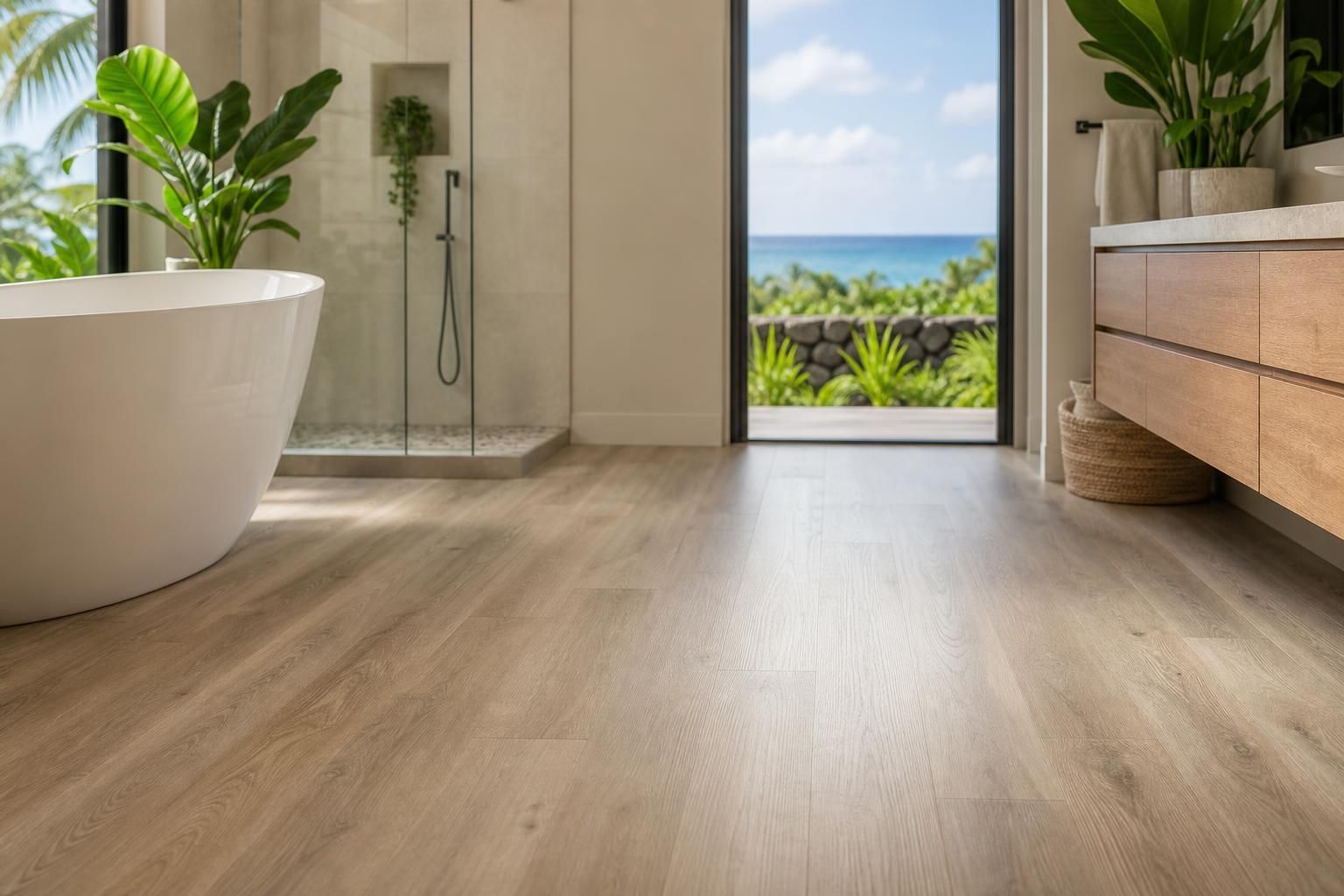
Waterproof vinyl plank and SPC (stone plastic composite) are the best all-around choice for most bathrooms because the plank itself is 100% waterproof, not just water-resistant, and it costs less to buy and install than tile. Porcelain tile remains the better choice for a shower pan or a floor that will see standing water for long stretches, since it's installed with a mortared, sloped substrate rather than a floating plank system. Solid or engineered hardwood should not go in a bathroom at all, regardless of finish.
Key takeaways
- Waterproof vinyl plank/SPC handles splashes, spills, and humidity better than laminate or hardwood, and it's priced lower per square foot than tile in most cases.
- Tile is still the right call for shower floors and pans; vinyl plank is built for the rest of the bathroom floor, not the wet enclosure itself.
- H&W Flooring publishes vinyl plank at $2.79/sq ft retail with installation from $8/sq ft, including demo of old flooring, leveling (incl. self-leveling material), and baseboard, so a homeowner can price a small bathroom before ever calling anyone.
Why Bathrooms Need Waterproof, Not Just Water-Resistant, Flooring
"Water-resistant" and "waterproof" get used interchangeably in flooring ads, but they describe different products. Water-resistant laminate has a wood core that will swell if water sits on a seam for hours — a dropped towel or a slow leak under the vanity is enough. Waterproof vinyl plank and SPC use a solid polymer or stone-composite core with no wood content, so standing water doesn't cause the plank itself to swell or delaminate. The EPA's guidance on mold and moisture control notes that trapped moisture behind or under flooring is one of the more common indoor mold triggers in homes, which is exactly the failure mode a wood-core product is more prone to than a polymer-core one.
Comparing Bathroom Flooring Options
| Flooring type | Waterproof? | Best use in a bathroom | Cost shape |
|---|---|---|---|
| Waterproof vinyl plank / SPC | Yes, full plank is waterproof | Floor field, vanity area, powder rooms | Priced by the square foot, lower than tile |
| Porcelain or ceramic tile | Yes, with proper substrate and grout maintenance | Shower pan, curb, floor in high-splash zones | Priced by the box, plus mortar and setting labor |
| Natural stone tile | Water-resistant, needs sealing | Accent or feature areas only | Priced by the slab or box, varies by stone |
| Laminate | Water-resistant at best | Not recommended for bathrooms | Lower than vinyl plank, but wrong material for wet rooms |
| Solid hardwood | Not water-resistant | Never in a bathroom | N/A |
What Makes Vinyl Plank and SPC Different
Vinyl plank flooring is built in layers: a waterproof core, a printed vinyl layer for the wood or stone look, and a wear layer on top that resists scratches and stains. SPC is a stiffer version of that core, made with limestone composite, which makes it more dimensionally stable in a room with temperature and humidity swings — relevant in a Honolulu bathroom that runs a hot shower daily. Neither product needs a sealed grout line the way tile does, which removes one of the more common maintenance complaints homeowners have about bathroom floors.
Where Tile Still Wins
Tile isn't obsolete in a bathroom — it's just doing a different job than the field floor. Shower pans, curbs, and any surface that gets sustained standing water need a sloped, mortared substrate that vinyl plank isn't designed to replace. The Tile Council of North America publishes installation handbook standards specifically for wet-area substrates, and those slope and waterproofing membrane requirements apply whether the field floor outside the shower is tile or vinyl plank. A common, sensible layout on Oʻahu is tile in the shower and vinyl plank everywhere else in the bathroom, which keeps the wet-enclosure standards intact while cutting material and labor cost on the rest of the room.
Installation Details That Actually Matter
A vinyl plank floor is only as waterproof as its perimeter. Seams at the tub, the toilet flange, and the door threshold need to be sealed, and the subfloor underneath needs to be flat and clean before planks go down — gaps or debris telegraph through a floating floor over time. If an existing tile or vinyl floor is coming out first, that's a demo step, which H&W Flooring includes in its installation rate. Anyone quoting a bathroom remodel should ask whether demo is included in a bid or billed on top of it, since that's a common place estimates diverge.
What It Costs to Materials and Install
For a homeowner pricing out a single bathroom, the two line items that matter are material and labor. H&W Flooring publishes waterproof vinyl plank at $2.79/sq ft retail, with installation billed separately, from $8/sq ft, including demo of old flooring, leveling (incl. self-leveling material), and baseboard — so a small bathroom's material and labor cost scales directly with its square footage rather than hiding inside a bundled estimate. Licensed contractors buying at volume get tiered wholesale pricing instead of the retail rate: $2.79/sq ft, $2.59/sq ft, and $2.39/sq ft depending on order size, with tiers starting around $5,000 and stepping down further at $15,000, $100,000, and $200,000 in purchase volume. That tier structure is worth understanding even for a homeowner, since it explains why a contractor's material line on a bid can look different from a retail quote for the identical plank.
For Contractors: Sourcing Bathroom-Grade Vinyl at Volume
A remodeler running several bathroom jobs a month doesn't want to reorder the same SPC plank one bathroom at a time at retail. Buying into a wholesale tier locks in a lower per-square-foot rate and, because the product is stocked on Oʻahu, avoids the mainland shipping lead times that can stall a bathroom job waiting on a container. For a deeper look at how tiered contractor pricing and trade accounts work, see this guide to wholesale flooring for Hawaii contractors, which breaks down how the volume thresholds are structured beyond what applies to a single bathroom purchase.
Frequently Asked Questions
Q: Is vinyl plank flooring actually waterproof, or just water-resistant?
Genuine waterproof vinyl plank and SPC have a polymer or stone-composite core with no wood content, so the plank itself won't swell from standing water. That's a different product than water-resistant laminate, which has a wood core that can still swell at a seam over time.
Q: Can I put vinyl plank flooring inside a shower?
No — a shower pan needs a sloped, waterproofed, mortared substrate that vinyl plank isn't built to replace. Tile or a solid-surface shower base is the standard choice for the enclosure itself, with vinyl plank commonly used on the floor outside the shower.
Q: What's the difference between SPC and standard vinyl plank?
SPC (stone plastic composite) uses a limestone-composite core that's stiffer and more dimensionally stable through temperature and humidity swings than a standard vinyl plank core. Both are waterproof; SPC tends to hold up better in rooms with more moisture and heat cycling, like a bathroom with daily hot showers.
Q: Does bathroom flooring need a different installation method than the rest of the house?
The plank product and floating installation method are usually the same, but the perimeter sealing matters more — seams at the tub, toilet flange, and door threshold need to be sealed so water can't get underneath. A flat, clean subfloor is also more critical in a small room where gaps are more likely to telegraph through the finished floor.
Q: How much does it cost to remove old bathroom flooring before installing new vinyl plank?
H&W Flooring's installation rate includes demo of the old flooring, billed separately from the new material. That figure matters when comparing bids, since some quotes bundle demo into the labor rate and others list it as its own line item.