Can Laminate Flooring Be Installed in a Bathroom?
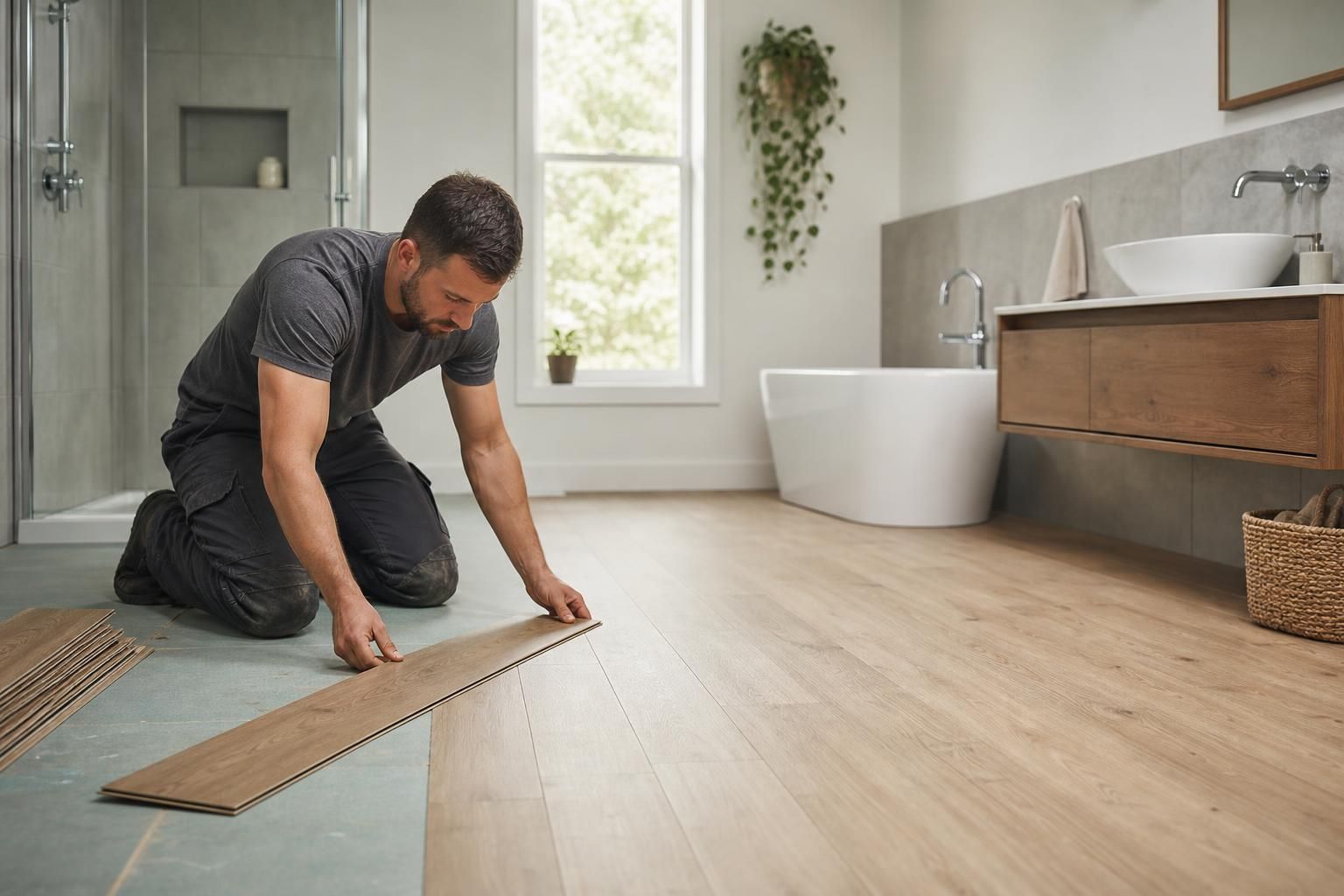
Key takeaway
Standard laminate flooring is not recommended for bathrooms because its core is made of compressed wood fiber (HDF) that swells and delaminates when water gets into the seams, even with a "water-resistant" surface coating. A small number of laminate products are rated fully waterproof and can handle a bathroom, but true waterproof vinyl plank, especially SPC rigid core, is the more reliable and widely used choice for wet rooms in Honolulu. If you already own laminate you love, save it for a dry room and use a waterproof product in the bathroom instead.
Key takeaways
- Most laminate flooring has a wood-fiber core that will swell and delaminate if water sits on it, so it's a poor fit for bathrooms, laundry rooms, and other wet areas.
- Only laminate specifically labeled "100% waterproof" (not just "water-resistant") should even be considered, and seams and transitions are still the weak point.
- Waterproof vinyl plank, particularly SPC rigid core, handles standing water, humidity swings, and daily mopping without the swelling risk, which is why it's the default choice for Oʻahu bathrooms.
Why Standard Laminate Struggles in Wet Rooms
Laminate flooring is built from a high-density fiberboard (HDF) core topped with a printed design layer and a clear wear layer. HDF is essentially compressed wood pulp, and wood pulp absorbs water. Once moisture works its way past a seam, around a toilet flange, or under a vanity, the core can swell, bubble, or separate at the joints. This isn't a cosmetic issue only — swollen laminate often can't be repaired, only replaced, because the board itself has physically changed shape.
Manufacturers have improved the wear layers and edge treatments over the years, and some laminate lines are now marketed as water-resistant for a limited time of exposure. That's different from waterproof. Water-resistant means the floor can handle a spill that's wiped up promptly; it is not designed for a shower splash zone, a leaking supply line overnight, or the humidity that builds up in a bathroom with poor ventilation.
Water-Resistant vs. Waterproof: The Distinction That Matters
This is the single most important thing to check before buying flooring for a bathroom:
- Water-resistant laminate slows water absorption for a short period but will eventually swell if moisture isn't cleaned up.
- Waterproof laminate uses a core engineered to resist swelling even with sustained exposure, but availability is limited and it's still a newer category compared to waterproof vinyl.
- Waterproof vinyl plank (including SPC rigid core) has a stone-polymer or plastic composite core that doesn't absorb water at all, so standing moisture isn't a structural risk.
The North American Laminate Flooring Association notes that laminate performance depends heavily on the specific product's core and installation method, which is exactly why "laminate" as a category can't be judged as a single material — a standard HDF-core laminate and a waterproof laminate perform very differently in the same bathroom. See the North American Laminate Flooring Association for product category standards.
Where Laminate Can Still Work in a Hawaii Home
Laminate isn't a bad product — it's a mismatched one for bathrooms. It holds up well in bedrooms, living rooms, and hallways where humidity is stable and spills are rare. If you're deciding between laminate and vinyl for the rest of the house, it's worth comparing how laminate flooring typically holds up in Honolulu homes before you commit a whole-house budget to one material, since the climate here — high ambient humidity, trade-wind-driven moisture, and occasional storm flooding — puts more stress on wood-based cores than a mainland climate would.
Humidity and moisture intrusion are also recognized mold risk factors indoors, which is another reason to keep wood-fiber-core products out of consistently damp rooms. The EPA's guidance on mold and moisture control points out that materials which stay damp for 24–48 hours are prone to mold growth, and a swollen laminate seam can trap moisture against the subfloor exactly that long.
What to Use Instead in a Bathroom
For bathrooms, laundry rooms, and other wet areas, waterproof vinyl plank is the standard recommendation at H&W Flooring. Rigid core SPC in particular combines a waterproof core with a stiffer feel underfoot than older flexible vinyl, which matters in a small bathroom where the floor meets tile thresholds and cabinet toe-kicks. If you haven't worked with SPC before, this breakdown of what rigid core vinyl plank actually is explains the layers and why the core material is the deciding factor for wet rooms.
H&W sells in-stock waterproof vinyl plank at a published retail price of $3.99 per square foot, with a limited-time Black Friday promotion at $2.49 per square foot. Installation is quoted from $8 per square foot, and that figure is all-inclusive — it covers demo of the old flooring, leveling (including self-leveling material where the subfloor needs it), and new baseboard, so there's no separate line item added later for prep work.
Waterproofing the Rest of the Bathroom
Flooring material is only part of a wet-area install. The seams where flooring meets the tub, shower pan, or toilet flange need proper sealing, and any plywood or concrete subfloor beneath the finish floor should be checked for existing moisture damage before new material goes down. This is also where installing vinyl plank over an existing plywood subfloor becomes relevant — the subfloor condition affects both the installation method and whether leveling is needed, which is already folded into the all-inclusive installation price rather than billed separately.
Frequently Asked Questions
Q: Is any laminate flooring actually waterproof?
A small number of laminate products are manufactured with waterproof cores and are marketed as "100% waterproof," but they are a narrower category than standard laminate and less common than waterproof vinyl plank. Always check the specific product's waterproof rating rather than assuming "water-resistant" laminate is safe for a bathroom.
Q: What happens if water gets under standard laminate in a bathroom?
The wood-fiber core absorbs the moisture and swells, which often shows up as lifted seams, bubbling, or boards that no longer sit flush. Once the core has swollen, the affected boards usually need to be replaced rather than dried out and reused.
Q: Is waterproof vinyl plank a good substitute for laminate in a bathroom?
Yes — waterproof vinyl plank, especially SPC rigid core, has a plastic composite core that doesn't absorb water, so it handles shower splash, mopping, and humidity without the swelling risk laminate carries. It's the product H&W Flooring recommends for Oʻahu bathrooms and other wet areas.
Q: Does bathroom flooring need a different installation method than other rooms?
Yes — the areas around the tub, shower pan, and toilet flange need careful sealing at the seams, and the subfloor should be checked for prior moisture damage before installation. A proper install also accounts for leveling, which is included in H&W's installation pricing rather than billed as an extra step.
Q: Can I install laminate in a half-bath that doesn't have a shower?
Standard laminate is still a risk in a half-bath because of sink splashes, mopping, and humidity, even without a shower present. A waterproof vinyl plank is the safer choice for any room with a plumbing fixture, regardless of whether it includes a shower or tub.