What Is Rigid Core Vinyl Plank Flooring?
Key takeaway
Rigid core vinyl plank flooring is a waterproof flooring category built around a dense, dimensionally stable core — usually stone-plastic composite (SPC) or wood-plastic composite (WPC) — instead of the flexible felt-backed core used in older vinyl products. That rigid core resists denting, telegraphing of subfloor imperfections, and expansion from heat or humidity, which is why it's become the default choice for kitchens, bathrooms, condos, and rental units. It's installed as a floating click-lock floor over almost any flat, stable subfloor, with no glue required in most residential layouts.
Key takeaways
- Rigid core vinyl plank (SPC or WPC) uses a solid composite core, making it more dent- and heat-resistant than flexible vinyl plank or sheet vinyl.
- It's 100% waterproof at the plank level, but seams and perimeters still need proper transitions and moisture-smart underlayment in wet areas.
- Retail pricing for in-stock luxury vinyl plank runs around $3.99/sq ft, with installation priced from $8/sq ft covering demo, leveling, and baseboard as one line item.
What's Actually Inside a Rigid Core Plank
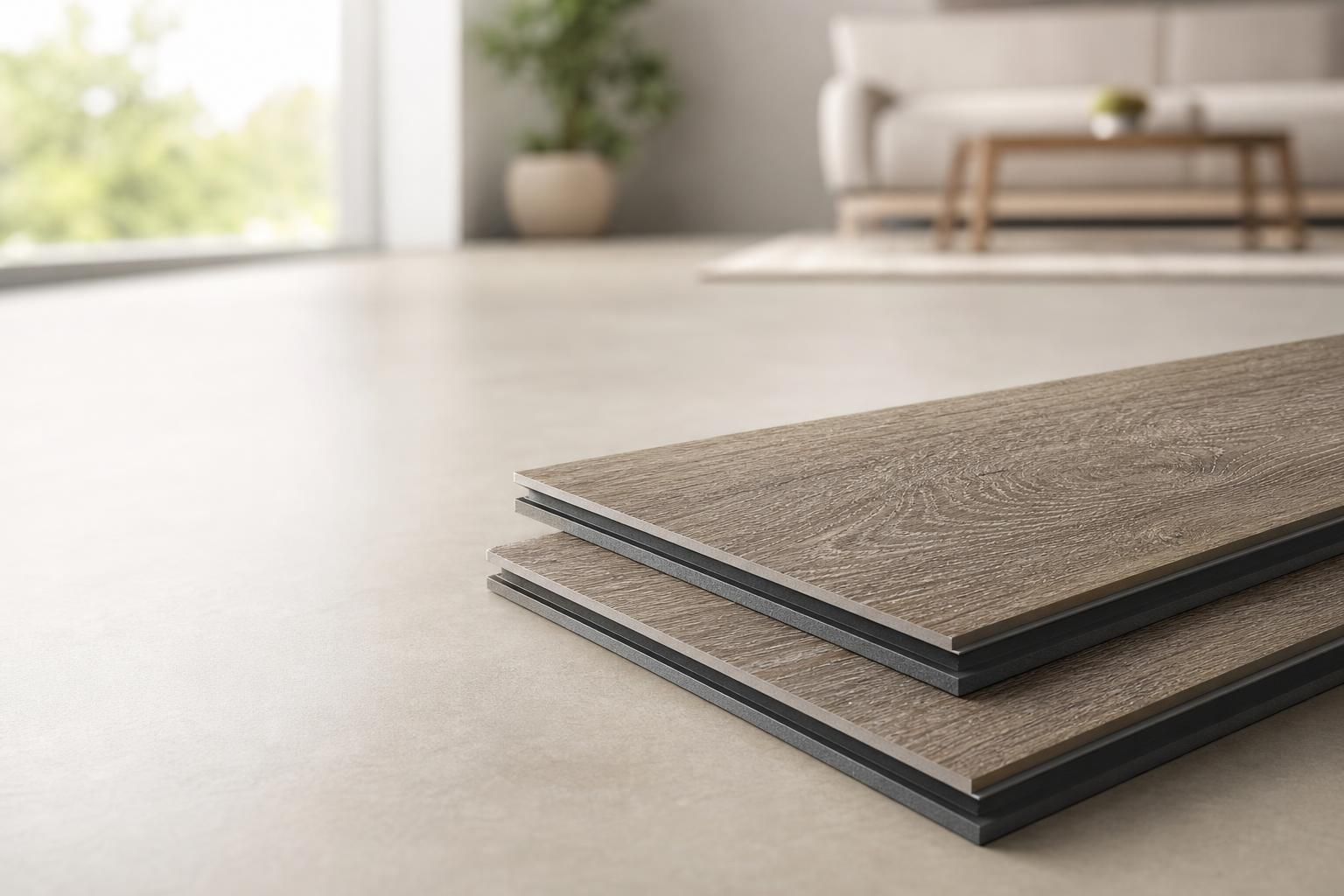
A rigid core plank is built in layers: a wear layer on top (clear urethane or similar, protecting against scuffs and UV fading), a printed vinyl design layer underneath that, then the rigid core itself, and often a backing pad for sound dampening and minor subfloor forgiveness. The core is where SPC and WPC differ:
- SPC (stone-plastic composite): a blend of limestone powder, PVC, and stabilizers compressed into a very dense, thin core — typically the harder and thinner of the two, which makes it a common fit for commercial traffic and for floors going under existing cabinetry without raising the finished height too much.
- WPC (wood-plastic composite): a foamed core using wood pulp or bamboo fiber blended with plastic, generally thicker and a bit softer underfoot, with more give for comfort in bedrooms or living rooms.
Both qualify as "rigid core" because, unlike older flexible vinyl plank, neither core will visibly flex or bow when you press down on it. For background on how vinyl plank is constructed in general, including the wear layer ratings that matter most for durability, see what vinyl plank flooring is made of.
How It Differs From Standard Luxury Vinyl Plank
"Luxury vinyl plank" is the umbrella term; rigid core is a subcategory within it. Standard flexible luxury vinyl plank uses a felt or foam-backed core that can telegraph small subfloor bumps and is more prone to denting under heavy furniture. Rigid core corrects both issues by swapping that soft core for a compressed composite layer, at the cost of being slightly less forgiving over a subfloor that isn't flat — gaps or high spots under a rigid plank can create hollow spots or clicking sounds over time. For a side-by-side on where rigid core fits against other vinyl formats, the full luxury vinyl plank guide breaks down wear layers, core types, and finish options in one place.
Why It Holds Up to Water and Weight
The core materials in SPC and WPC are inherently non-organic (stone powder, PVC, or plastic-encased fiber), so they don't absorb water or swell the way wood-based laminate cores can. That's distinct from being flood-proof: standing water at the seams can still work its way to the subfloor over time, which is why bathroom and laundry room installs benefit from sealed transitions and attention to the subfloor itself, not just the plank. If you're flooring a wet area, it's worth reading about how a moisture barrier works under vinyl plank before you commit to a layout. The U.S. EPA's guidance on moisture and mold is a useful general reference on why trapped moisture under any flooring — not just vinyl — is the real long-term risk, not the plank material itself.
Subfloor and Installation Basics
Rigid core planks click-lock together and float over the subfloor, which is part of why installation timelines are shorter than for glue-down or nail-down floors. Key points:
- The subfloor needs to be flat within a small tolerance (commonly within about 3/16 inch over a 10-foot span, per manufacturer norms) — high spots get ground down, low spots get filled.
- Plywood, concrete slab, and most existing hard floors are acceptable substrates if they're clean, dry, and level; see installing vinyl plank over plywood for subfloor-specific prep steps.
- A thin foam or cork underlayment is typically installed underneath for sound and slight cushioning, unless the plank already has an attached pad.
- Expansion gaps (usually 1/4 inch) are left at walls and large transitions since the floor is floating, not fixed.
When H&W Flooring quotes installation, that prep work — demo of the old floor, any self-leveling compound needed, and new baseboard — is included in the from-$8/sq ft installation price rather than billed as separate line items.
Cost: Buying vs. Installing
Pricing works in two separate buckets, and it's worth knowing which one applies to a given project:
- Material only: in-stock rigid core luxury vinyl plank at H&W Flooring is $3.99/sq ft retail, with a limited-time Black Friday promotion bringing it down to $2.49/sq ft.
- Installed: labor runs from $8/sq ft, and that figure is all-inclusive — it covers tear-out of the old flooring, leveling (including self-leveling compound where the subfloor needs it), and new baseboard, not three separate add-on charges.
- Contractor/wholesale: licensed Hawaii contractors can get tiered pricing based on order volume, which scales down per box as quantity goes up; this is handled on request for verified trade accounts rather than posted as a flat rate, since it depends on project size.
Anyone comparing per-box pricing across suppliers should also factor in lead time — mainland-shipped vinyl plank can take weeks, while Oahu-stocked wholesale flooring can be picked up the same day an order is placed.
Where It Makes Sense (and Where It Doesn't)
Rigid core is a strong fit for kitchens, bathrooms, laundry rooms, condos, and rental units where moisture resistance and low maintenance matter more than a soft, cushioned feel. It's less ideal in a home gym with heavy fixed equipment left in one spot for years (any floating floor can show compression marks under sustained point loads) or in rooms where a client specifically wants solid hardwood's refinishing ability — vinyl plank can't be sanded and refinished the way engineered or solid wood can. Independent testing standards for resilient flooring durability, including wear layer and indentation testing, are maintained by ASTM International, which manufacturers reference on product spec sheets.
Frequently Asked Questions
Q: Is rigid core vinyl plank the same as SPC flooring?
SPC is one type of rigid core vinyl plank — the other common type is WPC. Both have a solid composite core rather than a flexible backing, but SPC uses a stone-plastic blend while WPC uses a foamed wood-plastic blend.
Q: Can rigid core vinyl plank go directly over tile?
In most cases yes, as long as the tile is flat, securely bonded, and any grout lines are filled or sanded smooth so they don't telegraph through the new floor. Loose, cracked, or uneven tile should be addressed first since a floating floor will reflect those imperfections over time.
Q: Does rigid core vinyl plank need an underlayment?
Most installations use a thin foam or cork underlayment for sound dampening, unless the plank already has an attached pad on the back. The underlayment choice also affects comfort underfoot and, in some cases, helps manage minor subfloor moisture.
Q: How thick should rigid core vinyl plank be?
Residential rigid core planks commonly range from about 4mm to 8mm in overall thickness, not counting the attached pad. Thicker planks generally feel more solid underfoot and can be more forgiving over a slightly imperfect subfloor, but thickness isn't the only factor in durability — wear layer thickness matters just as much.
Q: Is rigid core vinyl plank good for bathrooms?
Yes, because the core itself doesn't absorb or swell with water exposure, unlike laminate or solid wood. Proper installation at seams, transitions, and around fixtures still matters, since standing water can eventually reach the subfloor if those edges aren't sealed.