Best Vinyl Plank Flooring for Airbnb Rentals in Honolulu
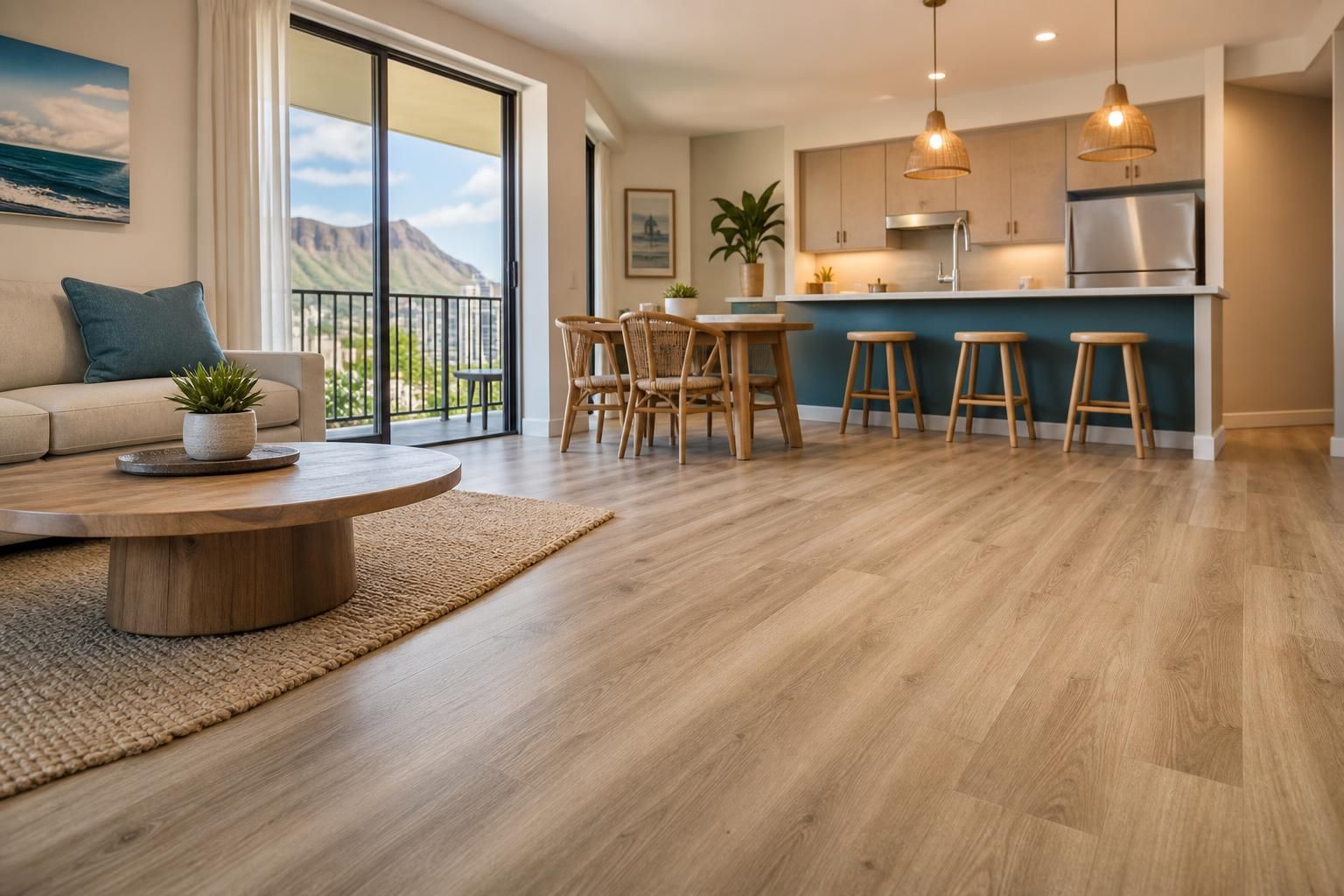
Key takeaway
The best vinyl plank flooring for an Airbnb or short-term rental is a rigid SPC (stone plastic composite) waterproof plank with at least a 12-20 mil wear layer, because it survives rolling luggage, pool-deck foot traffic, and fast guest turnover without the seam failures that laminate or engineered wood develop near lanais and bathrooms. For owners managing more than one unit, the real decision isn't just the product — it's whether a supplier can deliver matching stock on short notice and price it by volume instead of one room at a time.
Key takeaways
- SPC vinyl plank with a 12+ mil wear layer holds up to short-term rental turnover better than laminate or engineered hardwood in wet Hawaii conditions.
- H&W Flooring sells vinyl plank at $2.79 per square foot retail, with wholesale tiers at $2.79, $2.59, and $2.39 per square foot as order size crosses $5,000, $15,000, and $100,000.
- Buying flooring that stays in stock on Oahu matters more for multi-unit owners than for a single room, since a mid-season floor failure in one unit means lost booking nights while mainland freight is in transit.
Why Flooring Choice Matters More for Short-Term Rentals
A primary residence floor gets steady, familiar foot traffic. A short-term rental floor gets a new household every three to five nights, often with sandy feet, swimsuits, rolling suitcase wheels, and sometimes delivery of furniture or appliances between bookings. That cycle compresses years of wear-and-tear exposure into a shorter calendar window, which is why flooring built for a vacation rental needs a thicker wear layer and a genuinely waterproof core rather than a water-resistant laminate surface.
Humidity adds a second stress. Honolulu's year-round humidity and the moisture load from lanai doors and beach gear make core material as important as surface finish — a product that only resists spills on top but swells at the subfloor when humidity rises isn't built for the use case. The National Oceanic and Atmospheric Administration tracks Hawaii's consistently high relative humidity, which is part of why flooring rated for wet, high-traffic commercial use outperforms residential-grade laminate in island rental units.
What to Look for in Vinyl Plank for Rental Units
Four things matter more for an Airbnb floor than for a standard home floor:
- Wear layer thickness — look for 12 mil or higher; thin residential-grade wear layers (6-8 mil) show scuffs and scratches faster under rotating-guest traffic.
- Waterproof core, not just a waterproof surface — SPC and WPC cores resist swelling at seams near bathrooms and lanai doors, unlike laminate's wood-fiber core.
- Click-lock installation — floating floors install faster between bookings if a section needs replacing, without the drying time glue-down systems require.
- Consistent stock availability — if a unit needs a quick repair after a tenant issue, matching the original plank matters, which is only possible if the supplier still carries that exact SKU.
Understanding what separates SPC from other waterproof vinyl is worth a few minutes before ordering for multiple units — see what SPC flooring actually is for the core construction differences that affect rental durability.
Comparing Flooring Options for Short-Term Rental Use
| Flooring type | Water resistance | Turnover durability | Typical install method |
|---|---|---|---|
| SPC waterproof vinyl plank | Fully waterproof core | High — built for commercial-grade traffic | Click-lock, floating |
| WPC vinyl plank | Waterproof core, softer feel | Moderate-high | Click-lock, floating |
| Laminate | Water-resistant surface only | Moderate — core swells if soaked | Click-lock, floating |
| Engineered hardwood | Not waterproof | Lower in wet-exposure rooms | Nail-down or glue-down |
| Porcelain tile | Fully waterproof | High, but harder underfoot and colder | Thin-set, grouted |
For bathrooms and lanai-adjacent flooring specifically, the waterproofing details change the equation further — that's covered in more depth in what flooring actually holds up in a Honolulu bathroom.
Buying for Multiple Units: Where Wholesale Pricing Changes the Math
A single-unit Airbnb owner buys flooring the same way a homeowner does — by the room. An owner or property manager running three, five, or a dozen units is really buying at contractor volume, even without a contractor license, and that's where published wholesale tiers matter. H&W Flooring's pricing moves from $2.79 per square foot at retail down to $2.79, $2.59, and then $2.39 per square foot as the order crosses $5,000, $15,000, and $100,000 in total volume — thresholds that a five-to-ten-unit flooring refresh can realistically reach. Licensed contractors doing the buying on an owner's behalf should check how contractor pricing tiers actually get verified and applied before assuming a quote qualifies for a given tier.
Lead time matters just as much as the per-square-foot number. A mainland-ordered container can take weeks to land, which is a real problem when a unit needs to be back on the booking calendar in days, not a month. Flooring that's already staged on Oahu for same-day pickup removes that gap entirely — a meaningful difference for an owner trying to avoid a dark week on the calendar between guests.
Installation and Turnaround Between Bookings
Installation cost and demo cost are the two line items that get missed in a first-pass budget. Install runs from $8 per square foot, including demo of old flooring, leveling (incl. self-leveling material), and baseboard, published by H&W Flooring rather than quoted case by case. For an owner planning a multi-unit refresh, knowing both figures up front — rather than getting a demo estimate after the material quote — makes it possible to compare a full floor replacement against a partial repair before committing.
Click-lock SPC systems also shorten the gap between a damaged plank and a bookable unit again, since a floating floor section can be pulled and replaced without the cure time a glued-down floor requires. That turnaround speed is part of why rigid SPC has become the default recommendation for short-term rental flooring rather than glue-down luxury vinyl tile, even though glue-down systems have their own advantages in commercial settings per guidance from the U.S. Environmental Protection Agency on flooring materials and indoor air quality in high-occupancy buildings.
Frequently Asked Questions
Q: Is vinyl plank flooring durable enough for a high-turnover vacation rental?
Yes, provided it's SPC-core vinyl plank with a wear layer of 12 mil or higher — that spec is built for commercial and high-traffic use, which maps closely to the guest-turnover cycle of a short-term rental.
Q: Does vinyl plank flooring hold up to humidity and lanai doors in Hawaii rentals?
A genuinely waterproof SPC or WPC core resists swelling at seams near lanai doors and bathrooms, while laminate's wood-fiber core is more vulnerable to Hawaii's consistently high humidity levels.
Q: How much does vinyl plank flooring cost for a multi-unit Airbnb property?
H&W Flooring publishes retail vinyl plank at $2.79 per square foot, with wholesale tiers dropping to $2.79, $2.59, and $2.39 per square foot as total order volume crosses $5,000, $15,000, and $100,000 — a detailed room-by-room cost breakdown is available in how vinyl plank flooring is priced in Honolulu.
Q: Should Airbnb owners choose glue-down or click-lock vinyl plank?
Click-lock floating floors are generally easier to repair section-by-section between bookings without downtime for adhesive curing, which matters more for a rental calendar than for a primary residence.
Q: How long does vinyl plank flooring typically last in a rental unit?
Lifespan depends heavily on wear-layer thickness and traffic volume rather than a fixed number of years — see how long vinyl plank flooring actually lasts for the factors that speed up or slow down wear in high-traffic settings.