How Many Square Feet Does a Box of Vinyl Plank Cover?
Key takeaway
A box of vinyl plank flooring typically covers between 18 and 30 square feet, but the exact number depends on the plank's length, width, and how many pieces the manufacturer packs per carton. There's no single industry standard — a box of wide, long-format planks covers more area with fewer pieces, while a box of narrower, shorter planks needs more pieces to hit the same square footage. Always check the coverage number printed on the box label or the product spec sheet rather than assuming.
Key takeaways
- Box coverage runs roughly 18–30 sq ft depending on plank dimensions, not a fixed industry number — check the carton label.
- Order 7–10% extra for a straight layout and up to 15% for diagonal or herringbone patterns to cover cuts and waste.
- Buying by the box (not the loose square foot) means your real order usually rounds up slightly past the measured room size.
Why Box Coverage Varies by Product
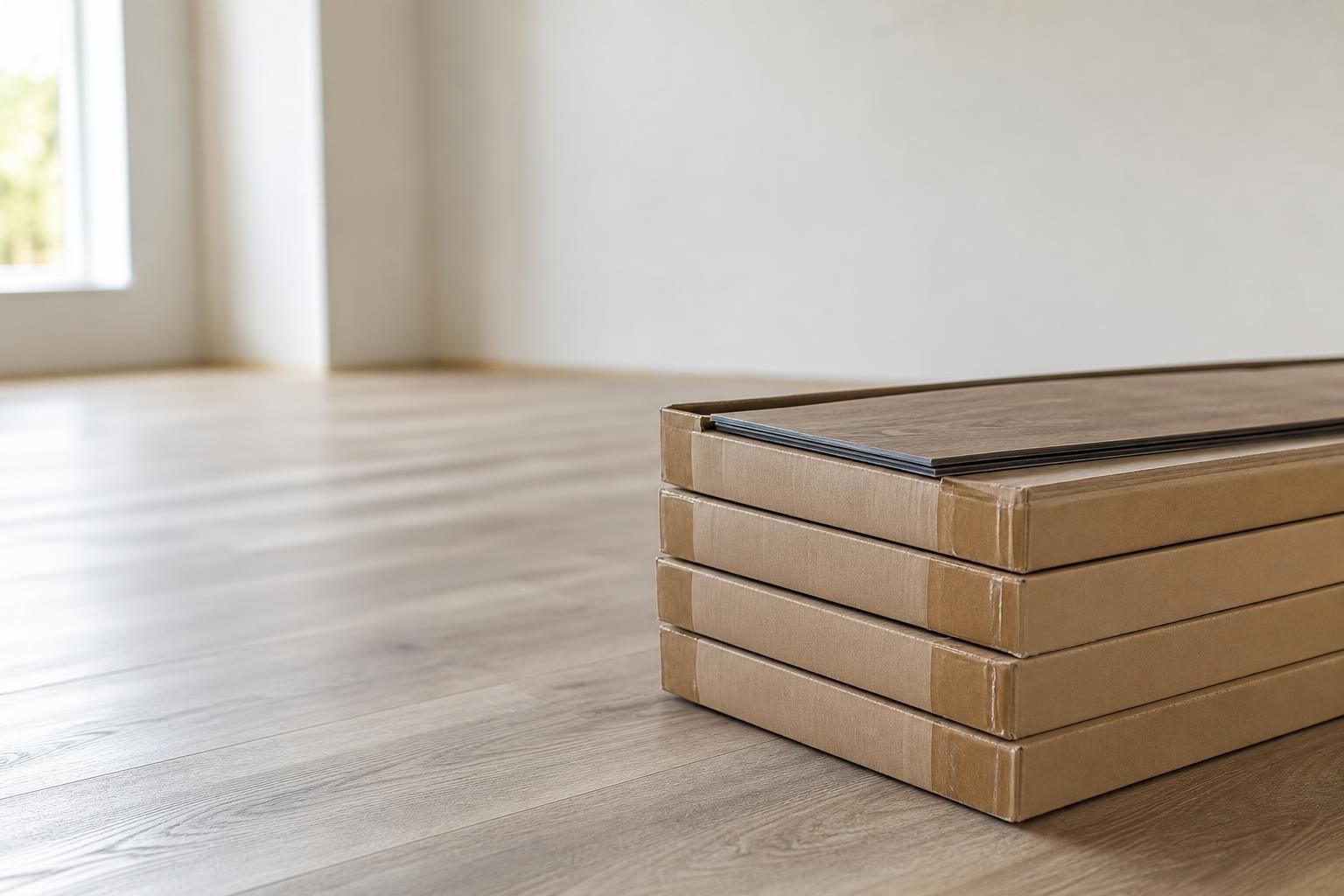
Vinyl plank is sold by the piece, packed into cartons, and the carton is labeled with total square footage — but that number is a function of plank size, not a fixed rule. A long-format plank (something in the 48-inch-plus range) might pack six or seven pieces per box and still cover more area than a shorter plank that packs ten pieces. SPC (stone plastic composite) cores tend to run slightly heavier and are sometimes packed in smaller box counts for easier handling. The only reliable way to know coverage is the label on the actual box or the product's spec sheet — not a rule of thumb from a different plank line. For a side-by-side look at how SPC and standard vinyl plank differ in thickness, weight, and handling, see this contractor's guide to SPC versus vinyl plank.
How to Calculate How Many Boxes You Need
The math is straightforward once you know a room's dimensions and a box's labeled coverage:
- Measure the room's length and width in feet and multiply them for total square footage.
- Add a waste factor — 7–10% for a straight, parallel layout; 12–15% for diagonal, herringbone, or rooms with lots of jogs, closets, or angled walls.
- Divide that adjusted total by the square footage printed on one box.
- Round up to the next whole box — partial boxes aren't sold, and you'll want at least one full box as overage for future repairs.
Example shape: a 300-square-foot living room with a straight layout needs roughly 320–330 square feet of material after waste, then that figure gets divided by whatever the box label states. A contractor refinishing several condo units at once will run this same calculation per unit and then total the boxes across the job to hit volume pricing.
Why Waste Factor Matters More Than People Expect
Waste isn't just offcuts thrown in the trash — it's the planks lost to doorways, closets, stair nosing, pipe cutouts, and the inevitable board that splits on a tight cut. The National Wood Flooring Association and most manufacturers recommend building in a waste allowance before ordering rather than ordering exact square footage and hoping. Rooms with a lot of jogs, multiple closets, or diagonal plank orientation eat more material than a simple rectangular room. Underestimating waste is the single most common reason a job stalls mid-install waiting on a reorder — which matters more when the next shipment is coming from the mainland than when it's sitting on a shelf across town.
Ordering by the Box vs. by the Square Foot
Flooring is priced and sold by the square foot, but it ships and sits on the warehouse floor by the box. That mismatch is normal — a 500-square-foot order rarely divides evenly into whole boxes, so the real order is always rounded up to the next full carton. For homeowners doing one room, that rounding is a minor overage. For contractors ordering across multiple units, it adds up fast, and it's part of why wholesale buyers work off tiered volume pricing rather than a flat per-square-foot rate — H&W Flooring, for example, publishes contractor tiers at $2.79, $2.59, and $2.39 per square foot as order size crosses $5,000, $15,000, and $100,000 thresholds, on top of a $2.79 retail rate. If you're pricing a full remodel rather than just material, this installation cost breakdown covers how labor and demo typically layer on top of the material total.
What Happens When You Run Short Mid-Job
Running short mid-install is a worse problem with flooring than with most materials, because dye lots and production runs can shift slightly between batches — a box ordered three weeks later may not match the first shipment exactly. The Resilient Floor Covering Institute notes that resilient flooring, like most manufactured goods, is produced in batches, which is part of why installers are generally advised to buy all material for a job at once rather than staggering orders. Buying local rather than from a mainland-shipped supplier shortens the window if a reorder is needed, but it doesn't guarantee an identical dye lot if the original run has sold through.
Practical Tips Before You Place the Order
- Pull the coverage-per-box number off the actual product page or box label, not a sales flyer for a similar product.
- Measure every closet, nook, and transition separately — they're easy to forget and they all need flooring.
- If a job spans multiple rooms with different layouts (straight in the bedrooms, diagonal in an entry), calculate waste separately for each before totaling boxes.
- For wet areas like bathrooms or laundry rooms, confirm whether the subfloor needs waterproofing prep before ordering, since that can change the finished footprint slightly — see what that prep typically involves in this guide on vinyl plank's lifespan and underlayment choices in this underlayment breakdown.
Frequently Asked Questions
Q: How many square feet are in a typical box of vinyl plank flooring?
Most boxes cover somewhere between 18 and 30 square feet, but the exact figure depends on the plank's length and width and how many pieces the manufacturer packs per carton. Check the label on the specific box you're buying rather than assuming a standard number.
Q: How much extra flooring should I order beyond the room's measured square footage?
Add 7–10% for a straight, parallel installation and 12–15% for diagonal, herringbone, or rooms with lots of angles, closets, or cutouts. This waste factor covers trimmed pieces, damaged boards, and future repair stock.
Q: Can I buy a partial box if I only need a few extra planks?
Generally no — vinyl plank is sold by the full carton, so any order that doesn't divide evenly into whole boxes gets rounded up to the next full box. That overage is normal and worth keeping on hand for future repairs.
Q: Will a reorder months later match the flooring I already installed?
Not necessarily. Resilient flooring is produced in batches, and dye lots can shift slightly between production runs, so it's best to buy all the material a job needs in one order rather than staggering purchases over time.
Q: Does box coverage differ between vinyl plank and SPC flooring?
It can, since SPC's rigid core often means a different plank thickness and weight, which changes how many pieces a manufacturer packs per box. The printed square footage on the box is still the only reliable number — don't assume SPC and standard vinyl plank cartons match.