What Size Boxes Does Vinyl Plank Flooring Come In?
Key takeaway
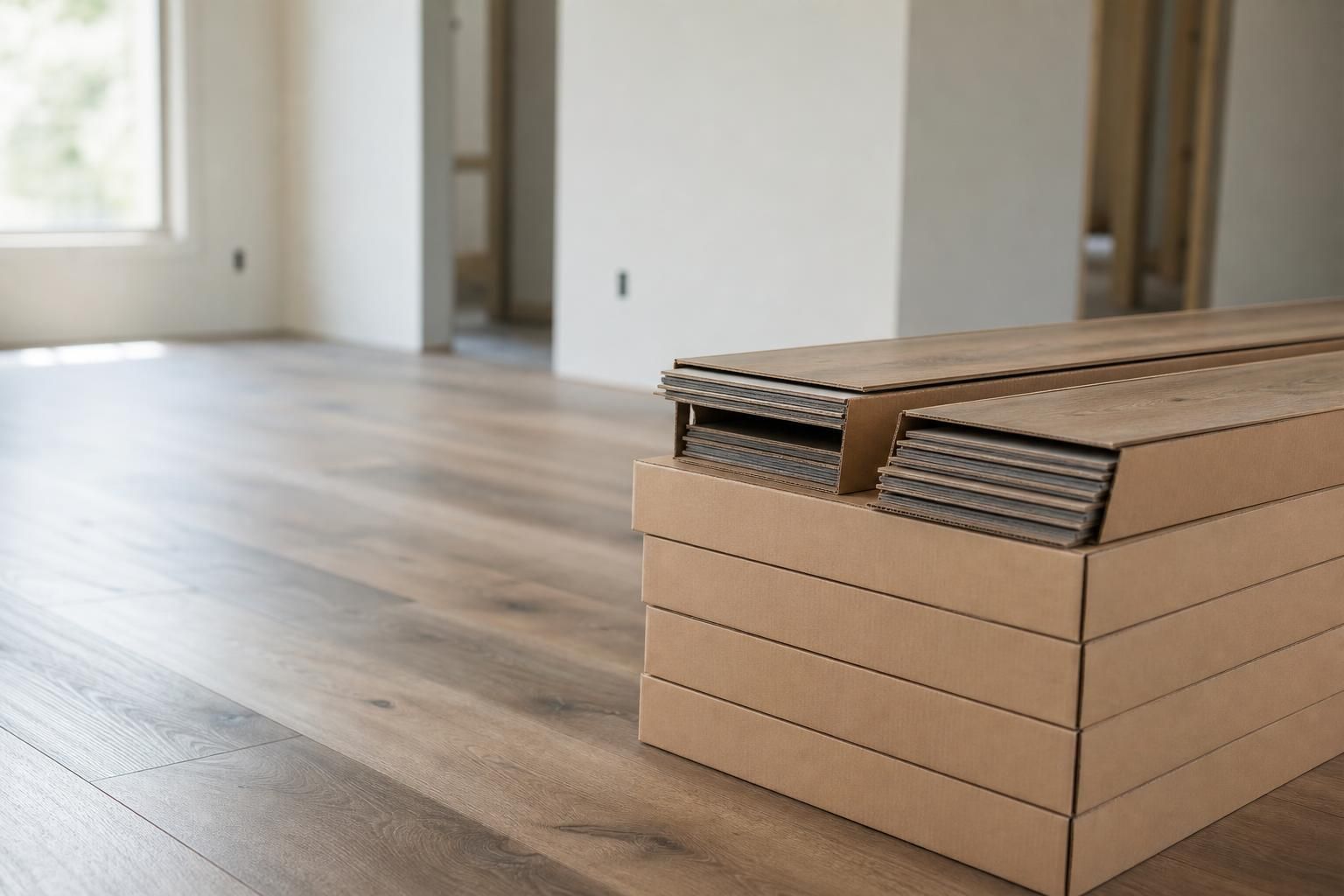
Most waterproof vinyl plank flooring is sold in boxes covering roughly 18 to 24 square feet, made up of individual planks typically measuring 7 inches by 48 inches or 9 inches by 60 inches. Box coverage depends on plank size, core type (WPC vs. SPC), and the manufacturer's packaging standard, so two boxes that look identical on a shelf can cover different square footage. Always check the coverage number printed on the box rather than assuming it matches a different product line.
Key takeaways
- Standard boxes cover 18-24 sq ft; always confirm the printed coverage before calculating how many you need.
- Order 10% extra for straight installs, 15% for diagonal or herringbone patterns, to cover cuts and waste.
- Boxes aren't sold as partial units, so round your total up to the next full box every time.
Common Plank Sizes and Box Coverage
Vinyl plank dimensions vary by collection, but a few formats dominate the residential market:
- 7" x 48" — a common mid-width plank, often packed 8-10 pieces per box for roughly 18-20 sq ft.
- 9" x 60" — a wider, longer "luxury" format popular for open floor plans, usually 6-8 pieces per box, covering closer to 20-23 sq ft.
- 6" x 36" — a shorter, narrower plank that reads more like traditional strip flooring, often boxed at 20-22 sq ft.
Thickness also factors in. Rigid SPC (stone polymer composite) core planks run anywhere from 4mm to 8mm thick with a wear layer between 12 and 20 mil, and denser cores mean heavier, sometimes slightly lower-coverage boxes compared to lighter WPC (wood polymer composite) products at the same square footage. If you're choosing between core types for a specific room, it helps to understand how click-lock and glue-down vinyl plank installation methods interact with thickness and core density before you commit to a box size.
Why Coverage Isn't Standardized Industry-Wide
There's no single mandated box size for vinyl plank flooring. Unlike lumber dimensions, which follow long-established milling conventions, resilient flooring packaging is set by each manufacturer based on plank size, pallet efficiency, and shipping weight limits. The National Wood Flooring Association publishes installation and acclimation guidance for wood and wood-look flooring broadly, and similar logic applies to vinyl: always use the coverage figure printed on that specific box, not a number remembered from a past project or a different brand.
This matters most when you're matching flooring across a remodel that spans several rooms purchased at different times — a mismatch in box coverage between an original order and a reorder is one of the more common reasons people come up short mid-install.
How to Calculate the Number of Boxes You Need
The math is straightforward once you have the room's square footage and the box's printed coverage:
- Measure the room's length and width in feet and multiply for total square footage.
- Add a waste factor — 10% for a simple rectangular room laid straight, up to 15% for diagonal, herringbone, or rooms with lots of angles and doorways.
- Divide that adjusted total by the box's coverage number.
- Round up to the next whole box, since suppliers don't split boxes or sell partial coverage.
A waste allowance exists because planks have to be cut to fit around walls, closets, and transitions, and those offcuts rarely reuse cleanly. If you're acclimating material before installation — which is standard practice for vinyl plank in Hawaii's humidity — ordering the full box count up front also means you're not waiting on a reorder mid-project. For more on that step, see how to acclimate vinyl plank flooring before installation.
Box Weight and Pallet Quantities
Box weight varies with core density, but a loaded box of rigid-core vinyl plank commonly falls in the 30-45 lb range. That's heavy enough that most homeowners move single boxes by hand but rely on a dolly or a second person for stacks of four or more. Contractors ordering pallet quantities should expect a standard pallet to hold several dozen boxes, with the exact count scaling by box size and core weight rather than a fixed number across every product line.
This is also where wholesale ordering starts to matter. H&W Flooring, for example, structures its contractor pricing in tiers — $2.79, $2.59, and $2.39 per square foot at the $5,000, $15,000, and $100,000 order thresholds — so the per-box cost drops as a job's total square footage climbs toward pallet- and truckload-scale orders.
Buying by the Box vs. Buying by the Pallet
For a single bathroom or bedroom, buying by the box is usually simplest — you calculate your need, round up, and pick up exactly that count. For a whole-home remodel or a contractor running several units at once, ordering by the pallet reduces per-box handling and often unlocks wholesale pricing tiers that per-box retail pricing doesn't offer.
If you're sourcing material locally rather than waiting on a mainland shipment, same-day stock availability changes how precisely you need to calculate up front, since a shortfall is a same-day fix rather than a weeks-long wait. For a closer look at sourcing options on the island, see this guide to the best place to buy vinyl plank flooring on Oahu.
What Else Affects Your Box Count
A few project details push your order higher than the basic square-footage math suggests:
- Pattern complexity — herringbone, chevron, and diagonal layouts waste more material than straight runs.
- Room shape — closets, bump-outs, and multiple doorways all generate extra cuts.
- Future repairs — keeping one or two extra boxes in storage means a matching repair later doesn't depend on the same dye lot still being in production.
- Multiple rooms, one order — buying all boxes from the same production run avoids subtle shade variation between batches.
If you're unsure how box count, underlayment, and labor all combine into a final number, a written quote should break each of those line items out separately. See what's included in a flooring installation quote for what that breakdown typically looks like.
Frequently Asked Questions
Q: How many square feet are in a typical box of vinyl plank flooring?
Most boxes cover between 18 and 24 square feet, though the exact number is printed on the box and varies by plank size and manufacturer.
Q: Can I return unopened boxes of vinyl plank flooring?
Return policies vary by seller, so check before ordering; buying from a local stock supplier typically makes exchanges faster than returning product shipped from the mainland.
Q: Why do box coverage numbers differ between brands?
Vinyl plank packaging isn't standardized industry-wide — manufacturers set box coverage based on plank dimensions, core thickness, and pallet shipping weight, so always use the coverage printed on the specific box you're buying.
Q: How much extra flooring should I order beyond the room's square footage?
A 10% overage covers a straightforward rectangular room laid in a standard pattern; complex layouts like herringbone or diagonal installs typically need 15% extra to account for cutting waste.
Q: Does plank thickness affect how many boxes I need?
Thickness doesn't change the square footage you need to cover, but it does affect box weight and sometimes the number of planks packed per box, which changes the printed coverage figure.