Click Lock vs. Glue Down Vinyl Plank: What's the Difference?
Key takeaway
Click lock vinyl plank snaps together along tongue-and-groove edges and floats over the subfloor without adhesive, while glue down vinyl plank is bonded directly to the subfloor with a troweled adhesive. Click lock installs faster and is easier to repair plank-by-plank; glue down creates a more rigid, lower-profile floor that handles rolling loads and large temperature swings better. The right choice depends on the subfloor, the room's moisture exposure, and whether a homeowner or a crew is doing the install.
Key takeaways
- Click lock floats over the subfloor and is the faster, more DIY-friendly option; glue down bonds permanently and suits commercial or high-traffic settings.
- Glue down tolerates more subfloor movement and holds up better under rolling carts, furniture castors, and heavy foot traffic.
- Installation labor for either method at H&W Flooring is from $8/sq ft, including demo of old flooring, leveling (incl. self-leveling material), and baseboard, with glue down typically taking longer per square foot due to adhesive spread and set time.
How Each System Actually Works
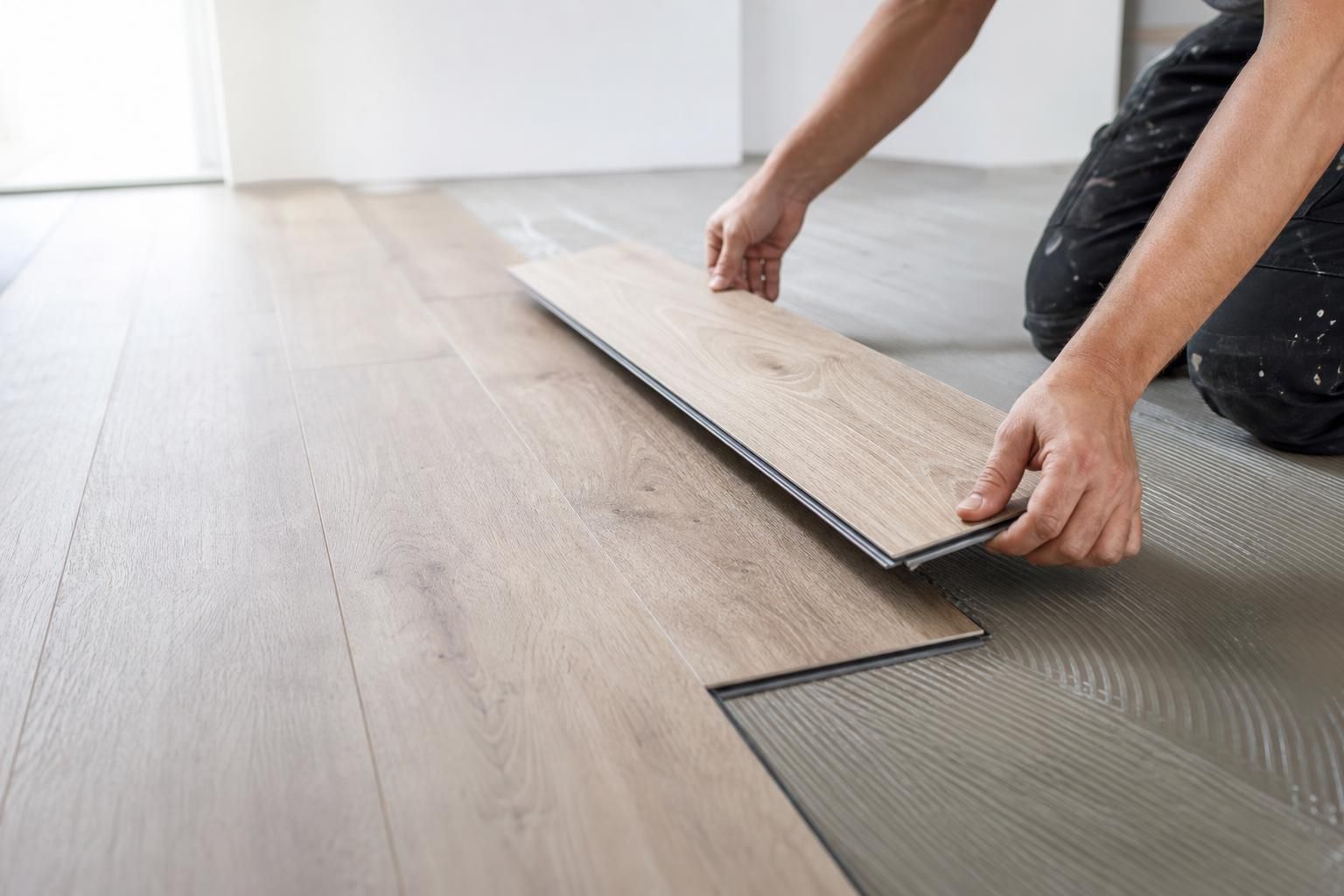
Click lock planks have a molded tongue-and-groove edge, often SPC rigid core, that locks mechanically to the next plank. The floor "floats" — nothing attaches it to the subfloor except gravity, trim, and friction, with a thin foam or attached underlayment absorbing minor imperfections. Glue down planks are flat-backed and require a full or perimeter spread of pressure-sensitive or wet-set adhesive, rolled with a floor roller to force full contact and eliminate air pockets.
The mechanical difference drives almost every other difference on this page: movement, repairability, subfloor tolerance, and sound.
Installation Speed and Skill Level
Click lock is built for speed. Planks snap together by hand, there's no adhesive open time to manage, and a room can be walked on immediately after the last board goes in. That's part of why click lock is the more common pick for homeowners weighing a DIY install against hiring a contractor — the margin for error is smaller and mistakes are easier to undo.
Glue down takes longer and rewards experience. The adhesive has to be spread with the correct trowel notch, the open time has to be respected before planks go down, and a roller pass is needed to set the bond. Rush any of those steps and planks can lift at the seams months later.
Moisture, Subfloor Movement, and Climate
Honolulu's humidity and the moisture that comes through ground-contact concrete slabs are relevant to both systems, but they respond differently.
Floating click lock floors can move slightly as a whole sheet in response to temperature and humidity swings, which is why expansion gaps at walls and transitions matter — see our guide on transitioning vinyl plank between rooms for how that's handled at doorways. Glue down floors don't move as a sheet because they're bonded to the substrate, which is one reason they're often specified in commercial spaces with big open floor plates.
Both systems rely on a waterproof wear layer and core rather than the installation method itself to resist moisture — that's a core-and-wear-layer question more than a click-vs-glue question, covered in our breakdown of vinyl plank performance in high-humidity climates.
Core Type and Which Method Fits
Core construction and fastening method are related but not identical choices:
- SPC rigid core: almost always click lock, because the rigid core holds the locking profile under foot traffic without flexing.
- WPC and flexible vinyl plank: available in both click lock and glue down versions, chosen based on the project.
- Glue down vinyl plank: typically a thinner, more flexible plank without a locking edge, relying entirely on the adhesive bond.
For a deeper look at how core material changes performance, see our comparison of SPC and WPC flooring.
Side-by-Side Comparison
| Factor | Click Lock | Glue Down |
|---|---|---|
| Installation method | Floats, mechanically locks together | Bonded to subfloor with adhesive |
| Typical skill level | Moderate — DIY-friendly | Higher — adhesive technique matters |
| Subfloor tolerance | More forgiving of minor imperfections | Needs a flatter, cleaner subfloor |
| Repair | Individual planks can often be replaced | Repairs usually require cutting out the plank |
| Best suited for | Residential rooms, condos, rentals | High-traffic, commercial, rolling-load areas |
| Installed cost | Installation from $8/sq ft (includes demo, leveling, baseboard) | Installation from $8/sq ft (includes demo, leveling, baseboard), often more labor time |
Repair and Longevity
A damaged click lock plank near a wall can sometimes be worked loose and swapped without disturbing the whole floor, because the locking mechanism allows disassembly in reverse order. A damaged glue down plank generally has to be cut out and a new piece glued in, since prying up a bonded plank risks damaging its neighbors.
Over the life of the floor, glue down tends to stay flatter and quieter underfoot in commercial traffic because it can't shift, while click lock floors are easier to pull up entirely for a full replacement later, since nothing is permanently bonded to the subfloor.
Cost Considerations
Material pricing for vinyl plank itself doesn't change dramatically based on click lock versus glue down — retail pricing runs $2.79 per square foot, with wholesale tiers for licensed contractors at $2.79, $2.59, and $2.39 per square foot depending on order volume. The cost difference shows up in labor and prep: glue down requires more subfloor prep (patching, grinding, priming) and more installer time per square foot, while click lock labor is faster per room but still benefits from a professional crew leveling and acclimating the subfloor correctly. Either way, professional installation at H&W Flooring is from $8/sq ft, including demo of old flooring, leveling (incl. self-leveling material), and baseboard, with demo of old flooring included.
Homeowners comparing bids should check what's actually included in the number — subfloor prep, trim, and transitions can be priced separately or bundled, which is covered in our article on what's included in a flooring installation quote.
Industry and Safety Notes
Adhesives used in glue down installation can carry volatile organic compounds (VOCs), and the U.S. Environmental Protection Agency recommends ventilating rooms during and after installation of adhesive-set flooring. Subfloor moisture testing before either installation method is typically done to a standard such as ASTM F710, published by ASTM International, which sets acceptable moisture vapor emission limits for resilient flooring installs.
Frequently Asked Questions
Q: Is click lock or glue down vinyl plank better for a condo?
Click lock is usually the better fit for a condo because it's faster to install, doesn't require extensive subfloor prep, and floats over minor slab imperfections common in older buildings.
Q: Can you glue down a click lock vinyl plank?
No — click lock planks are engineered with a locking tongue-and-groove edge and a backing meant to float; gluing them voids the locking function and isn't how the product is designed to perform.
Q: Which is more waterproof, click lock or glue down?
Neither installation method determines waterproofing on its own — that comes from the plank's core and wear layer. A fully glued seam can add a layer of water resistance at the edges, but a quality waterproof core performs similarly either way.
Q: Does click lock vinyl plank make noise when you walk on it?
A floating click lock floor can sound slightly hollower underfoot than a glued-down floor, especially over concrete, though attached underlayment pads reduce this. Glue down floors are bonded directly to the subfloor and tend to sound and feel more solid.
Q: How much does it cost to install glue down vinyl plank versus click lock?
Professional installation for either system at H&W Flooring is from $8/sq ft (including demo, leveling, and baseboard), but glue down jobs often take more labor hours per square foot due to subfloor prep, adhesive spread, and roller time.