Vinyl Plank Flooring Pros and Cons for Oʻahu Homes and Jobs
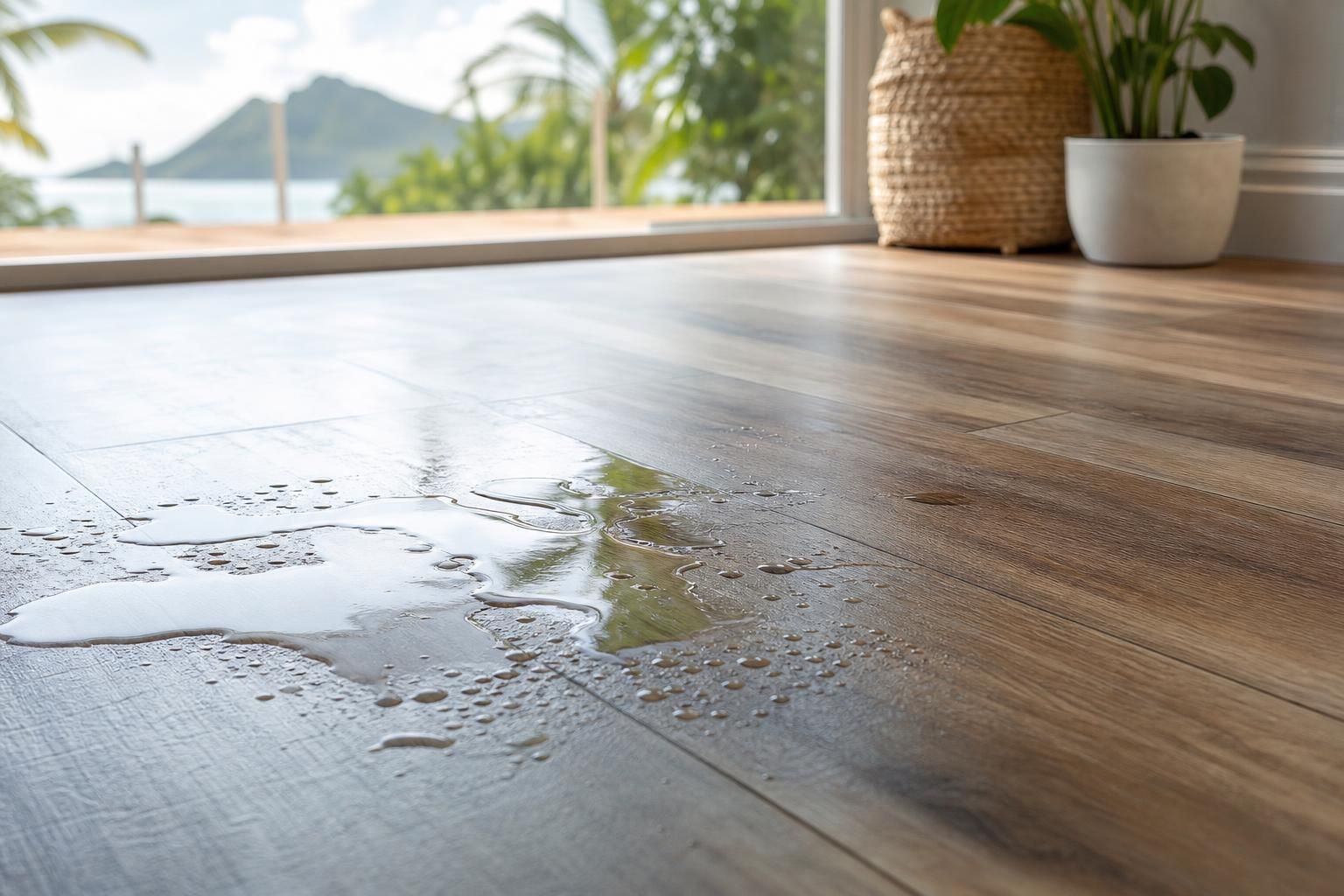
Key takeaway
Vinyl plank flooring's main advantages are that it's fully waterproof, holds up to Hawaiʻi's humidity and foot traffic without expanding or warping, and installs faster than tile or hardwood. Its main drawbacks are that it can't be sanded or refinished once worn, cheaper products dent under heavy furniture, and quality varies enormously between the $1-a-square-foot big-box stuff and a proper SPC (stone plastic composite) core. Whether it's the right call depends on the room, the traffic, and how long you plan to own the property.
Key takeaways
- True waterproof vinyl plank (SPC or WPC core) won't swell from moisture, making it a solid pick for kitchens, bathrooms, and ground-floor condo units in humid climates.
- It can't be refinished like hardwood — once the wear layer scratches through, the plank gets replaced, not sanded.
- Wear layer thickness (measured in mil) is the number that actually predicts how a floor holds up, not just "vinyl plank" as a category.
Where Vinyl Plank Flooring Earns Its Reputation
The biggest pro is moisture performance. Rigid-core vinyl plank — SPC in particular — is built with a limestone-composite core that doesn't absorb water the way laminate's wood-fiber core does. That makes it a realistic option for bathrooms, laundry areas, and lānai-adjacent rooms where humidity swings are constant on Oʻahu.
Other advantages worth naming specifically:
- Dimensional stability. SPC cores resist the expansion and contraction that plagues solid hardwood in humid, non-climate-controlled buildings — a real factor in older Honolulu walk-ups without central air.
- Installation speed. Click-lock vinyl plank goes down over a prepped subfloor without nailing, sanding, or finishing time, which shortens a remodel timeline compared to site-finished hardwood.
- Lower lifetime maintenance. No refinishing cycle, no wax, no periodic sealing the way some natural materials require.
- Underlayment options. Many rigid-core planks come with attached pad, which helps with sound and comfort underfoot in condo units where HOA rules often require impact-noise reduction between floors.
Where Vinyl Plank Comes Up Short
The trade-offs are real and worth stating plainly rather than glossing over.
- It can't be refinished. Hardwood can be sanded down and re-coated multiple times over its life. Vinyl plank's wear layer is fixed at manufacture — once it's scratched through in a high-traffic path, that plank gets swapped, not sanded.
- Wear layer thickness varies a lot. A residential-grade plank with a thin wear layer will show scuffs faster in an entryway or rental unit than one built for heavier traffic. This is the single most important spec to check, and it's rarely advertised prominently.
- Subfloor prep still matters. Vinyl plank telegraphs an uneven or debris-covered subfloor over time, so skipping demo and floor prep on a remodel — including tearing out old flooring, which H&W Flooring's installation rate already covers — tends to show up as visible flaws within a year or two.
- It's a synthetic material. Unlike solid hardwood or tile, it's petroleum-based, which matters to some buyers on principle even when off-gassing on quality products is minimal. The EPA's indoor air quality guidance is a reasonable starting point for anyone comparing flooring materials on that basis.
Waterproof vs. Water-Resistant: The Distinction That Actually Matters
"Waterproof" and "water-resistant" get used interchangeably in flooring marketing, and they shouldn't be. Water-resistant laminate can survive a spill wiped up promptly; it will still swell if water sits at a seam overnight. Waterproof SPC vinyl plank is built to handle standing water without the core swelling, which is why it's the more defensible choice for bathrooms, laundry rooms, and lānai transitions rather than laminate in those same spots.
This distinction is also where wear-layer and core-construction standards get tested. ASTM International maintains the test methods manufacturers use to rate abrasion resistance and indentation — the numbers behind marketing claims like "commercial grade."
Cost Shape: Retail vs. Wholesale
Pricing on vinyl plank is straightforward to compare once you know what's included. H&W Flooring publishes retail vinyl plank starting at $2.79 per square foot, with installation billed separately, from $8 per square foot, including demo of old flooring, leveling (incl. self-leveling material), and baseboard. Contractors buying in volume get tiered wholesale pricing — $2.79, $2.59, and $2.39 per square foot — with each tier unlocked at $5,000, $15,000, and $100,000 in purchase volume, with a further tier at $200,000. For anyone trying to understand why a materials quote looks different for a homeowner buying one room versus a contractor stocking multiple units, how contractor pricing works for flooring in Hawaii breaks down how those thresholds get applied.
Where This Fits Into a Larger Remodel
Vinyl plank rarely gets installed in isolation on a real job — it's usually one piece of a bathroom refresh, a condo turnover, or a whole-unit remodel that also involves demo, subfloor leveling, and sometimes wet-area waterproofing behind the walls. Contractors sourcing material for multiple units at once are dealing with a different set of questions than a single homeowner — lead times, stocking depth, and what counts toward a wholesale tier — which is covered in more detail in what wholesale flooring actually means for Hawaii contractors.
Climate Context: Why This Matters More in Hawaiʻi
Oʻahu's year-round humidity is higher and more consistent than most mainland markets, which is exactly the condition solid hardwood struggles with — expansion gaps, cupping, and finish stress over time. NOAA's climate data for the Hawaiian Islands documents the sustained humidity levels that make dimensionally stable, moisture-proof materials a more practical default here than in drier climates, independent of any particular brand's marketing.
Frequently Asked Questions
Q: Is vinyl plank flooring actually waterproof or just water-resistant?
Rigid-core vinyl plank built with an SPC or WPC core is genuinely waterproof — the core won't swell even under standing water. Vinyl products without a rigid core, or laminate marketed as "water-resistant," are a different tier and shouldn't be treated the same for wet-area use.
Q: Can vinyl plank flooring be refinished if it gets scratched?
No. Unlike solid hardwood, vinyl plank's wear layer is fixed at manufacture and can't be sanded down and recoated. A damaged plank gets replaced rather than refinished.
Q: How long does vinyl plank flooring typically last?
Lifespan depends heavily on wear layer thickness and traffic level rather than the vinyl plank category as a whole — a thin residential wear layer in a high-traffic entryway wears differently than a thicker commercial-grade product in a bedroom.
Q: Is vinyl plank a good choice for a Hawaii condo?
Yes, particularly rigid-core SPC, since it resists the humidity swings common in non-climate-controlled buildings and many products include attached underlayment that helps with the impact-noise standards some HOAs require.
Q: Does vinyl plank flooring cost less than tile or hardwood?
Material cost comparisons vary by product tier, but vinyl plank generally installs faster than tile or site-finished hardwood, which affects total project cost beyond the per-square-foot material price. Checking published installation rates alongside material pricing gives a more complete picture than comparing material cost alone.