Vinyl Plank vs. Epoxy Flooring: Which Fits Your Job?
Key takeaway
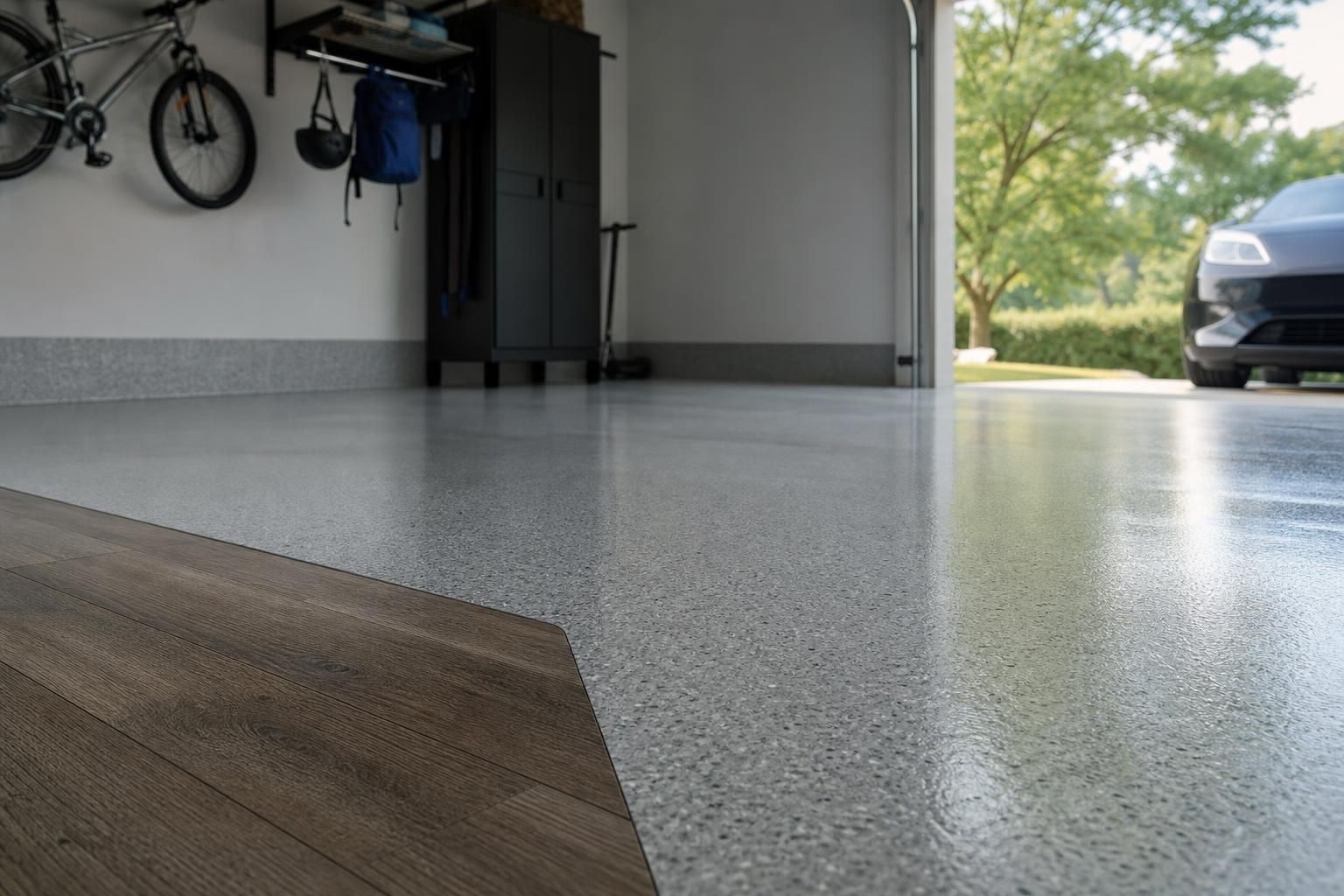
Vinyl plank flooring installs faster, tolerates humidity without special prep, and can be walked on the same day it's laid, while epoxy flooring forms a seamless, chemical-resistant coating bonded directly to concrete but needs days of cure time and a dust-controlled application. Choose vinyl plank for living spaces, rentals, and quick-turnaround units; choose epoxy for garages, warehouses, and floors that need to resist solvents, forklift traffic, or constant moisture exposure.
Key takeaways
- Vinyl plank is a floating or glue-down floor covering; epoxy is a liquid-applied coating bonded to the slab, so they solve different problems, not the same one.
- Epoxy needs a clean, dry, properly tested concrete substrate and multi-day cure windows before full use; vinyl plank from H&W can go down and be walked on the same day.
- For contractors bidding mixed-use or multi-unit jobs, H&W's wholesale pricing tiers make vinyl plank the more predictable per-square-foot cost on volume orders.
What each product actually is
Vinyl plank flooring is a rigid or flexible plank — often SPC (stone plastic composite) core — that locks together or glues down over an existing subfloor. It's a finished floor covering out of the box: no mixing, no cure time, no off-gassing period before move-in.
Epoxy flooring is a two-part resin system poured and troweled or rolled directly onto prepared concrete. It cures into a hard, seamless membrane rather than individual pieces. That seamlessness is the whole appeal in wet or chemical-exposed environments — there are no seams for liquid to find.
Cost shape: material plus labor, not just material
Vinyl plank pricing scales by square footage and volume. H&W Flooring publishes retail vinyl plank starting at $2.79 per square foot, with contractor-wholesale tiers at $2.79, $2.59, and $2.39 per square foot as order size crosses the $5,000, $15,000, and $100,000 thresholds. Installation runs from $8 per square foot, including demo of old flooring, leveling (incl. self-leveling material), and baseboard — so a contractor can build a full bid from published numbers rather than waiting on a quote.
Epoxy pricing works differently: it's driven by substrate prep (grinding, crack repair, moisture mitigation), the number of coats, and whether a broadcast or flake system is specified. H&W doesn't sell or install epoxy coatings, so that side of the comparison is better priced by a coatings specialist who can quote the actual prep work your slab needs rather than a flat rate.
Side-by-side comparison
| Factor | Vinyl Plank (SPC) | Epoxy Coating |
|---|---|---|
| Install method | Click-lock or glue-down over subfloor | Poured/rolled resin bonded to bare concrete |
| Time to use | Same-day walkable | Multi-day cure before light traffic, longer before heavy equipment |
| Moisture tolerance | Waterproof core, handles spills and humidity | Needs a dry, tested slab before application or it can fail to bond |
| Repair method | Replace individual planks | Patch and re-coat affected area; seams in repairs can be visible |
| Typical setting | Homes, condos, offices, retail floors | Garages, warehouses, industrial and lab floors |
| Underfoot feel | Slight give, warmer | Hard, cold, can be slick when wet unless textured |
Where vinyl plank wins the job
For residential remodels, condo turnovers, and most commercial interiors, vinyl plank is the lower-friction choice. It doesn't require the slab to be bone-dry before installation the way epoxy does, it can go over existing tile in many cases, and a crew can finish a room and have it in use the same afternoon. For a deeper look at how it performs over time, see how long vinyl plank flooring lasts before specifying it on a multi-year lease property.
Contractors running several units at once also get a cost advantage vinyl plank can offer that epoxy generally can't: volume pricing tiers. Ordering enough square footage to cross H&W's $15,000 or $100,000 thresholds drops the per-square-foot rate, which matters on multi-door jobs where margin is set at the bid stage, not after.
Where epoxy wins the job
Epoxy earns its place in garages, mechanical rooms, warehouse floors, and any space that sees vehicle traffic, chemical spills, or constant wet conditions like a commercial kitchen back-of-house. Its seamless surface resists staining from oil, solvents, and standing water in a way a seamed floor covering can't fully match. The tradeoff is substrate sensitivity — concrete has to be tested for moisture vapor emission before a coating is applied, commonly using methods referenced in ASTM International's standards for in-situ concrete moisture testing, or bond failures and bubbling can follow.
Epoxy application also requires attention to ventilation and curing conditions. Many epoxy systems release solvents during application, and the U.S. Environmental Protection Agency notes that products used indoors can affect indoor air quality while curing, which is part of why occupied spaces usually need to be cleared out during the work. Crews applying solvent-based coatings should also follow OSHA's guidance on ventilation and respiratory protection for coating application in enclosed areas.
Waterproofing is a separate question from floor covering
It's worth separating "waterproof floor covering" from "waterproofed wet area." Vinyl plank resists surface moisture and spills, but a bathroom or shower assembly still needs a proper waterproofing membrane underneath before any finish floor goes down — that's true whether you finish with vinyl plank, tile, or anything else. If a bathroom or wet-area remodel is part of the scope, waterproofing the substrate correctly matters more than which surface finish sits on top.
Ordering for a mixed-scope job
Some projects need both: epoxy in the garage or utility room, vinyl plank through the living space. On jobs like that, a contractor buying vinyl plank in volume should set up pricing ahead of the bid rather than per order. Opening a trade account with a flooring supplier locks in tiered pricing and confirms what's in stock before the schedule is set, which matters more on Oahu than on the mainland since reorders can't just ship overnight from a regional warehouse.
Frequently Asked Questions
Q: Is vinyl plank or epoxy flooring better for a garage?
Epoxy is generally the better fit for a garage floor because it forms a seamless coating that resists oil, solvents, and vehicle traffic. Vinyl plank can work in a garage used mainly for storage or a converted living space, but it isn't built for direct tire contact or chemical spills the way a coating system is.
Q: How long does epoxy flooring take to cure before you can use it?
Cure time depends on the specific resin system and manufacturer's data sheet, but epoxy generally needs a period of light-traffic-only time before it's walkable and a longer full-cure period before heavy equipment or furniture returns. Vinyl plank, by contrast, is typically walkable the same day it's installed.
Q: Can you install vinyl plank over an existing epoxy floor?
It depends on the condition and adhesion of the existing epoxy coating; a sound, flat, well-bonded epoxy surface can sometimes serve as a subfloor, but a failing or flaking coating needs to be addressed first. A flooring contractor should inspect the existing surface before specifying an install method.
Q: Does H&W Flooring install epoxy coatings?
No — H&W Flooring specializes in waterproof vinyl plank, SPC, laminate, hardwood, and tile, along with related remodel and waterproofing work, not epoxy coating systems. For epoxy, a coatings specialist who handles concrete prep and resin application is the better fit.
Q: Which option costs less per square foot?
Vinyl plank has a published, predictable per-square-foot cost — H&W Flooring lists retail vinyl plank from $2.79 per square foot with contractor-wholesale tiers as low as $2.39 per square foot on larger orders, plus installation from $8 per square foot, including demo of old flooring, leveling (incl. self-leveling material), and baseboard. Epoxy pricing varies more by job because it depends heavily on the condition of the existing concrete and how much prep work the slab needs.