Engineered Hardwood vs. Vinyl Plank Flooring: What's the Difference?
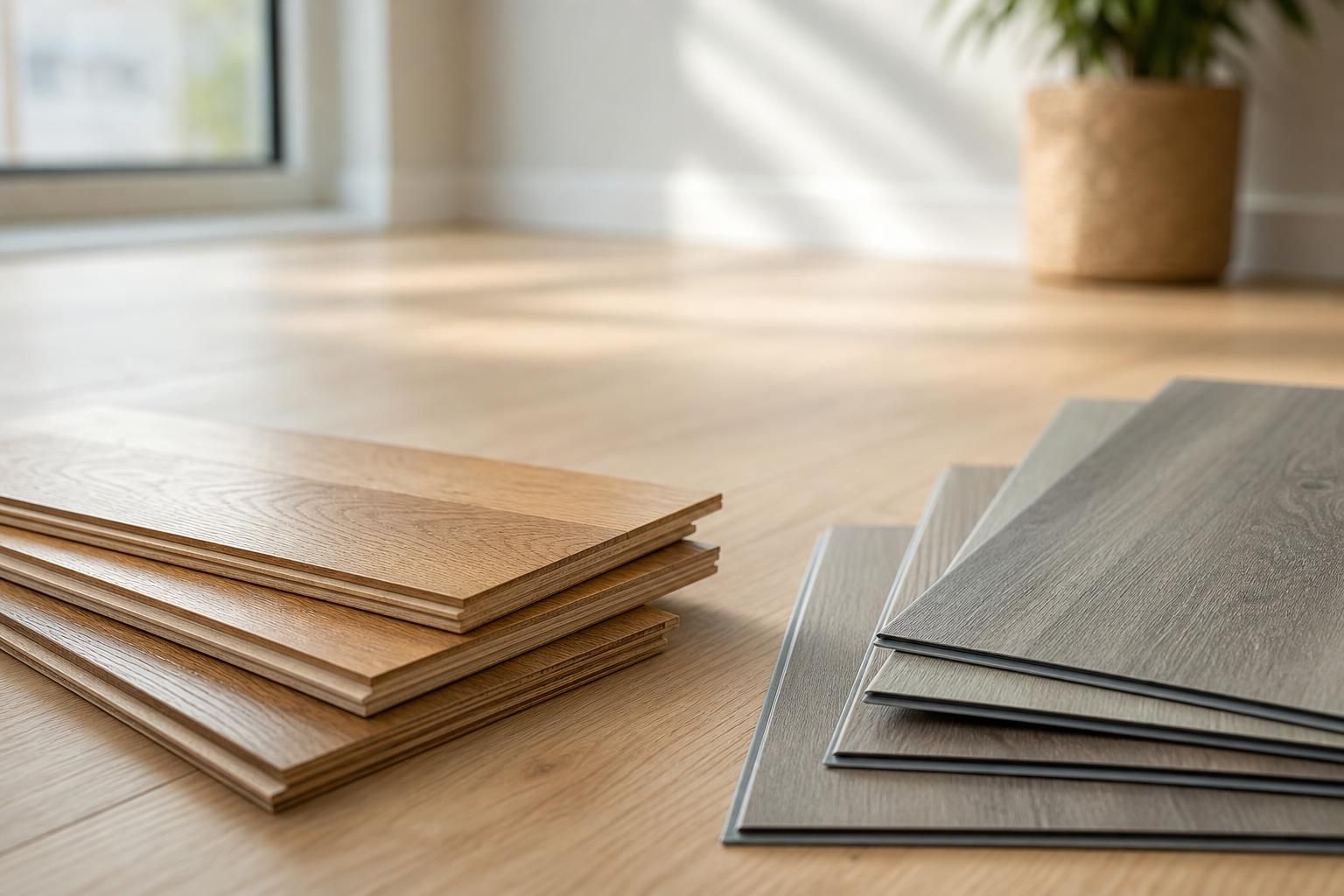
Key takeaway
Engineered hardwood is a real wood veneer bonded to a plywood or high-density fiberboard core, while vinyl plank is a fully synthetic product — often a rigid stone-plastic composite (SPC) core topped with a printed vinyl layer and a clear wear layer. The practical difference for Hawaii homes is water tolerance: engineered hardwood can handle occasional moisture better than solid wood but will still swell or delaminate if it stays wet, while vinyl plank is built to sit in standing water indefinitely without damage. That single distinction drives most of the cost, maintenance, and room-by-room decisions below.
Key takeaways
- Vinyl plank (especially SPC core) is waterproof and rated for bathrooms, laundry rooms, and ground-floor slabs; engineered hardwood is moisture-resistant, not moisture-proof.
- Engineered hardwood can be lightly sanded and refinished once or twice depending on veneer thickness; vinyl plank cannot be refinished and is replaced plank by plank instead.
- H&W Flooring publishes vinyl plank at $2.79 per square foot retail, with wholesale tiers at $2.79, $2.59, and $2.39 per square foot as contractor order volume increases.
How Each Product Is Actually Built
Engineered hardwood construction is standardized enough that the National Wood Flooring Association defines it as multiple layers of wood veneer, plywood, or HDF cross-layered under a hardwood wear layer — the cross-layering is what keeps it more dimensionally stable than solid wood in a humid climate. The wear layer thickness (often measured in millimeters) determines how many times it can be sanded down and refinished before you hit the plywood core.
Vinyl plank and SPC are a different animal entirely: a rigid core (stone-plastic or wood-plastic composite), a printed decorative film that mimics wood grain, and a urethane or aluminum-oxide wear layer on top. There's no wood content at all, which is why it doesn't expand and contract with humidity the way engineered hardwood can.
Water and Humidity Performance in a Hawaii Climate
Indoor humidity swings and occasional water exposure — a leaking washer, a slow bathroom leak, storm intrusion — are routine maintenance issues in island homes, and the EPA's guidance on indoor moisture control notes that sustained moisture against building materials is what drives mold growth, not a single spill. Engineered hardwood's plywood core resists humidity better than solid hardwood, but standing water for more than a few hours can still cause the veneer to cup or the layers to separate.
Vinyl plank and SPC don't have that failure mode. They're the standard choice for bathrooms, laundry closets, lanai-adjacent rooms, and condo units on slab foundations where a moisture barrier isn't always guaranteed. That's also why bathroom and wet-area waterproofing work often gets specified alongside vinyl plank rather than hardwood in a remodel scope.
Cost and How the Pricing Is Structured
| Engineered Hardwood | Vinyl Plank / SPC | |
|---|---|---|
| Water tolerance | Moisture-resistant, not waterproof | Fully waterproof core |
| Refinishing | Sandable once or twice (veneer-dependent) | Not refinishable; replace planks instead |
| Feel underfoot | Warmer, more "real wood" flex | Firmer, cooler, very stable |
| Best rooms | Living rooms, bedrooms, dry areas | Bathrooms, kitchens, condos, whole-home |
| Retail starting price | Varies by product, not published here | $2.79/sq ft, per H&W Flooring |
| Contractor wholesale tiers | Not applicable at this scale | $2.79 / $2.59 / $2.39 per sq ft, per H&W Flooring |
Where a specific engineered hardwood price isn't published by a supplier, it's more useful to describe the shape of it than to guess: hardwood pricing tends to scale with wood species, veneer thickness, and finish, and it's typically quoted per box rather than a flat per-square-foot rate. Vinyl plank pricing is simpler to compare because it's usually sold at one published rate per square foot regardless of style.
H&W Flooring's wholesale tiers step down as order size grows, with breakpoints at $5,000, $15,000, and $100,000 in order value, dropping to $2.39 per square foot at the top tier — a structure worth understanding before bidding a multi-unit job, and it's laid out in more detail in how contractor pricing tiers work. Installation runs from $8 per square foot, including demo of old flooring, leveling (incl. self-leveling material), and baseboard, published by H&W Flooring directly.
Durability and Maintenance Over Time
Engineered hardwood scratches and dents more easily than a good vinyl wear layer, and once the wear layer is gone, repair means sanding (if there's enough veneer left) or replacing the board. Vinyl plank's wear layer resists scuffs well in normal residential traffic, and because planks click together rather than glue down as one continuous surface, a damaged plank can often be swapped without redoing the whole floor.
Neither product needs waxing or the periodic refinishing cycle that solid hardwood does. Engineered hardwood should still avoid standing water and excessive humidity swings; vinyl plank just needs regular sweeping and the occasional damp mop.
Which One Moves Faster on a Job Site
For contractors managing tight schedules, stock availability often matters as much as the product spec. Vinyl plank and SPC are commodity products that suppliers can hold in volume on Oahu for same-day pickup, while engineered hardwood is frequently a special-order item tied to a specific mill run or finish batch. If a job depends on same-day or next-day material to keep a crew moving, that's a real scheduling variable worth asking about before the product is even chosen — a distinction covered in more depth in what wholesale flooring actually means for a contractor buying at volume rather than by the box.
For a full remodel that touches multiple rooms — say, converting a condo from hardwood-look flooring in the living areas to a fully waterproof product throughout — the flooring choice usually gets folded into a broader scope that includes demo, subfloor prep, and trim work, which is where a remodeling contractor's typical process becomes relevant alongside the material decision itself.
Frequently Asked Questions
Q: Is engineered hardwood waterproof like vinyl plank?
No. Engineered hardwood is more moisture-resistant than solid hardwood because of its cross-layered plywood core, but it isn't rated for standing water or constant humidity the way a vinyl or SPC product is.
Q: Can vinyl plank be installed over a concrete slab?
Yes, vinyl plank and SPC are commonly installed directly over concrete slabs, which is one reason they're favored for condo units and ground-floor rooms in Hawaii where a wood subfloor isn't present.
Q: Which option costs less to install?
Installation labor for vinyl plank is often more predictable because it clicks together without nailing or extensive sanding; H&W Flooring publishes vinyl plank installation from $8 per square foot, including demo of old flooring, leveling (incl. self-leveling material), and baseboard.
Q: Do contractors get a different price than homeowners?
Yes. Wholesale pricing for licensed contractors is typically tiered by total order volume rather than a flat rate — H&W Flooring's tiers move from $2.79 down to $2.39 per square foot as order size crosses set thresholds.
Q: Can either flooring type be refinished if it gets scratched?
Engineered hardwood can be lightly sanded and refinished a limited number of times depending on how thick the top veneer layer is. Vinyl plank cannot be sanded or refinished; a scratched or damaged plank is typically pulled and replaced instead.