Waterproof Flooring: What Oahu Buyers Need to Know
Key takeaway
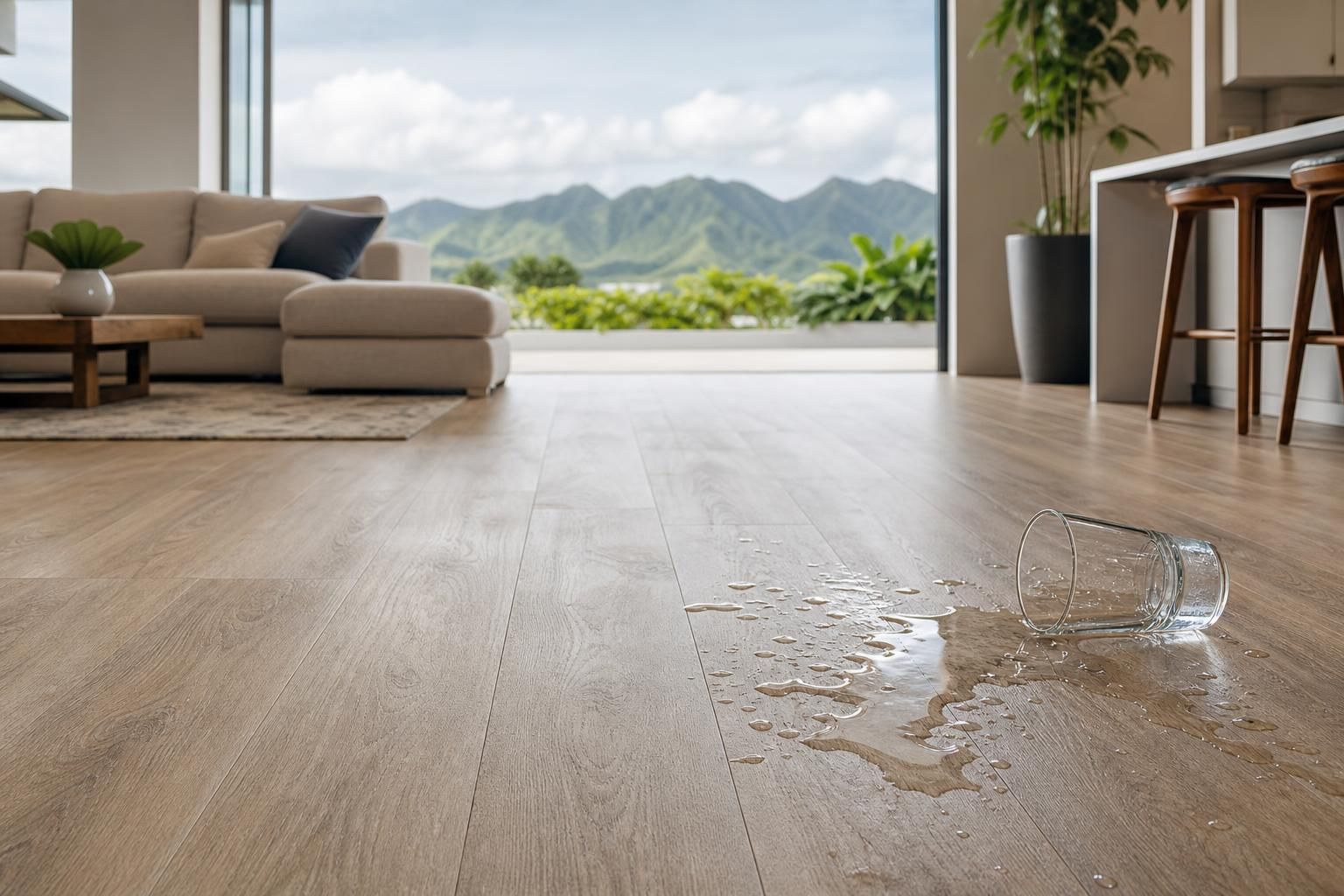
Waterproof flooring, in practical terms, means the plank itself has a rigid core — usually SPC (stone plastic composite) — that won't swell, delaminate, or warp if it sits in standing water, unlike laminate or engineered wood, which are only water-resistant at best. For Oahu homes, that distinction matters most in bathrooms, kitchens, laundry rooms, condo units above ground floor, and anywhere lanai doors let rain track indoors. The core material, not the surface layer or the marketing label, is what determines whether a floor actually survives a spill, a leak, or a slab moisture issue.
Key takeaways
- "Waterproof" requires a rigid SPC or WPC core — laminate and engineered hardwood are water-resistant at the surface only, not waterproof through the plank.
- H&W Flooring prices in-stock waterproof vinyl plank at $2.79 per square foot retail, with installation from $8 per square foot, including demo of old flooring, leveling (incl. self-leveling material), and baseboard.
- Contractors buying in volume move onto wholesale tiers of $2.79, $2.59, and $2.39 per square foot as order size crosses $5,000, $15,000, $100,000, and $200,000.
What Makes a Floor Actually Waterproof
The term gets used loosely, but there's a real construction difference behind it. Laminate flooring has a wood-fiber core (HDF or MDF) wrapped in a water-resistant coating — it can handle a spilled glass of water wiped up promptly, but standing water at a seam will swell the core within hours. Waterproof vinyl plank and SPC flooring use a compressed limestone-and-PVC core instead of wood fiber, so there's nothing organic in the plank to absorb moisture and swell. That's the mechanism, not just the label. For a side-by-side on how these cores actually differ in daily use, see vinyl plank vs. laminate flooring.
Tile and natural stone are also fully waterproof at the material level, but the vulnerability shifts to the grout lines and the substrate underneath — which is why bathroom failures are almost always a waterproofing-membrane problem, not a tile problem. A guide to bathroom flooring choices covers that distinction in more detail.
Where It Matters Most in Hawaii Homes
Oahu's building stock has a few conditions that make waterproof cores worth the premium over standard laminate:
- Slab moisture — many single-wall and post-war homes sit on slab foundations that can wick moisture upward, especially near plumbing runs, which is a known failure point for wood-fiber-core products.
- Condo units — HOA rules often require a moisture barrier and sometimes waterproof-rated flooring specifically because a failed floor in a unit can mean water intrusion into the unit below.
- Lanai and entry transitions — sliding doors and covered lanais bring in rain and salt air moisture that standard laminate wasn't built to handle at the threshold.
- Rental and multi-family units — property managers favor SPC because a tenant's spill or a slow leak doesn't turn into a full-room tear-out.
SPC vs. WPC: The Two Waterproof Cores
Both are considered fully waterproof, but they perform differently underfoot:
- SPC (stone plastic composite) is denser and more rigid — better for high-traffic areas, dents less under furniture, and handles subfloor imperfections without telegraphing them through the surface.
- WPC (wood plastic composite) has a slightly softer, more cushioned feel and is a bit quieter, but is less common in commercial and rental settings because it's less impact-resistant.
A full breakdown of core construction, wear layers, and where SPC fits against other resilient flooring is in what SPC flooring actually is.
What Waterproof Flooring Costs on Oahu
H&W Flooring publishes retail pricing on waterproof vinyl plank at $2.79 per square foot, with installation priced separately, from $8 per square foot, including demo of old flooring, leveling (incl. self-leveling material), and baseboard. Where a room needs old flooring removed first, demo is already included in the installation rate. That's the retail path for a homeowner doing a single room or a condo unit.
Contractors buying at volume move to a different pricing structure entirely. H&W Flooring's wholesale tiers step down as order size increases — $2.79 per square foot, then $2.59, then $2.39 — with the tier thresholds set at $5,000, $15,000, $100,000, and $200,000 in order value. That structure rewards committing to a bigger order rather than requiring a long-term contract, which matters for contractors bidding jobs where the flooring line item swings the whole estimate. The mechanics of how those tiers get assigned are covered in how contractor pricing works in Hawaii.
Where a project needs an exact total, price it by the square footage of the actual room plus waste factor rather than working from a rule-of-thumb number — box coverage and waste percentage vary by plank size and layout.
Stock and Lead Time: Why It Matters More Here Than on the Mainland
Waterproof vinyl plank shipped from the mainland typically means a freight lead time measured in weeks, which is a real constraint when a bathroom is torn out and unusable or a rental unit is sitting vacant. Suppliers that stock inventory on Oahu remove that variable — a contractor or homeowner can pick up in-stock product the same day rather than scheduling a job around a shipping container's arrival. That's a meaningful scheduling advantage on an island where every product either comes by container ship or gets held at a distribution point before reaching a local warehouse. For a look at how that same-day pickup process actually works, see same-day flooring pickup in Honolulu.
Waterproofing Wet Areas Beyond the Plank Itself
A waterproof core doesn't waterproof a bathroom on its own — the seams, transitions, and the area around drains and tubs still need a proper membrane or sealant system underneath, especially in a full wet-area remodel rather than a straight plank swap. The U.S. EPA's guidance on moisture and mold prevention notes that trapped moisture behind or under flooring, not the flooring surface itself, is the primary driver of mold growth in residential remodels — which is why a waterproof plank installed over an improperly sealed subfloor can still trap moisture problems beneath it. Flooring standards for resilient products, including wear-layer and dimensional-stability testing, are set through bodies like ASTM International, which manufacturers reference when rating a product's performance claims.
Frequently Asked Questions
Q: Is vinyl plank flooring actually 100% waterproof?
Vinyl plank with an SPC or WPC rigid core is waterproof at the plank level, meaning standing water won't cause the core to swell or delaminate. The installation still needs proper sealing at seams, walls, and transitions to keep water from reaching the subfloor underneath.
Q: What's the difference between water-resistant and waterproof flooring?
Water-resistant flooring, like standard laminate, has a wood-fiber core that will swell if water sits on it for an extended period. Waterproof flooring uses a stone-composite or plastic-composite core that has no organic material to absorb moisture at all.
Q: Does waterproof flooring cost more than regular vinyl or laminate?
It typically costs somewhat more than basic laminate because of the rigid core construction, though pricing varies by brand and wear layer thickness. H&W Flooring lists in-stock waterproof vinyl plank at $2.79 per square foot retail as a reference point for Oahu pricing.
Q: Can waterproof vinyl plank go directly over a concrete slab?
Yes — SPC and WPC plank are commonly installed over slab, which is one reason they're popular in Hawaii's slab-foundation homes, though the subfloor still needs to be flat and clean per the manufacturer's installation instructions.
Q: Do contractors get a different price than homeowners on waterproof flooring?
Yes. Suppliers that serve both markets, like H&W Flooring, typically price homeowners at a set retail rate and offer contractors tiered wholesale pricing that drops as order volume increases, usually verified through a trade account rather than a one-time purchase.