Is Vinyl Plank Flooring Good for Stairs?
Key takeaway
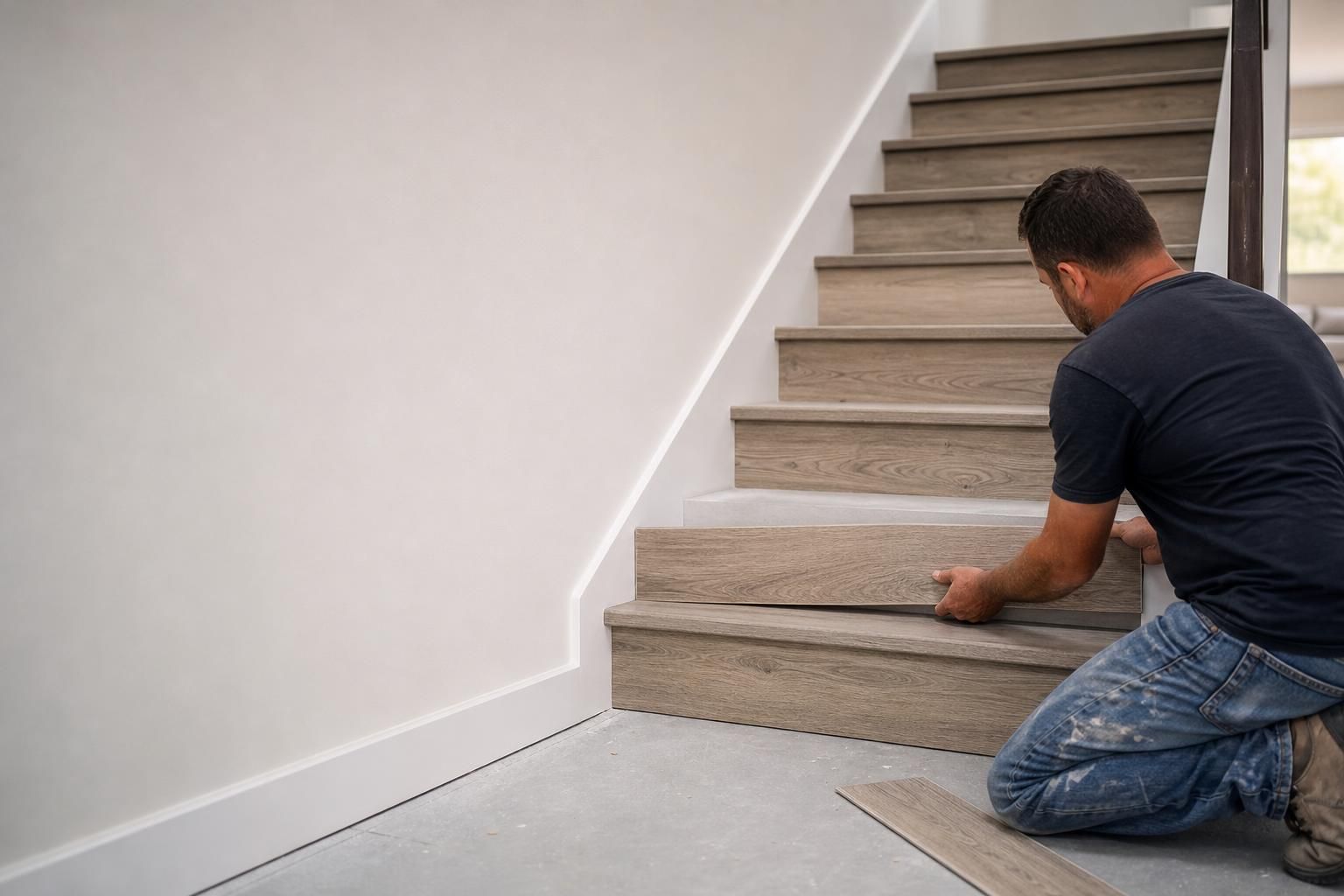
Yes, waterproof vinyl plank flooring works well on stairs, but only certain products and installation methods hold up — rigid-core (SPC) vinyl plank, fully adhered rather than floating, is the right choice, and every step edge needs to be finished with a stair nosing profile. Standard click-lock planks are designed to float as one connected sheet across a flat room, and that locking system comes apart under the concentrated foot traffic and vertical edge impact a stair tread takes, which is why plain plank-on-a-stair jobs fail first at the nose of each step.
Key takeaways
- Use rigid SPC core vinyl plank, glued or fully bonded to the tread, not floating click-lock planks, on stairs.
- Cap every step edge with a matching stair nosing profile — an exposed cut plank edge is the first thing to chip or peel.
- Stair installation is priced and planned differently from flat-floor installation because of the per-step cutting, mitering, and nosing work involved.
Why Floating Click-Lock Planks Fail on Stairs
Floating vinyl plank floors rely on the whole field of planks locking together and expanding or contracting as one unit across an open room. A stair tread is a narrow, isolated piece of substrate with no neighboring planks to lock into on three sides, and it takes direct downward and shear force every time someone steps on the nose of it. Without a full-spread adhesive bond to the substrate, the plank lifts, the locking joint separates, and the exposed front edge starts to chip within months. That's a mechanical issue with how the product is built, not a durability complaint about waterproof vinyl in general.
Choosing the Right Vinyl Plank for Stairs
Rigid core vinyl plank — SPC, or stone plastic composite — is the category built for this job because its dense, dimensionally stable core holds its shape under glue-down installation and resists denting on a tread edge better than a flexible WPC or standard LVT product. For a stair job you also want a wear layer thick enough to handle concentrated point traffic at the leading edge of each tread, since that's where shoes land hardest and where scuffing shows first. A stocked, in-stock SPC plank lets a contractor or homeowner match stair treads to the same lot used on the adjoining floor without waiting on a reorder, which matters on a job where even one mismatched box is visible at the top landing.
Stair Nosing Is the Detail That Makes or Breaks the Job
Stair nosing is the pre-formed trim piece that wraps the front edge and underside lip of each tread, and it's not optional on a vinyl plank stair install — it's the only thing protecting the cut edge of the plank from the impact of a heel strike. Residential nosing profiles typically project slightly past the riser below to give a visual and tactile edge, a detail building codes also address for safety reasons: the International Code Council sets limits on tread nosing projection and uniformity because inconsistent stair dimensions are a documented tripping hazard. The Consumer Product Safety Commission tracks stair falls as one of the most common home injury categories, which is part of why getting nosing height, projection, and slip resistance right on a stair remodel isn't just a cosmetic choice.
Subfloor Prep Is Different on Stairs Than on Flat Floors
Flat-floor vinyl plank installs often involve self-leveling compound to flatten dips in a subfloor before the planks go down. Stair treads don't work that way — each tread is its own small, rigid platform, usually plywood or OSB over the stringers, and it needs to be solid, void-free, and fastened tight before any adhesive or plank touches it. A squeaky or slightly loose tread will telegraph through vinyl plank just as it would through any other hard-surface flooring, so re-securing treads to the stringers is typically part of stair prep rather than a separate line item.
What Stair Installation Costs on Oahu
H&W Flooring's installation pricing starts from $8 per square foot for flat flooring, and that figure already includes demo of the old flooring, leveling (including self-leveling material), and baseboard — it's a single all-in number, not a base price with add-ons. Stairs don't fit neatly into a flat square-footage rate because labor scales with the number of steps, the tread depth, and how much mitered nosing and riser work each step needs, so stair pricing is quoted per project rather than assumed from a flat-floor rate. On the material side, H&W's regular retail price for waterproof vinyl plank is $3.99 per square foot, with a limited-time Black Friday promotional price of $2.49 per square foot — either way, buying the same lot number for treads and the adjoining room avoids a visible color break at the top of the stairs.
Wholesale Pricing for Contractors Doing Stair Work
Contractors bidding stair-and-remodel jobs in volume can get tiered wholesale pricing from H&W Flooring, available to verified, Hawaii-licensed contractors on request and scaled by order volume rather than a flat per-box rate. Because the flooring and matching nosing trim are stocked on Oahu, a contractor can pick up what a job needs the same day instead of waiting on a mainland shipment for a specialty nosing profile mid-project — a common bottleneck on stair remodels where the trim piece is the long-lead item, not the plank itself.
Frequently Asked Questions
Q: Can you put click-lock vinyl plank on stairs?
Not reliably. Click-lock planks are designed to float as a connected field across a room, and a stair tread is an isolated piece that takes direct edge impact, so the lock joints tend to separate at the nose within months. Glue-down rigid-core SPC plank with proper stair nosing is the standard approach instead.
Q: Is vinyl plank flooring slippery on stairs?
A smooth vinyl surface can be slicker underfoot than carpet, especially when wet, which is why many stair installations pair vinyl plank with a textured or grooved stair nosing profile rather than a flush, smooth edge. Checking the manufacturer's slip-resistance rating on the specific plank and nosing combination is worth doing before installing on stairs.
Q: Do I need special trim for vinyl plank on stairs?
Yes — stair nosing designed for the plank's thickness is necessary on every step to cover and protect the cut front edge. Without it, the exposed edge of the plank chips and peels from repeated foot impact.
Q: How much does it cost to install vinyl plank on stairs?
Stair installation is quoted per project rather than as a flat per-square-foot rate because labor scales with the number of steps, tread depth, and nosing work involved, unlike flat-floor installs which start from $8 per square foot all-inclusive. Getting an exact figure requires a step count and a look at the existing stair substrate.
Q: Does a vinyl plank warranty still apply on stairs?
Warranty terms can differ for stair applications since treads see more concentrated wear than open floor area, so it's worth checking the specific product warranty before buying plank for a stair job rather than assuming flat-floor coverage carries over.