What to Ask a Flooring Contractor Before Hiring
Key takeaway
Before hiring a flooring contractor, ask them to verify their Hawaii contractor license, explain exactly what their price per square foot includes (demo, leveling, baseboard), confirm who physically installs the floor, and show you in-stock material so you know your real timeline. A contractor who can't answer these clearly in the first conversation usually can't back it up later with a written quote.
Key takeaways
- Verify any contractor's license yourself on the Hawaii DCCA license search before signing anything.
- Ask whether the quoted installation price is truly all-in — demo, leveling, and baseboard are the line items most often added back later.
- Find out if your own crew will install the floor or if the job gets handed off to day labor you never meet.
Confirm the license and insurance, not just the sales pitch
Any contractor doing flooring or remodel work in Hawaii for pay should be able to produce a current license number on request. You don't have to take their word for it — the Hawaii Department of Commerce and Consumer Affairs maintains a public license search where you can look up a contractor's license status, classification, and any disciplinary history before you hand over a deposit. Ask for the license number up front and check it yourself; a legitimate contractor won't hesitate.
Separately, ask about insurance coverage. A contractor should be able to state their general liability coverage amount and whether they carry workers' compensation for their crew, and provide a certificate of insurance if your HOA or property manager requires one. "Fully insured" should mean something specific, not just a phrase on a business card.
Ask exactly what the per-square-foot price includes
This is where most flooring quotes get vague, and vagueness is where costs creep in later. Ask directly: does the quoted price include removal of the old flooring, floor leveling or self-leveling compound if the subfloor is uneven, and new baseboard? Some installers quote a bare labor number and then add these as "surprise" line items once the job starts.
H&W Flooring, for example, quotes installation from $8 per square foot as a single number that already includes demo of the old floor, leveling (including self-leveling material where needed), and baseboard — not as separate add-ons. Whatever contractor you're talking to, ask them to confirm in writing whether their number works the same way, because a cheaper-looking quote that excludes leveling or haul-away often ends up costing more once those are tacked on. If you're budgeting for a full unit rather than one room, it's worth comparing that line-item breakdown against what a condo flooring replacement typically runs in Honolulu so you know if a quote is in the right range before you commit.
Ask about material pricing and whether it's published
A contractor who sells flooring as well as installs it should be able to tell you a retail price per square foot without hedging. For reference, retail waterproof vinyl plank commonly runs around $3.99 per square foot at set-price suppliers, with occasional limited-time promotions — H&W Flooring, for instance, has run a Black Friday promotion at $2.49 per square foot as a short-term discount, not a permanent price. If a contractor refuses to quote a number and only offers "it depends" without explaining what it depends on (box count, grade, finish), that's worth pressing on.
If you're a licensed contractor buying in volume rather than a homeowner doing one room, ask whether the supplier offers trade or wholesale pricing. Legitimate wholesale pricing is usually tiered by order volume and limited to verified, licensed contractors — if a "wholesale" price is offered to anyone who asks with no verification step, be skeptical of how real that discount actually is.
Ask who is actually going to install your floor
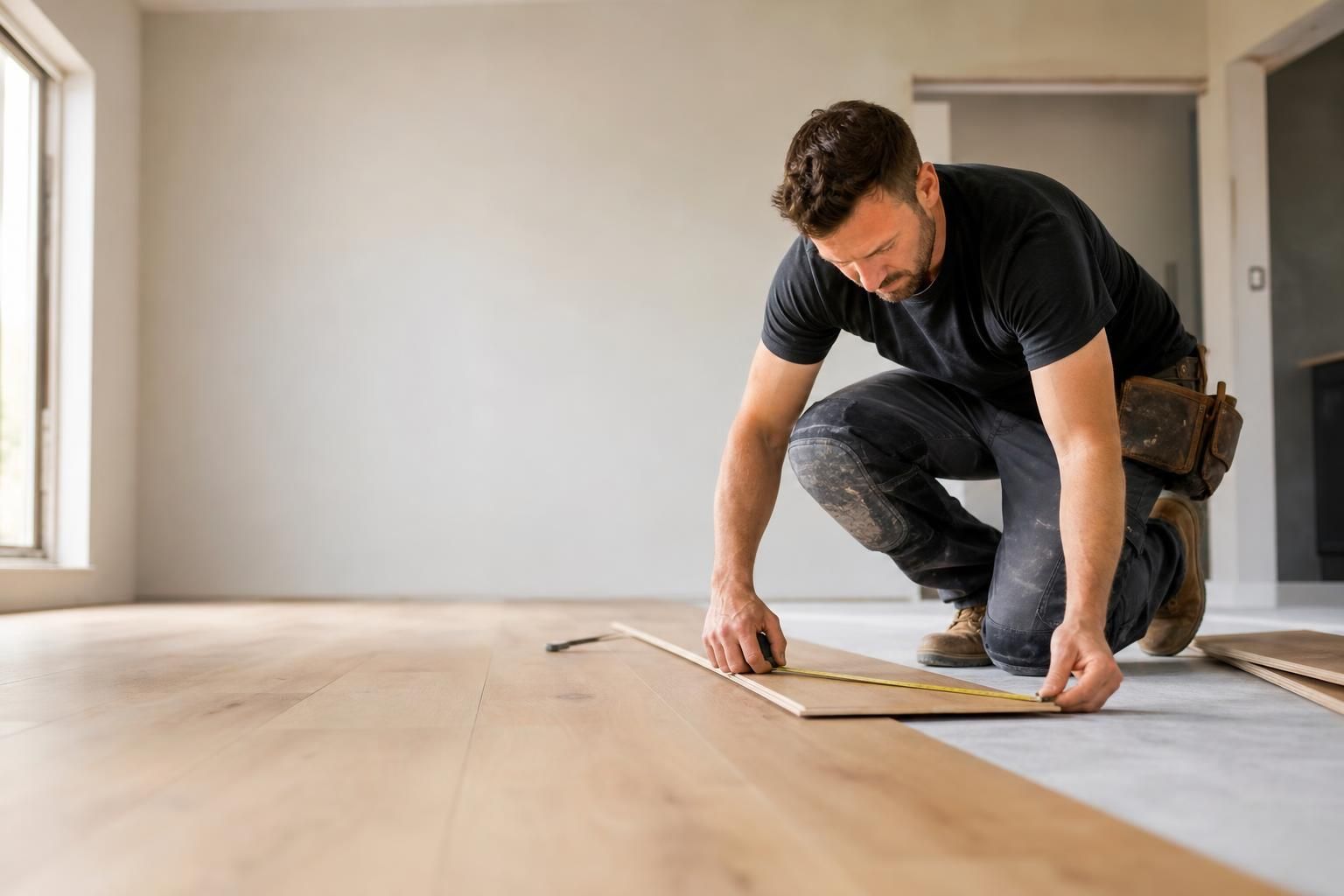
This is the question homeowners skip most often, and it matters more than almost anything else. Ask plainly: "Will your own crew install this, or will it be subcontracted out to day labor?" A company that owns its installation — where the people measuring, cutting, and fitting your floor are the same people the owner supervises directly — tends to be more accountable than one that bids the job out to whoever's available that week. Ask how installs are supervised and who you'd call if something needs to be redone.
This question matters even more in multi-unit buildings, where the wrong underlayment or fastening method can create noise complaints from the unit below. If you live in a condo, it's worth asking specifically how the crew handles sound transmission requirements between units, since many Oahu associations have specific impact-noise rules written into their house rules.
Ask about wet areas and moisture protection separately
Bathrooms, laundry rooms, lanais, and ground-floor slabs each have different moisture behavior, and a contractor should treat them differently rather than installing the same way everywhere. Ask what waterproofing method they use in wet areas, whether they test or account for slab moisture before installation, and how they handle transitions at shower curbs and exterior doors. The EPA's guidance on moisture and mold control notes that controlling moisture is the single most effective way to prevent mold growth indoors — which is exactly why wet-area prep deserves its own conversation, not a one-line mention in a general quote.
Ask about stock, lead time, and what happens if you need more material later
Ask whether the flooring you've chosen is in stock locally or has to be special-ordered from the mainland. This affects both your start date and your ability to get a matching box later if a plank gets damaged during move-in. A supplier that stocks material on Oahu can typically get you product the same day; one that special-orders may quote weeks of lead time, and dye-lot differences can make matching a replacement box difficult after the fact.
If you're still comparing materials rather than contractors at this stage, it helps to understand how rigid core vinyl plank differs from standard luxury vinyl before you ask for site-specific pricing, since the answer affects both cost and installation method.
Get the quote, warranty, and payment terms in writing
Before work starts, ask for a written quote and a timeframe for receiving it — a contractor should be able to commit to something concrete, such as delivering a written quote within 48 hours of a site visit, rather than leaving pricing verbal. Ask what the material warranty covers versus what the installer's workmanship warranty covers, since those are two separate things and failures get blamed on whichever one isn't covered. If you want a plain-language breakdown of what's typically included, understanding what a vinyl plank warranty actually covers is worth reading before you sign. Finally, confirm payment terms and ask about secure, easy payment options rather than handing over cash with no receipt.
Frequently Asked Questions
Q: What's the most important question to ask a flooring contractor before hiring them?
Confirm their Hawaii contractor license number and verify it yourself through the DCCA license search, since this single check filters out most problem contractors before you spend any more time evaluating them.
Q: Should I ask for a written quote, or is a verbal estimate enough?
Always get it in writing. A written quote should itemize material cost, installation cost, and what's included (demo, leveling, baseboard), and a credible contractor can typically turn one around within 48 hours of seeing the space.
Q: How do I know if an installation price is actually all-inclusive?
Ask directly whether demo of old flooring, subfloor leveling, and new baseboard are included in the per-square-foot labor price, or billed separately. If the contractor can't answer in one sentence, assume there will be add-ons later.
Q: Does it matter if the installer uses their own crew instead of subcontractors?
Yes — an in-house, owner-supervised crew generally offers clearer accountability than work handed off to day labor, since there's one point of contact responsible for quality from measurement to final walkthrough.
Q: What should I ask specifically for a bathroom or wet-area flooring job?
Ask what waterproofing method is used at the shower curb, floor drain, and wall transitions, and how the installer manages slab moisture before laying material, since wet areas require different prep than a bedroom or living room.