Soundproof Flooring for Condos in Hawaii: What Works
Key takeaway
The most reliable soundproof flooring for Hawaii condos is a rigid-core SPC waterproof vinyl plank installed over an attached or separate acoustic underlayment rated to meet the building's required Impact Insulation Class (IIC), typically IIC 50 or higher. No hard-surface floor eliminates footstep noise entirely, but the combination of a dense SPC core and a proper underlayment is what gets a unit past the condo association's review and keeps the downstairs neighbor from hearing every step.
Key takeaways
- Most Oahu condo house rules require a minimum IIC rating (commonly 50+) before hard flooring is approved over a concrete slab — get this number from your association in writing before buying material.
- SPC rigid-core vinyl plank with an attached or separately installed acoustic pad is the standard fix; carpet tile and cork are the only materials that typically outperform it for impact noise.
- Confirm underlayment compatibility and IIC documentation with your supplier before purchase — a box that isn't rated won't satisfy a board's paperwork even if it sounds quiet underfoot.
Why Condo Boards Care About IIC, Not Just "Sound"
Impact Insulation Class (IIC) measures how well a floor-ceiling assembly blocks impact noise — footsteps, dropped objects, dragged chairs — moving downward through a slab. It's a lab-tested rating defined by acoustic testing standards from bodies like ASTM International, and it's different from STC (Sound Transmission Class), which rates airborne noise like voices or music. A condo association that requires "IIC 50" is asking for a documented lab or field test result for the full assembly — slab, underlayment, and finish floor together — not just a claim on the flooring box.
This matters because many Hawaii condo buildings were built with bare concrete slabs and no acoustic mat between units, so the entire noise-reduction burden falls on whatever gets installed on top. Associations that skip this requirement tend to get noise complaints within the first year of a hard-surface remodel, which is why house rules have gotten stricter over the past decade.
What Actually Reduces Impact Noise in a Unit
Three things determine how quiet a hard floor is in a multi-story building:
- Core density and rigidity. SPC (stone plastic composite) vinyl plank is denser than standard WPC or flexible vinyl, which changes how it transmits vibration — denser isn't automatically quieter, but it responds predictably to underlayment, which is why installers pair it with a rated pad rather than relying on the plank alone. For a deeper comparison of core types, see our breakdown of SPC versus laminate durability.
- Underlayment. This is the layer that does most of the acoustic work — either factory-attached to the plank or installed as a separate rated pad before the floor goes down. Underlayment choice is the single biggest lever a homeowner controls, more than the plank brand or color.
- Perimeter isolation. A small acoustic gap at the wall line, covered by the baseboard, keeps the floor from transmitting vibration directly into the wall framing. This is a standard detail on any waterproof vinyl plank install and doesn't add a separate cost.
What Hawaii Condo Associations Typically Ask For
Before buying material, call your association's management office and get three things in writing:
- The minimum IIC rating required (commonly in the 50–55 range for mid-rise and high-rise buildings).
- Whether they require a manufacturer's lab test certificate, a field test after installation, or both.
- Any restrictions on underlayment thickness, since some buildings cap total floor buildup height at door thresholds and lanai transitions.
Skipping this step is the most common reason a condo remodel gets held up — not the flooring choice itself, but missing documentation. If you're also waterproofing a bathroom or lanai threshold as part of the same remodel, it's worth reviewing slip-resistant flooring options for wet areas at the same time, since both projects usually go through the same association approval.
Buying the Material: Retail vs. Wholesale
How you buy depends on who you are. A homeowner doing one or two units pays retail; a licensed contractor managing multiple condo remodels for an association or investor typically qualifies for volume pricing.
- Retail (homeowners): H&W Flooring's in-stock waterproof vinyl plank runs $3.99 per square foot at regular retail, with a limited-time Black Friday promotion at $2.49 per square foot. Installation is quoted from $8 per square foot, and that figure already includes demo of the old floor, leveling (including any self-leveling material the slab needs), and baseboard — there's no separate line-item for those steps.
- Wholesale (licensed contractors): Pricing is tiered by order volume and available to Hawaii-licensed contractors who verify their license, generally through DCCA's contractor license lookup. Tier pricing scales with how much flooring a contractor is ordering at once rather than a flat rate, so it's worth requesting a quote directly for a specific project size.
Because the material is stocked on Oahu, same-day pickup is possible — a real advantage on condo projects where a board has approved a tight installation window and waiting on a mainland shipment isn't an option.
Getting the Install Right
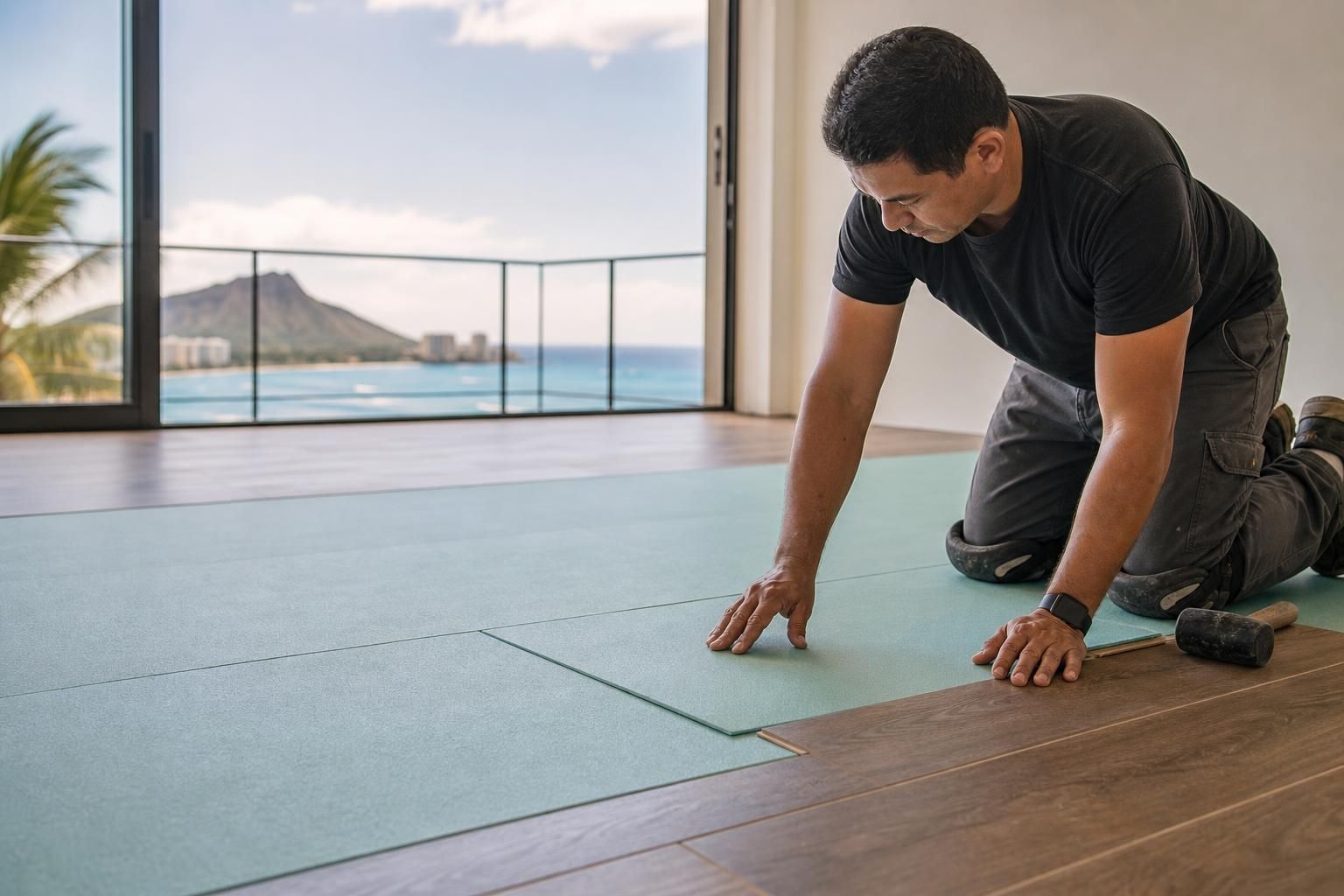
Even a correctly rated product underperforms if the subfloor isn't flat or the underlayment is seamed sloppily. Before any acoustic floor goes down, the slab needs to be checked for moisture and leveled — steps covered in more detail in how to prepare a home for flooring installation. Vinyl plank over concrete also raises moisture questions specific to condos on upper floors; if that's part of your planning, what a moisture barrier actually does is worth reading before you order material. An owner-supervised crew that handles demo, leveling, and underlayment as one sequence — rather than subcontracting each step separately — is generally what keeps the acoustic layer intact instead of getting punctured or compressed during install.
Frequently Asked Questions
Q: What IIC rating do Hawaii condos usually require for hard flooring?
Most mid-rise and high-rise condo house rules on Oahu set a minimum IIC rating somewhere between 50 and 55 for the finished floor-ceiling assembly. The exact number varies by building, so it should be confirmed with your association's management office in writing before purchasing material.
Q: Is vinyl plank actually quiet enough for a condo, or should I use carpet?
Rigid-core SPC vinyl plank paired with a rated acoustic underlayment can meet typical condo IIC requirements, though carpet and cork generally score higher on impact noise tests. Most condo owners choose vinyl plank anyway because it's waterproof and far more durable for daily living than carpet.
Q: Does the underlayment need to be purchased separately from the flooring?
It depends on the product — some vinyl plank comes with an attached acoustic pad, while other planks require a separate underlayment rolled out before installation. Either way, ask for the IIC documentation for the combined assembly, since that's what your condo association will want to see.
Q: Can I install soundproof flooring myself, or does it need a crew?
DIY installation is possible with click-lock vinyl plank, but acoustic performance depends heavily on a flat, properly leveled subfloor and tight underlayment seams, which is harder to get right without experience. An improperly leveled slab can create gaps under the underlayment that reduce its rated performance.
Q: Do contractors get a different price than homeowners on this type of flooring?
Yes — Hawaii-licensed contractors who verify their license can access tiered wholesale pricing that scales with order volume, separate from the standard retail price homeowners pay per square foot. Contractors typically need to request this pricing directly rather than see it published online.