Best Flooring for Condos on Oahu: What Actually Works
Key takeaway
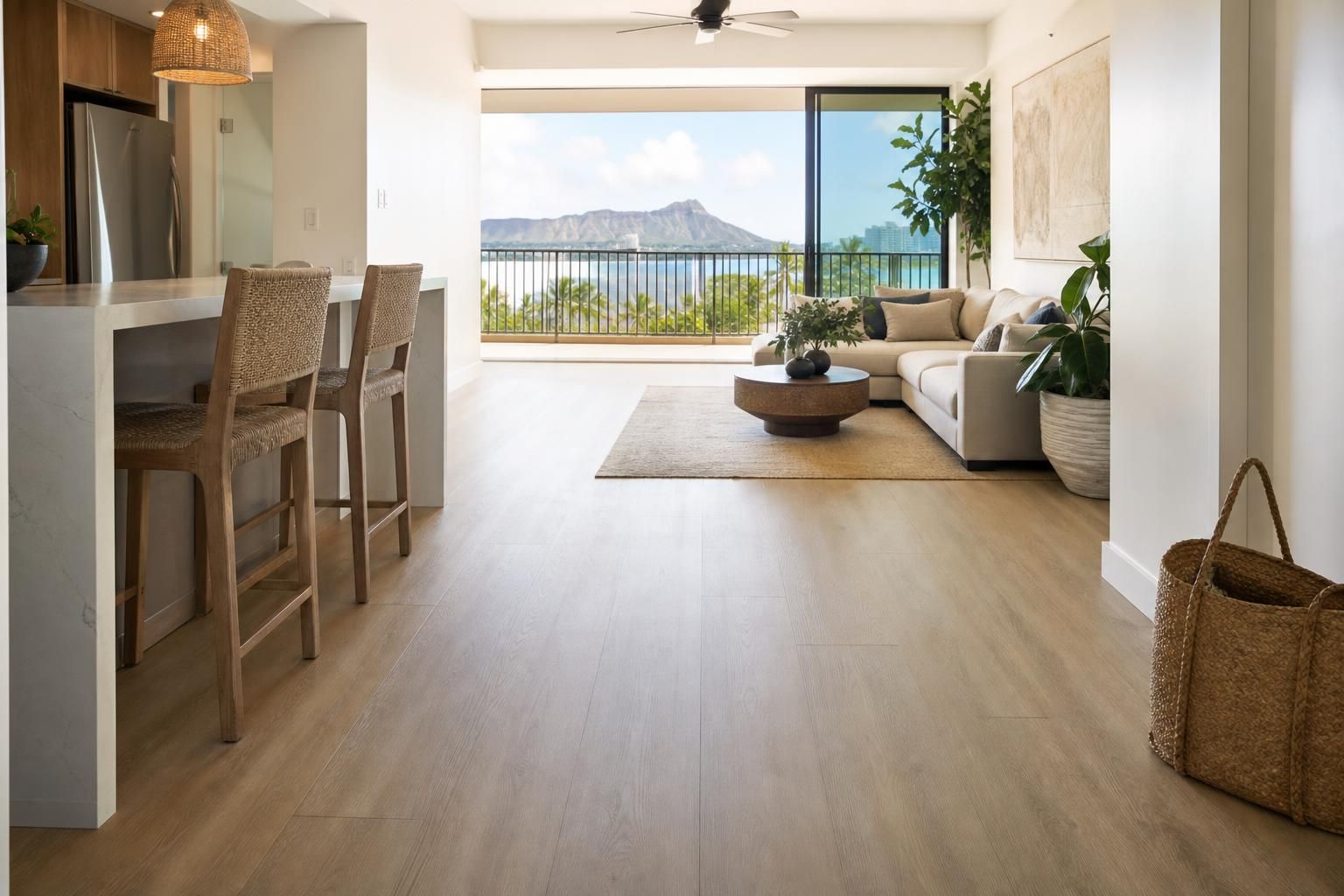
For most Oahu condo units, waterproof SPC (stone plastic composite) vinyl plank with an attached sound-rated underlayment is the best overall choice because it resists moisture on concrete slabs, meets the impact-sound requirements many AOAOs enforce, and doesn't add the weight or height build-up that tile or solid hardwood can. The right pick still depends on your building's house rules, your unit's slab condition, and whether you're renovating one unit or several.
Key takeaways
- Check your AOAO house rules for a minimum IIC/sound rating before buying anything — many Honolulu buildings require 50+ IIC and will reject a install without documentation.
- Waterproof vinyl plank with an attached pad handles concrete slab moisture and sound requirements in one product, and H&W Flooring stocks it on Oahu at $2.79/sq ft retail.
- If you're renovating multiple units for one owner or association, ask about contractor wholesale tiers before pricing it unit by unit — bulk purchasing changes the math.
Why Condos Are a Different Flooring Problem Than Houses
A single-family home owner picks flooring for looks and durability. A condo owner has to clear a third hurdle first: the building's association rules. Most Oahu high-rises built on concrete podium or slab construction have house rules restricting hard-surface flooring unless it meets a minimum Impact Insulation Class (IIC) rating, because footfall noise transmits through concrete far more than through a wood-framed house. Associations also commonly require a moisture-mitigation layer against the slab, since concrete can wick moisture upward for years after a building is finished — a known issue tracked by organizations like the EPA, which flags trapped slab moisture as a mold risk under any impermeable flooring installed without a vapor barrier.
That combination — sound rules plus slab moisture plus (in older buildings) weight limits on upper floors — rules out several flooring types that work fine in a house.
Comparing Flooring Types for a Condo Unit
| Flooring Type | Sound Performance | Moisture Resistance on Slab | Weight/Height Concern | Typical Fit for Condos |
|---|---|---|---|---|
| Waterproof SPC vinyl plank (attached pad) | Good to excellent with rated pad | Excellent — waterproof core | Low profile, low weight | Strong fit, most common choice |
| Laminate | Moderate, needs separate underlayment | Poor without a vapor barrier | Low weight | Workable if slab is sealed |
| Solid hardwood | Poor on concrete, rarely allowed | Poor — swells with slab moisture | Heavier, needs subfloor | Usually restricted by AOAOs |
| Ceramic or porcelain tile | Good (hard surface, dense) | Excellent | Heaviest option | Allowed but adds build-up height |
| Carpet with pad | Excellent | Fine if slab is dry | Lightest option | Allowed almost everywhere, less durable in wet areas |
What to Check Before You Buy Anything
Before ordering flooring for a condo, confirm these items with your AOAO or building manager:
- Minimum IIC/STC rating required for hard-surface flooring, and whether you need written documentation or a product spec sheet submitted for approval.
- Moisture mitigation requirements against the slab — some buildings specify a minimum-permeance underlayment or a liquid-applied vapor barrier.
- Weight restrictions, particularly in older towers, which can rule out thick tile set in a full mortar bed.
- Elevator and work-hour rules, which affect how fast a contractor can move material and debris, not the flooring choice itself but a real scheduling factor.
A rated underlayment under vinyl plank is usually the simplest way to satisfy both the sound and moisture requirements at once rather than layering separate products — see the breakdown of underlayment options for how pad thickness and density affect IIC ratings.
Why Waterproof Vinyl Plank Fits Most Condo Jobs
Waterproof vinyl plank — whether a flexible WPC core or a rigid SPC core — handles the three condo constraints better than most alternatives because the core itself doesn't absorb water, it installs as a floating floor without glue-down mess in a multi-unit building, and it comes in attached-pad versions engineered specifically for sound ratings. H&W Flooring sells waterproof vinyl plank at $2.79 per square foot retail, with installation priced separately, from $8 per square foot, including demo of old flooring, leveling (incl. self-leveling material), and baseboard, which lets a condo owner price the full job — flooring plus labor — before committing.
SPC in particular is worth understanding on its own terms if you're choosing between it and standard vinyl plank, since the rigid core changes how it performs under furniture and rolling loads common in condo living rooms and lanais — see this contractor's comparison of SPC and vinyl plank for the structural differences.
Bathrooms and Lanais Need Their Own Plan
Even with waterproof flooring throughout the main living space, condo bathrooms and covered lanais are wet areas that need proper waterproofing at the membrane level, not just a water-resistant floor surface. Standing water, grout lines, and drain transitions behave differently than open-room moisture. If your renovation includes a bathroom, treat it as a separate scope — what actually works for a Honolulu bathroom floor covers the waterproofing steps that matter before the finish flooring goes down.
If You're Renovating More Than One Unit
Investors and property managers handling several condo units — or contractors bidding association-wide renovations — are a different buyer than a single homeowner. H&W Flooring publishes wholesale pricing tiers for Hawaii-licensed contractors buying in volume, starting at $2.79 per square foot and stepping down to $2.59 and $2.39 per square foot at higher purchase thresholds. For a multi-unit job, pricing by unit instead of checking whether the total order crosses a wholesale threshold usually leaves money on the table.
Same-day pickup from Oahu stock also matters more at scale: a mainland-shipped order delayed by a few weeks can stall an entire building's renovation schedule when units are turned over on a tight timeline between tenants or sales.
Frequently Asked Questions
Q: What flooring do most Honolulu condo associations allow?
Most AOAOs allow waterproof vinyl plank, laminate, carpet, and tile, provided hard surfaces meet a minimum sound rating, typically expressed as an IIC score. Solid hardwood is the type most often restricted or banned outright because of poor sound performance on concrete slabs.
Q: Does vinyl plank flooring meet condo sound requirements?
It can, but only with the right underlayment — standard vinyl plank without a rated pad usually won't clear a building's minimum IIC score, while vinyl plank manufactured with an attached sound-rated pad is built specifically to meet those thresholds.
Q: Is tile a better choice than vinyl plank for a condo?
Tile performs well for moisture and sound but adds more weight and installed height than vinyl plank, which matters in older buildings with load limits or in units where floor height needs to match adjoining rooms without a step.
Q: How much does it cost to install vinyl plank flooring in a condo?
Material and labor are priced separately. H&W Flooring sells waterproof vinyl plank at $2.79 per square foot retail with installation from $8 per square foot, including demo of old flooring, leveling (incl. self-leveling material), and baseboard, so total cost scales directly with the square footage of the unit.
Q: Do I need a moisture barrier under vinyl plank on a condo slab?
Concrete slabs can retain moisture well after a building is finished, so a vapor-retarding underlayment or liquid-applied barrier is standard practice under vinyl plank in condo installations, even when the flooring itself is waterproof.