Best Flooring for a Home Gym: What Actually Holds Up
Key takeaway
The best flooring for a home gym is a waterproof, impact-resistant surface that won't crack or warp under dropped weights and sweat — for most Oʻahu homes, that means either rubber gym tiles over a vinyl plank subfloor or a commercial-grade SPC rigid core vinyl plank rated for heavy point loads. Carpet and standard laminate are poor choices because moisture and repeated impact break down the core material over time. The right pick depends on whether you're dropping barbells, running cardio equipment, or doing yoga and bodyweight work.
Key takeaways
- Rubber tiles (6–8mm) are still the standard directly under free weights; vinyl plank is better for the rest of the room and for resale value.
- Waterproof SPC vinyl plank handles sweat and humidity without swelling, unlike laminate or engineered hardwood.
- Installation cost for a gym-sized room runs on the same all-inclusive basis as any other room: demo, leveling, and baseboard included in one per-square-foot number.
What a Home Gym Floor Actually Has to Survive
A home gym floor deals with three stresses regular living-room flooring doesn't: repeated point-load impact from dropped weights, constant moisture from sweat and cleaning, and equipment that stays in one spot long enough to leave dents or discoloration if the surface can't handle sustained pressure. Cardio machines also vibrate, which over months can loosen poorly installed flooring or telegraph through a weak subfloor. The Centers for Disease Control and Prevention notes that strength training is recommended at least twice a week as part of a complete fitness routine — which for a home gym means the floor needs to tolerate that load pattern indefinitely, not just survive a few sessions.
Comparing the Top Flooring Options
| Flooring Type | Impact/Weight Resistance | Moisture Tolerance | Typical Feel Underfoot | Best For |
|---|---|---|---|---|
| Rubber gym tiles/rolls | Excellent | Excellent | Firm, slightly cushioned | Free weights, dropped barbells |
| SPC rigid core vinyl plank | Very good | Excellent (waterproof core) | Firm, floor-like | Cardio, general gym floor, multi-use rooms |
| Flexible/WPC vinyl plank | Good | Excellent | Slightly softer | Yoga, bodyweight, light equipment |
| Laminate | Poor to fair | Poor (swells at seams) | Hard | Not recommended for gyms |
| Carpet tile | Poor (crushes, traps odor) | Poor | Soft | Not recommended for weight areas |
Rubber still wins for a dedicated weight-lifting corner because nothing beats it for absorbing a dropped plate. But for the rest of a multi-use gym — a spin bike, a stretching area, a Peloton — a waterproof vinyl plank floor holds up better long-term and looks like a finished room instead of a garage. For a deeper breakdown of how rigid core construction resists dents and point loads, see what rigid core vinyl plank flooring actually is.
Why Waterproof Vinyl Plank Works for a Honolulu Gym Room
Hawaii's humidity is the main reason laminate and traditional hardwood underperform in a home gym here. Laminate's core is wood-fiber based, so it swells and the seams peak when it absorbs ambient moisture or sweat — a known failure mode that manufacturers' own installation guidance warns against for wet or humid rooms. Waterproof vinyl plank, by contrast, uses a solid polymer core that doesn't absorb water at all, which is why it's become the standard choice for Oʻahu bathrooms, laundry rooms, and now home gyms. If the gym is going into a converted garage or ground-floor slab room, it's worth understanding what a moisture barrier does under vinyl plank flooring before installation, since slab moisture is common in older Honolulu homes.
Rubber Mats vs. Vinyl Plank: Where Each One Belongs
- Under a squat rack or deadlift platform: rubber, 3/4" or thicker, laid loose or glued over the subfloor.
- Everywhere else in the room: vinyl plank, for a finished look that also works if the room later gets converted back to a bedroom or office.
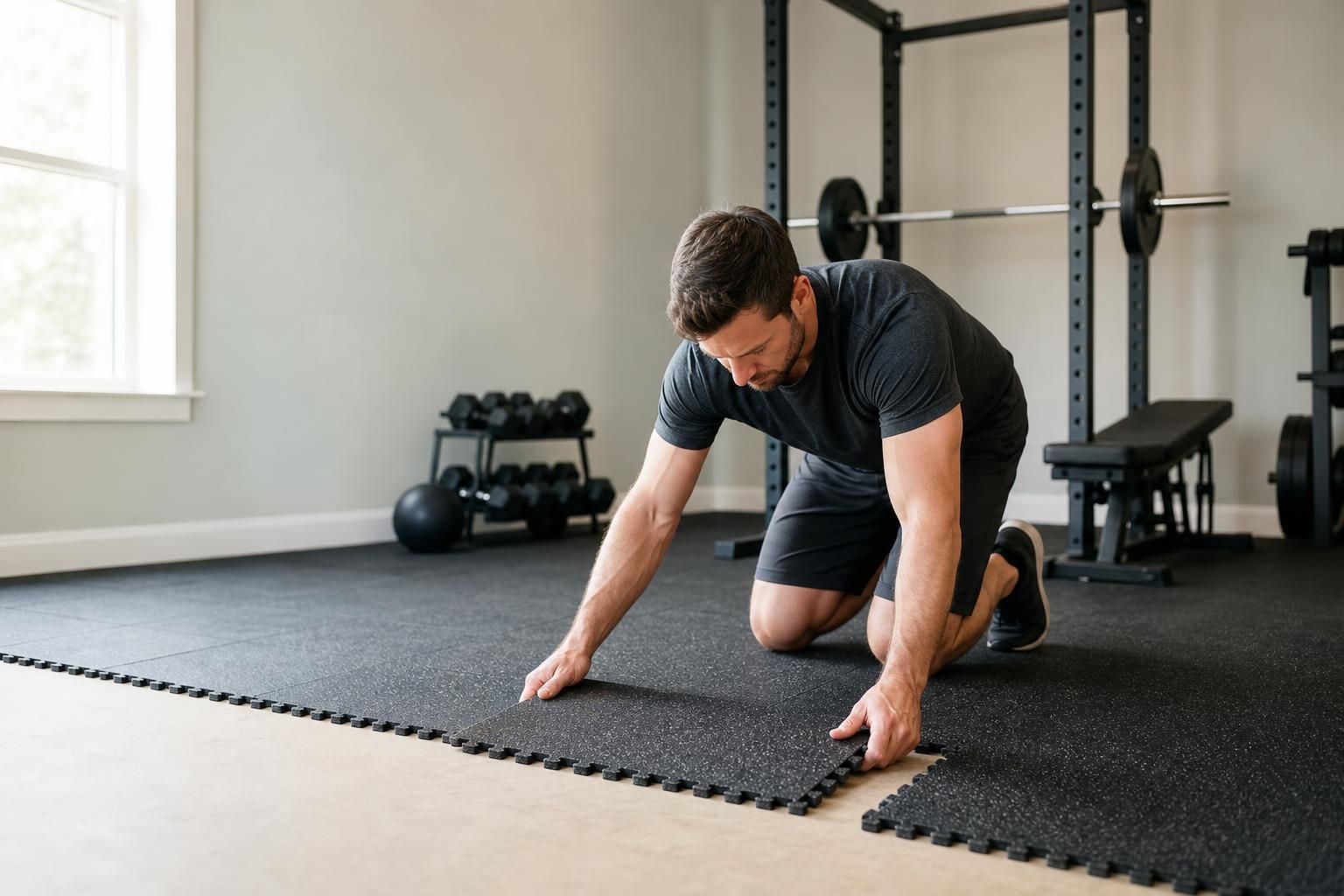
- Mixed installs: many Honolulu homeowners float rubber tiles on top of a permanently installed vinyl plank floor, so the rubber can be pulled up and repositioned as equipment changes without damaging the floor underneath.
- Sound and vibration: rubber dampens impact noise better, which matters in condos with neighbors below — a consideration covered in more detail in guides on condo flooring replacement in Honolulu.
Subfloor and Installation Considerations
A home gym floor is only as good as what's underneath it. Concrete slabs common in Honolulu single-family homes and condos need to be flat and dry before any waterproof vinyl plank goes down — the OSHA walking-working surfaces standard also points out that uneven flooring is a leading contributor to slip-and-fall injuries, which is exactly what you don't want in a room full of free weights and moving cardio equipment. That's why leveling is treated as part of the installation job, not an upsell: at H&W Flooring, installation is priced from $8 per square foot and that figure already includes demo of the old flooring, leveling with self-leveling compound where the slab needs it, and baseboard — so there's no surprise add-on once the crew finds an uneven spot.
What It Costs to Floor a Home Gym
Retail waterproof vinyl plank runs $3.99 per square foot at regular pricing, with H&W periodically running a Black Friday promotion down to $2.49 per square foot for a limited time. A contractor building out a commercial gym or a multi-unit property can request tiered wholesale pricing, which scales with order volume and is available to verified, Hawaii-licensed contractors — a structure worth understanding before you shop around, covered in what to look for in a flooring store with contractor pricing. For a typical home gym room, total cost is material plus the all-inclusive $8/sq ft installation rate, with no separate charges for prep work layered on top.
Frequently Asked Questions
Q: Can you put regular vinyl plank flooring under weight equipment?
Yes, if it's a rigid core (SPC) product rated for commercial or heavy residential use — the dense core resists denting under squat racks and dumbbell racks better than flexible vinyl. For a dedicated free-weight zone, most installers still recommend a rubber mat on top for impact absorption.
Q: Is laminate flooring okay for a home gym?
Not recommended. Laminate's wood-fiber core swells when exposed to sweat or spilled water, and the resulting peaked seams become a trip hazard over time.
Q: Do I need a moisture barrier under gym flooring on a concrete slab?
It depends on the slab's moisture levels and the specific vinyl plank product's backing — some rigid core products include an attached pad with built-in moisture protection, while others need a separate underlayment. A quick moisture test before installation settles the question either way.
Q: How much does it cost to floor a 300-square-foot home gym?
Using published rates, 300 square feet of waterproof vinyl plank at $3.99/sq ft for material plus $8/sq ft for installation works out to roughly $35 per square foot, or about $10,500 total before any promotional pricing is applied — and that installation figure already covers demo, leveling, and baseboard.
Q: Is rubber or vinyl plank better for a home gym floor?
Rubber is better directly under dropped free weights because of its shock absorption; vinyl plank is better for the rest of the room because it's easier to clean, doesn't trap odor, and holds up if the room is ever repurposed. Many gyms use both — rubber tiles over a vinyl plank base.