Can Vinyl Plank Flooring Be Used Outdoors in Hawaii?
Key takeaway
No — standard luxury vinyl plank is built for interior use and will warp, fade, or delaminate if installed on an open, sun-exposed lanai or pool deck in Hawaii. It can work on a fully covered, shaded lanai that stays dry and doesn't bake in direct sun for most of the day, but even then it's a compromise, not a true outdoor product. For genuinely outdoor areas, exterior-rated composite decking, porcelain pavers, or outdoor-specific vinyl tile are the safer long-term choice.
Key takeaways
- Direct sun and daily heat cycling will fade and expand vinyl plank faster than any interior wear it's rated for — it's not a UV-stable exterior product.
- A shaded, well-drained, covered lanai is the only outdoor-adjacent setting where vinyl plank has a realistic chance of holding up.
- For rain-exposed decks, pool surrounds, or anywhere water pools, choose a product actually rated for exterior wet exposure instead.
Why Interior Vinyl Plank Struggles Outdoors in Hawaii
Luxury vinyl plank, including rigid SPC core, is engineered to be waterproof against spills and humidity inside a house — not to survive constant UV radiation and the temperature swings of an open-air space. Vinyl is a thermoplastic, and plastics expand and contract with heat; a plank floor baking in direct Hawaii sun all day and cooling at night will expand and contract repeatedly until seams gap or planks start to bow at the edges. The wear layer and printed design layer are also not UV-stabilized the way true exterior products are, so color fading and chalking show up within a season or two of full sun exposure, according to general guidance from the Vinyl Institute, the industry group representing vinyl product manufacturers.
Hawaii's UV exposure is also simply more intense than most of the mainland locations these products are tested for. The National Weather Service regularly reports UV Index values in Honolulu in the "very high" to "extreme" range for much of the year, which is harder on exposed building materials — plastics included — than the moderate exposure assumed in typical flooring warranties.
Where It Might Actually Work: Covered, Shaded Lanai Space
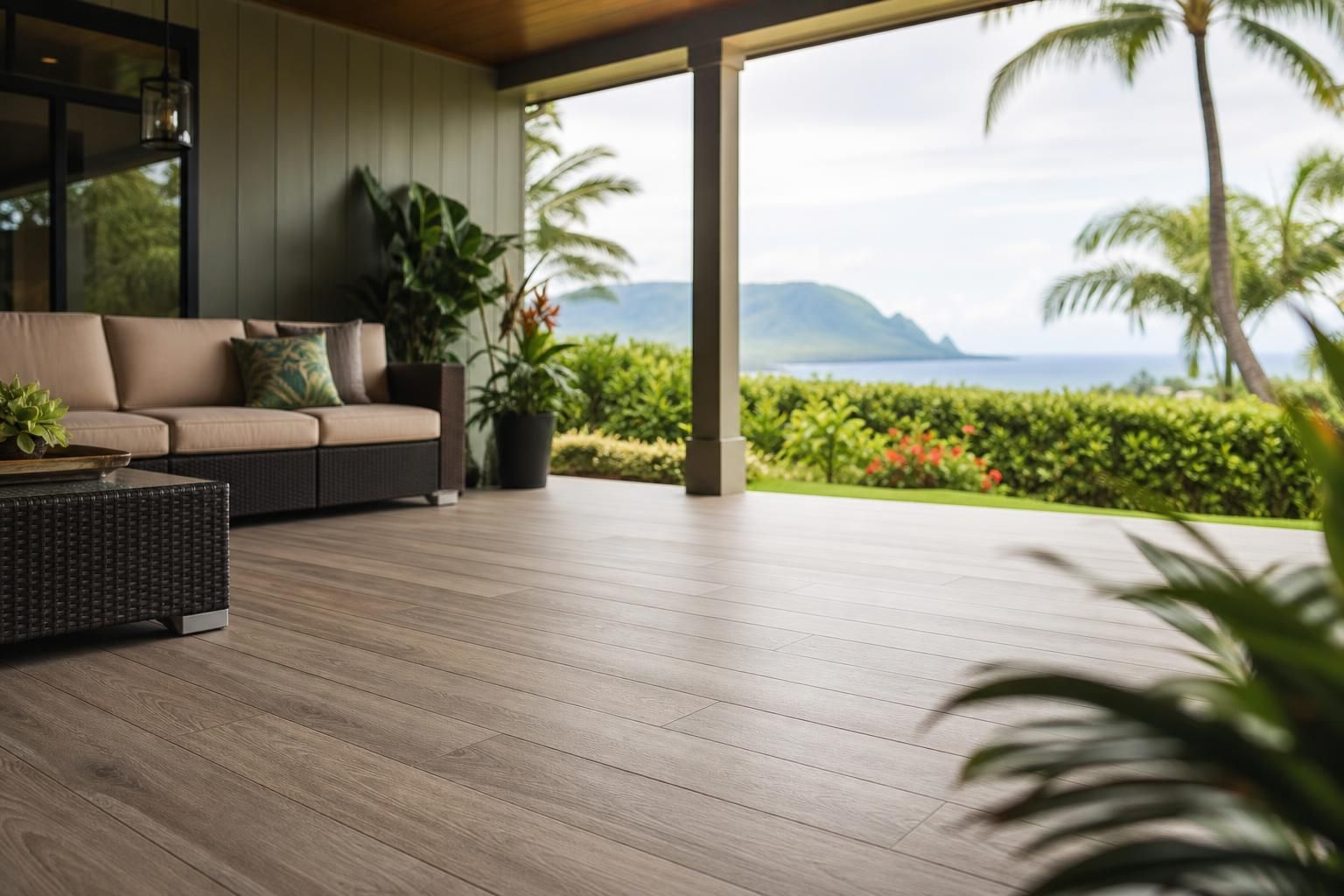
If a lanai is fully roofed, stays dry even during Kona-direction rain, and gets only filtered or indirect light, vinyl plank can sometimes hold up reasonably well — similar to how it performs in an enclosed porch. The key conditions:
- No direct standing water or pooling after rain
- No hours of direct afternoon sun hitting the surface
- A solid, flat subfloor so it can be installed the same way as an interior room
- Good airflow so humidity doesn't stay trapped against the underside
Even in these cases, it's worth treating it as a trial rather than a guarantee — manufacturers' warranties for interior vinyl plank typically exclude exterior or semi-exterior installations outright, so there's no fallback if it fails early. For homes where the lanai gets any real weather exposure, this guide on how to maintain vinyl plank flooring in a beach house covers the maintenance habits that extend the life of vinyl in salt-air, high-moisture settings close to outdoor conditions.
What to Use Instead for True Outdoor Flooring
For a pool deck, open lanai, or anywhere exposed to rain and sun, the better options are materials actually tested for exterior exposure:
- Composite decking — UV- and moisture-resistant by design, made for direct weather exposure
- Porcelain paving tile — dense, frost- and fade-resistant, commonly used on exterior patios and pool surrounds
- Exterior-rated vinyl or rubber tile — a small category of products specifically formulated and tested for outdoor UV and water exposure, distinct from interior luxury vinyl plank
None of these fall under a typical interior flooring supplier's stocked range, and H&W Flooring's in-stock inventory is focused on interior waterproof vinyl plank, laminate, hardwood, and tile rather than exterior decking or paver materials — worth knowing before planning a lanai project around vinyl plank specifically.
Where Vinyl Plank Genuinely Excels in Hawaii Homes
Inside the house, vinyl plank is one of the better flooring choices for Hawaii's climate precisely because it's built to resist the moisture and humidity swings that cause problems for solid hardwood and some laminates. Rigid SPC core planks in particular resist expansion from humidity far better than wood-based products, which matters in homes without constant air conditioning. The detailed breakdown in is vinyl plank flooring good for high humidity climates goes further into why interior vinyl holds up so well across Oahu's indoor conditions — even though that same resistance doesn't extend to direct outdoor weather.
Bathrooms, laundry rooms, and covered entryways are where waterproof vinyl plank does its best work in a Hawaii home — wet-area zones that need real water resistance but aren't fighting direct sun and rain exposure the way an open lanai does.
Buying Considerations for Indoor-Outdoor Transition Areas
Homes with a lanai that opens directly off a living room often want visual continuity between the interior floor and the covered outdoor space. In practice, that usually means running the same vinyl plank through the covered, protected section of the lanai and switching materials at the point where the roofline ends and true weather exposure begins — rather than running one product across both zones. Getting that transition line planned before ordering material is easier with in-stock product that's available to see and measure against in person; the guide to the best place to buy vinyl plank flooring on Oahu covers what to look for when sourcing locally rather than ordering sight-unseen from the mainland.
Frequently Asked Questions
Q: Will vinyl plank flooring fade if installed on a lanai?
Yes, if the lanai gets regular direct sunlight. Vinyl plank's printed design layer isn't UV-stabilized for exterior exposure, so color fading and surface chalking typically appear faster than they would in an interior room, even one with large windows.
Q: Is SPC vinyl plank more durable outdoors than standard vinyl plank?
SPC's rigid core resists moisture-related swelling better than standard vinyl plank, but that durability is about internal stability, not UV or weather resistance — SPC still isn't rated for direct outdoor exposure.
Q: Can vinyl plank handle a covered, screened-in lanai?
A covered, dry, shaded lanai is the closest thing to a workable outdoor setting for vinyl plank, since it avoids direct sun and standing water. It's still outside the conditions most manufacturer warranties cover, so it should be treated as a judgment call rather than a guaranteed-safe installation.
Q: What flooring should I use on an open pool deck in Hawaii instead?
Porcelain paving tile and composite decking are built specifically for direct sun, rain, and pool-splash exposure, which makes them a more reliable long-term choice than any interior-rated vinyl product for that kind of space.
Q: Does humidity alone damage vinyl plank, even indoors?
No — waterproof vinyl plank, especially SPC core, is specifically designed to resist the humidity and moisture that cause problems for hardwood and some laminates, which is part of why it performs well in Hawaii homes when kept indoors.