Hardwood Flooring Honolulu: Costs, Climate, and Alternatives
Key takeaway
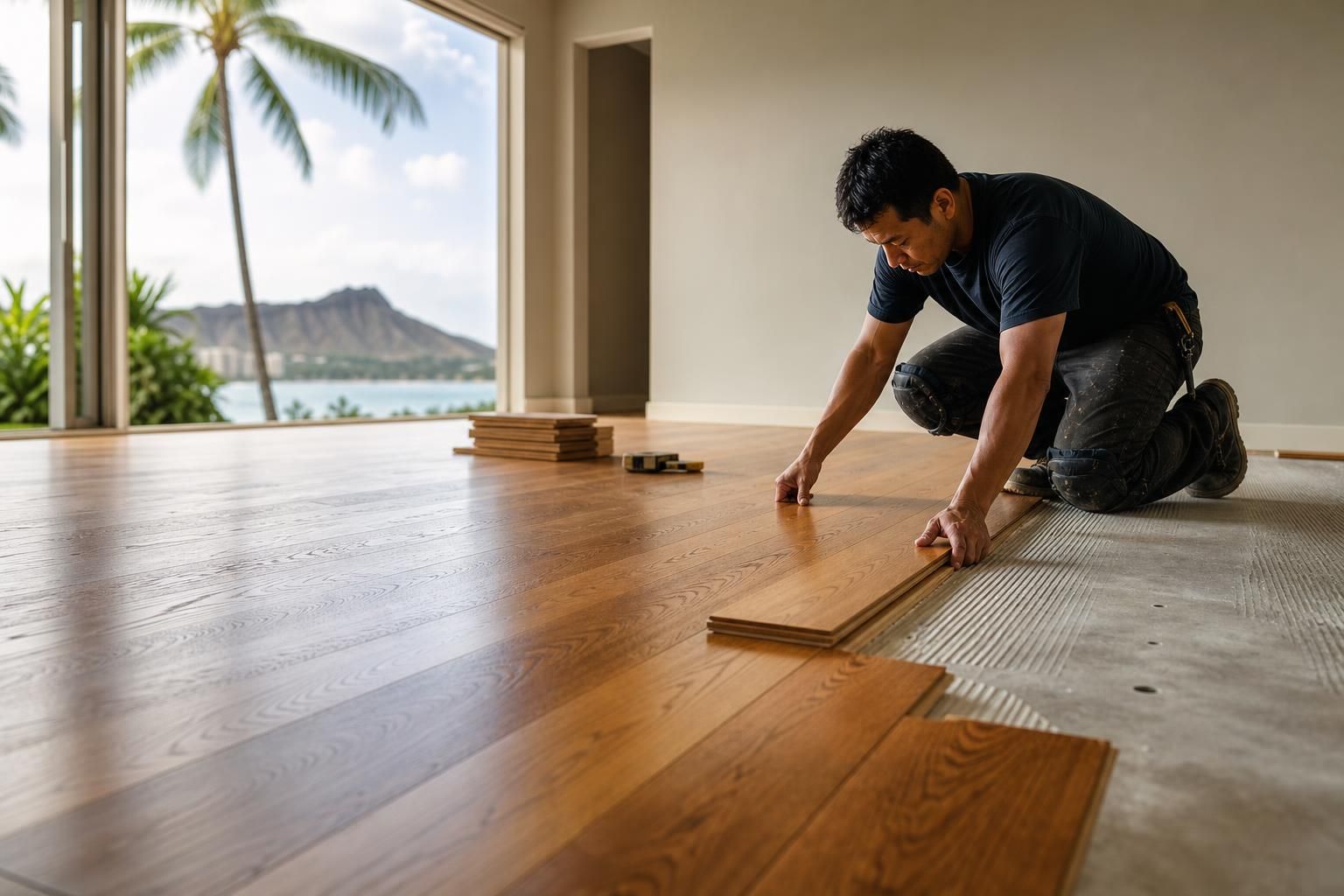
Solid hardwood flooring is available in Honolulu, but Oahu's humidity, termite pressure, and frequent moisture exposure in kitchens, lanais, and bathrooms mean many homeowners and contractors end up specifying engineered hardwood or waterproof vinyl plank instead. Installed pricing for any flooring category runs on labor plus material; H&W Flooring's installation is from $8/sq ft, including demo of old flooring, leveling (incl. self-leveling material), and baseboard. The right choice depends less on looks and more on where in the house the floor is going and how much moisture it will see over its life.
Key takeaways
- Solid hardwood expands and contracts with Oahu's humidity swings; engineered hardwood or waterproof vinyl plank handles wet seasons and slab moisture more predictably.
- At H&W Flooring, installation runs from $8/sq ft, including demo of old flooring, leveling (incl. self-leveling material), and baseboard, which covers removing an existing floor before new material goes down.
- For wet areas — bathrooms, laundry rooms, ground-floor units near the water table — waterproof vinyl plank is the more durable and lower-maintenance choice than any wood product.
Why "hardwood" means something different in Honolulu than on the mainland
When people search for hardwood flooring in Honolulu, they're usually picturing the look — wide planks, visible grain, a warm finish — more than the material itself. That look is achievable three ways: solid hardwood (milled from a single piece of wood), engineered hardwood (a thin real-wood veneer over a plywood core), and waterproof vinyl plank with a photographic wood-look layer. Only the first two are "real wood" in the traditional sense, and only the third is genuinely waterproof.
Hawaii's building stock skews toward concrete slab construction, especially in condos and newer single-family homes. Solid hardwood needs to acclimate to a space and tolerates slab moisture poorly without a proper vapor barrier and underlayment system. Engineered hardwood performs better over slab because its plywood core is more dimensionally stable, but it still isn't rated for standing water or frequent wet mopping.
What drives the cost of a hardwood floor in Honolulu
Material cost for solid or engineered hardwood is typically priced by the box rather than at a single flat rate, since species, plank width, and finish grade all move the price. What's consistent across material types is the labor side: H&W Flooring's installation is from $8/sq ft, including demo of old flooring, leveling (incl. self-leveling material), and baseboard, and that figure can scale up with pattern complexity (herringbone, wide-plank, diagonal runs) and stair work. If an existing floor — tile, old vinyl, carpet — needs to come out first, demo is included in the install rate.
For a full room-by-room cost comparison across flooring types, the kitchen remodel flooring cost breakdown walks through how material, demo, and installation line items stack for a typical Oahu kitchen, which is one of the rooms where hardwood is most often considered and most often reconsidered in favor of a waterproof product.
Where solid or engineered hardwood still makes sense
Hardwood isn't wrong for Honolulu — it's wrong for certain rooms. It tends to work best in:
- Living rooms and bedrooms on upper floors, away from plumbing and exterior doors
- Homes with central air conditioning that keeps interior humidity relatively stable year-round
- Single-family houses with raised or well-ventilated foundations rather than slab-on-grade
- Spaces where resale value or a specific design aesthetic calls for genuine wood grain
Outside those conditions — ground-floor units, lanai-adjacent rooms, bathrooms, laundry areas, and any condo near sea level — moisture risk goes up substantially. The Environmental Protection Agency notes that persistent indoor humidity above roughly 60% creates conditions favorable to mold growth, and Honolulu's average relative humidity sits in that range for much of the year, which is a meaningful factor for any absorbent flooring material, wood included.
Why waterproof vinyl plank is the common substitute
Waterproof vinyl plank, particularly SPC (stone plastic composite) rigid core products, replicates the wood look with a rigid, moisture-resistant core that doesn't swell, cup, or require refinishing. It also installs faster in most rooms since it floats over the existing subfloor without nailing or extensive moisture testing. H&W Flooring sells waterproof vinyl plank at retail for $2.79/sq ft, stocked on-site in Māpunapuna for same-day pickup rather than special-order lead times — a meaningful difference from suppliers that ship wood products in from the mainland on a multi-week timeline.
For rental units specifically, where durability under tenant turnover matters more than species authenticity, the comparison between wood-look options is laid out in the guide to vinyl plank flooring for Airbnb rentals, which covers wear-layer thickness and why it matters for short-term rental traffic.
Hardwood, condos, and permit timing
Condo associations in Honolulu frequently restrict hardwood installation on upper floors because of sound transmission to the unit below, requiring sound-mat underlayment or ruling out solid wood entirely in favor of vinyl or laminate. Anyone planning a hardwood-look floor in a condo should check the association's material and underlayment rules before ordering material, since a non-compliant floor can mean a costly rip-out after the fact. The condo remodel guide to Honolulu permits and flooring picks covers which flooring categories condo boards typically approve and what documentation they ask for.
Maintenance differences worth knowing before you choose
Solid and engineered hardwood both require periodic refinishing or recoating, avoidance of standing water, and humidity-controlled interior conditions to prevent gapping between boards. Waterproof vinyl plank needs none of that — it's wiped clean, tolerates standing water from a spill or a leak, and doesn't require climate control to stay flat. The National Wood Flooring Association publishes maintenance guidance for wood floors that's worth reviewing if hardwood is still the preferred look, particularly around recommended humidity ranges for interior spaces.
Finding someone to install it
Whichever material gets chosen, installation quality affects longevity more than almost any other factor — gaps, squeaks, and moisture failures usually trace back to subfloor prep rather than the plank itself. For guidance on what to ask a crew before hiring them, the guide to finding flooring installers on Oahu covers licensing verification and questions to ask about subfloor moisture testing specifically.
Frequently Asked Questions
Q: Is solid hardwood flooring a good choice in Honolulu's climate?
It can work in upper-floor, air-conditioned rooms away from moisture sources, but Hawaii's humidity and slab construction make it a riskier choice than engineered hardwood or waterproof vinyl plank for most rooms, especially ground-floor and wet-area spaces.
Q: What does hardwood flooring installation cost in Honolulu?
Material is typically priced by the box depending on species and grade, while H&W Flooring's installation is from $8/sq ft, including demo of old flooring, leveling (incl. self-leveling material), and baseboard, and can scale with pattern complexity. Removing an existing floor first is included in H&W Flooring's installation rate.
Q: Can I install hardwood flooring in a Honolulu condo?
Many condo associations restrict solid hardwood on upper floors due to sound transmission rules and require sound-mat underlayment or an alternative material; check the association's flooring policy before purchasing material.
Q: What's the difference between engineered hardwood and waterproof vinyl plank?
Engineered hardwood has a real wood veneer over a plywood core and needs protection from standing water, while waterproof vinyl plank uses a rigid, moisture-resistant core with a photographic wood-look layer that tolerates spills and humidity without warping.
Q: Does hardwood flooring need special care in humid conditions?
Yes — wood flooring benefits from stable indoor humidity, prompt cleanup of spills, and avoidance of wet mopping, since repeated moisture exposure causes boards to cup or gap over time.