How Much Does Hardwood Flooring Cost in Honolulu?
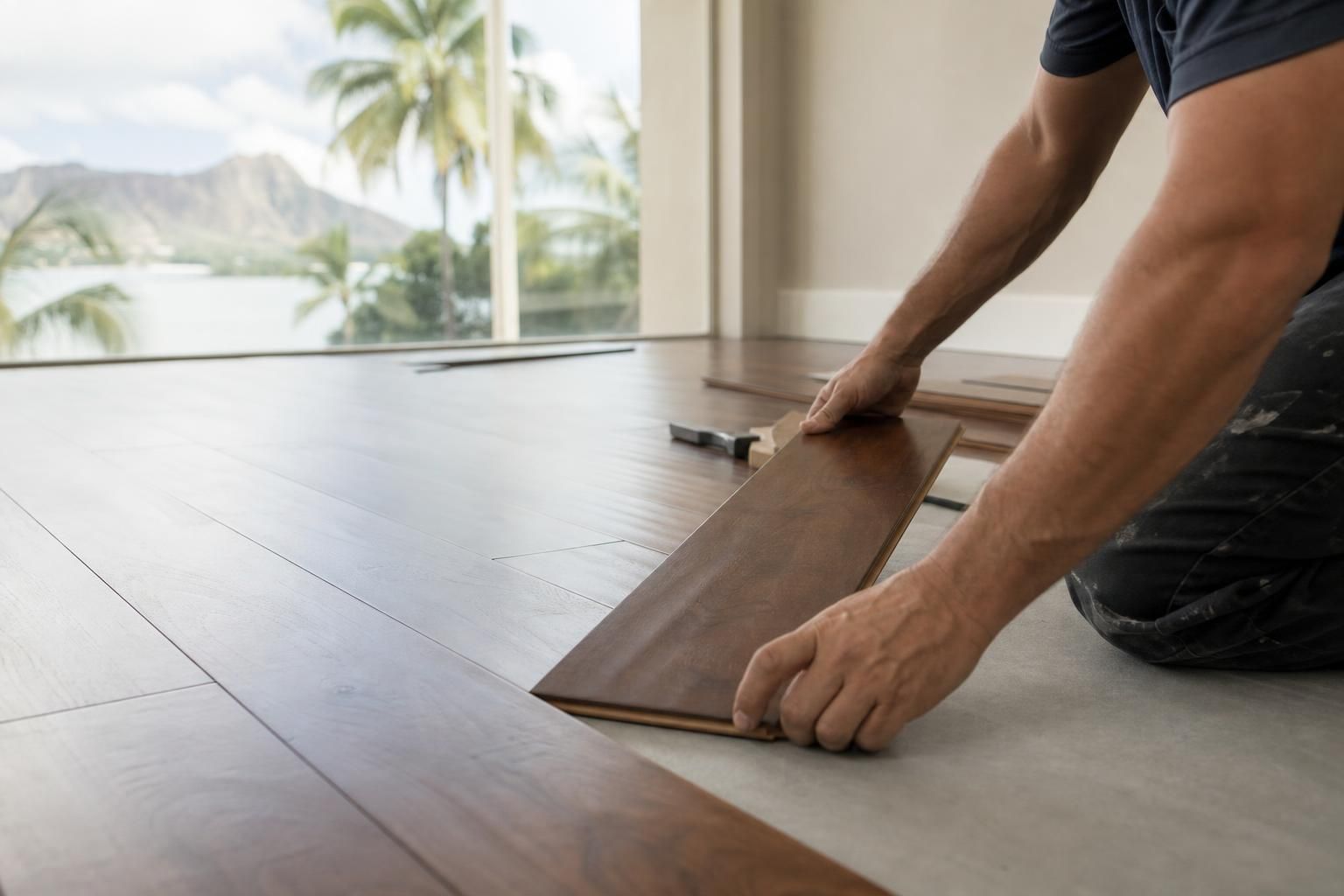
Key takeaway
Hardwood flooring cost is driven by species, grade, plank width, and finish, with installation labor typically adding as much to the job as the material itself — and in Honolulu, humidity control and acclimation time add a further layer of cost that mainland pricing guides don't account for. There is no single number that applies everywhere, because every supplier prices by the species and grade they have in stock. The more useful question for an Oʻahu homeowner is which cost factors are fixed, which scale with the job, and whether solid hardwood is even the right call in a humid coastal climate.
Key takeaways
- Hardwood cost is quoted per square foot for material and separately for installation; demo of old flooring is a third line item most estimates leave out.
- Hawaii's humidity swings mean solid hardwood needs a longer acclimation period and tighter moisture control than it would on the mainland, which adds time and sometimes cost.
- Waterproof vinyl plank is priced transparently at some Oʻahu suppliers — for example, H&W Flooring publishes $2.79 per square foot retail — which makes it easier to budget against than hardwood's variable per-job quotes.
What Actually Drives the Price
Hardwood pricing has more moving parts than most other flooring categories. A supplier's quote reflects:
- Species — domestic species generally price lower than imported exotics.
- Grade — "select" or "clear" grades with fewer knots and color variation cost more than "character" grades.
- Plank width and length — wider, longer planks require more select lumber per square foot and cost more to produce.
- Finish — pre-finished planks are priced into the material; site-finished floors shift some of that cost into labor (sanding, staining, sealing on-site).
- Underlayment and subfloor prep — concrete slabs, common in Hawaii construction, often need a moisture barrier or plywood subfloor before solid hardwood can go down at all.
Because every one of these varies by job, a flooring supplier can't responsibly quote a flat national number — only describe the shape of the cost and quote the specific species and grade a customer wants. For a deeper breakdown of hardwood options available on Oʻahu, see this hardwood flooring cost and climate guide.
Why Honolulu's Climate Changes the Math
Solid hardwood is a hygroscopic material — it absorbs and releases moisture with the air around it, expanding and contracting as humidity shifts. The EPA's guidance on indoor moisture control notes that uncontrolled humidity indoors can affect building materials and finishes, and Hawaii's year-round humidity sits well above what most mainland hardwood manufacturers design their acclimation guidelines around. The National Wood Flooring Association recommends an acclimation period before installation specifically so planks reach equilibrium with the room's moisture level before they're fastened down — skip it, and gaps or cupping can show up months later.
That acclimation step takes real time, which is itself a cost: delayed install dates, a job site that has to stay climate-controlled while material sits, and in some cases a moisture-barrier underlayment that wouldn't be needed in a drier climate. Engineered hardwood with a plywood core handles humidity swings better than solid hardwood, but it still isn't rated for standing water the way SPC rigid-core vinyl plank is.
Hardwood vs. Waterproof Vinyl Plank: Cost Side by Side
| Cost factor | Solid/engineered hardwood | Waterproof vinyl plank |
|---|---|---|
| Material pricing | Priced by species and grade, quoted per job | H&W Flooring publishes $2.79/sq ft retail |
| Contractor wholesale tiers | Not typically published | $2.79, $2.59, $2.39/sq ft at $5,000, $15,000, and $100,000+ volume |
| Installation | Scales with sanding/finishing steps if site-finished | From $8/sq ft (includes demo, leveling, baseboard) |
| Demo of old flooring | Varies by job, often quoted separately | Included in install rate |
| Humidity/moisture tolerance | Needs acclimation, vulnerable to standing water | Waterproof core, no acclimation-driven moisture failures |
Installation and Demo Costs
Installation labor is usually the second-biggest line item after material, and for hardwood it varies more than for vinyl plank because site-finished floors add sanding, staining, and sealing steps that nailed-down or click-lock vinyl simply doesn't have. Demolition and haul-away of the old floor is its own cost that's easy to forget when comparing quotes — some suppliers fold it into the install price, others itemize it. On the vinyl plank side, H&W Flooring itemizes installation from $8 per square foot, including demo of old flooring, leveling (incl. self-leveling material), and baseboard, so a homeowner can see exactly what each step costs before committing. Whole-house jobs also take longer than a single room, and the timeline for either material depends on square footage and subfloor condition — see this breakdown of how long whole-house flooring installation takes for a sense of scheduling.
Homeowner vs. Contractor Pricing
Homeowners doing a single room typically pay retail, quoted per job for hardwood since grade and species vary so much. Licensed, DCCA-verified contractors buying in volume can access tiered wholesale pricing on vinyl plank — at H&W Flooring that's $2.79/sq ft under $5,000, $2.59/sq ft from $5,000–$15,000, and $2.39/sq ft above $100,000, scaling further at $200,000. Hardwood doesn't lend itself to the same published tier structure because lumber cost fluctuates with species and grade availability, so contractors sourcing hardwood should expect a per-job wholesale quote rather than a fixed table. Written quotes, regardless of material, are typically turned around within 48 hours once square footage and material selection are confirmed.
A Practical Starting Point
If budget certainty matters as much as the look of real wood, waterproof vinyl plank with an SPC rigid core gives a published, repeatable number to plan around instead of a per-species quote. If the goal is specifically solid or engineered hardwood, the right move is to get the room's square footage, note whether the subfloor is concrete or plywood, and request quotes on two or three grades so the cost range becomes concrete rather than theoretical. Either way, proper acclimation before installation protects the investment regardless of which material ends up on the floor.
Frequently Asked Questions
Q: Is hardwood flooring more expensive than vinyl plank?
Generally yes — hardwood material and site-finishing labor usually add up to more per square foot than waterproof vinyl plank, though the exact gap depends on the species and grade chosen. Vinyl plank's published pricing makes it easier to budget precisely in advance.
Q: Does humidity in Hawaii affect hardwood flooring cost?
Yes. Hawaii's consistently high humidity means solid hardwood needs a longer acclimation period and sometimes added moisture-barrier underlayment, both of which add time and cost compared to drier mainland climates.
Q: What's included in a hardwood flooring installation quote?
A complete quote should separate material cost, installation labor, and demo/haul-away of the old floor as distinct line items, since each varies independently by job.
Q: Can I get wholesale hardwood pricing as a contractor?
Licensed, DCCA-verified contractors can typically request wholesale quotes on hardwood, but because lumber cost varies by species and grade, it's usually quoted per job rather than on a fixed published tier like vinyl plank.
Q: Is engineered hardwood a cheaper alternative to solid hardwood?
Engineered hardwood often costs less than solid hardwood of the same species because it uses a thinner wear layer over a plywood core, and it also handles humidity swings better — though it still isn't waterproof like SPC vinyl plank.